Tripod Combat Vehicle – ~50 Deployed
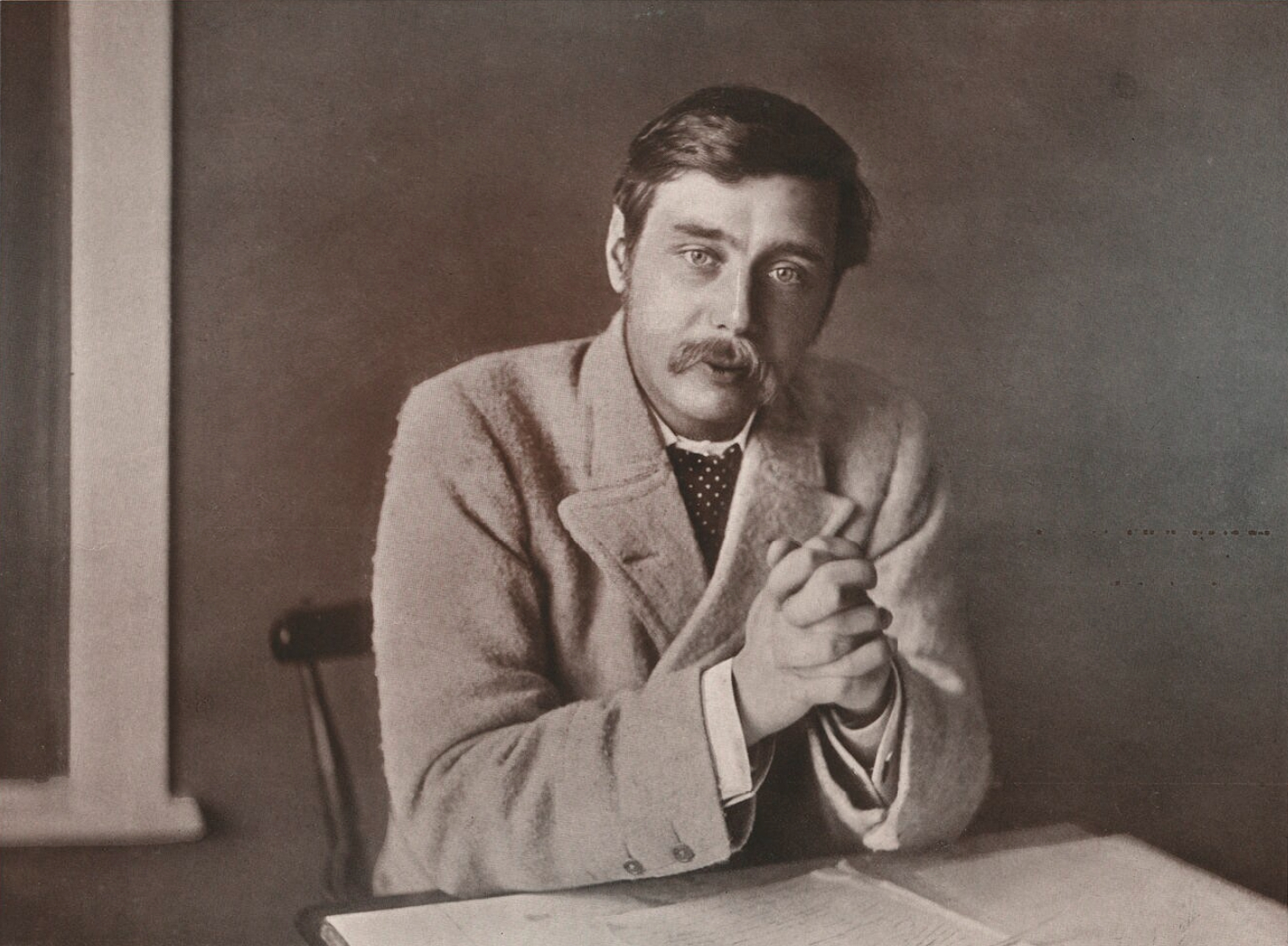
Few authors in history have ever come close to the level of influence of Herbert George Wells. Not only was he arguably the inventor of the tank, but he is widely regarded as the father of science fiction. Although Wells’ works are not the earliest examples of the genre, they very definitely set the standard for all modern science fiction, and remain some of the most highly regarded works of that variety, even more than one hundred years after they were written. No book is a better example of this than the 1898 novel, The War of the Worlds.
Pitting highly-advanced Martians, desperate to escape their dying planet, against the unprepared and powerless people of Victorian Britain, The War of the Worlds was the first story to depict an alien invasion, a concept now so familiar in the cultural zeitgeist that most readers can certainly recount the story beat-for-beat without even having read the book. The War of the Worlds is by far H. G. Wells’ most successful and most well-known work, having never gone out of print in all of the 127 years of its existence (as of 2025). It has spawned nearly countless retellings and derivative works. Without doubt, the most lasting image from this story, regardless of which incarnation, is the Martian Fighting Machine, the enormous tripedal craft the invaders used to so efficiently demolish the world of mankind.
The Martian vehicles from The War of the Worlds are in some ways the forebearers, certainly of sci-fi mechs and walkers, but also of armored vehicles in general, not only those confined to works of fiction. French Captain P. G. L. Dutil says as much in his 1919 study, Les Chars D’Assaut, where he cites The War of the Worlds as one of the works contributing to the invention of the tank. At the time the book was written, there was simply no equivalent to the Fighting Machines in the inventory of all the armies of the world. Wells would go on to explain how there could be, in the short story The Land Ironclads, published in 1903, wherein he imagined what could only be described as tanks, twelve years before the first true tank was built.

Description of the Fighting Machine
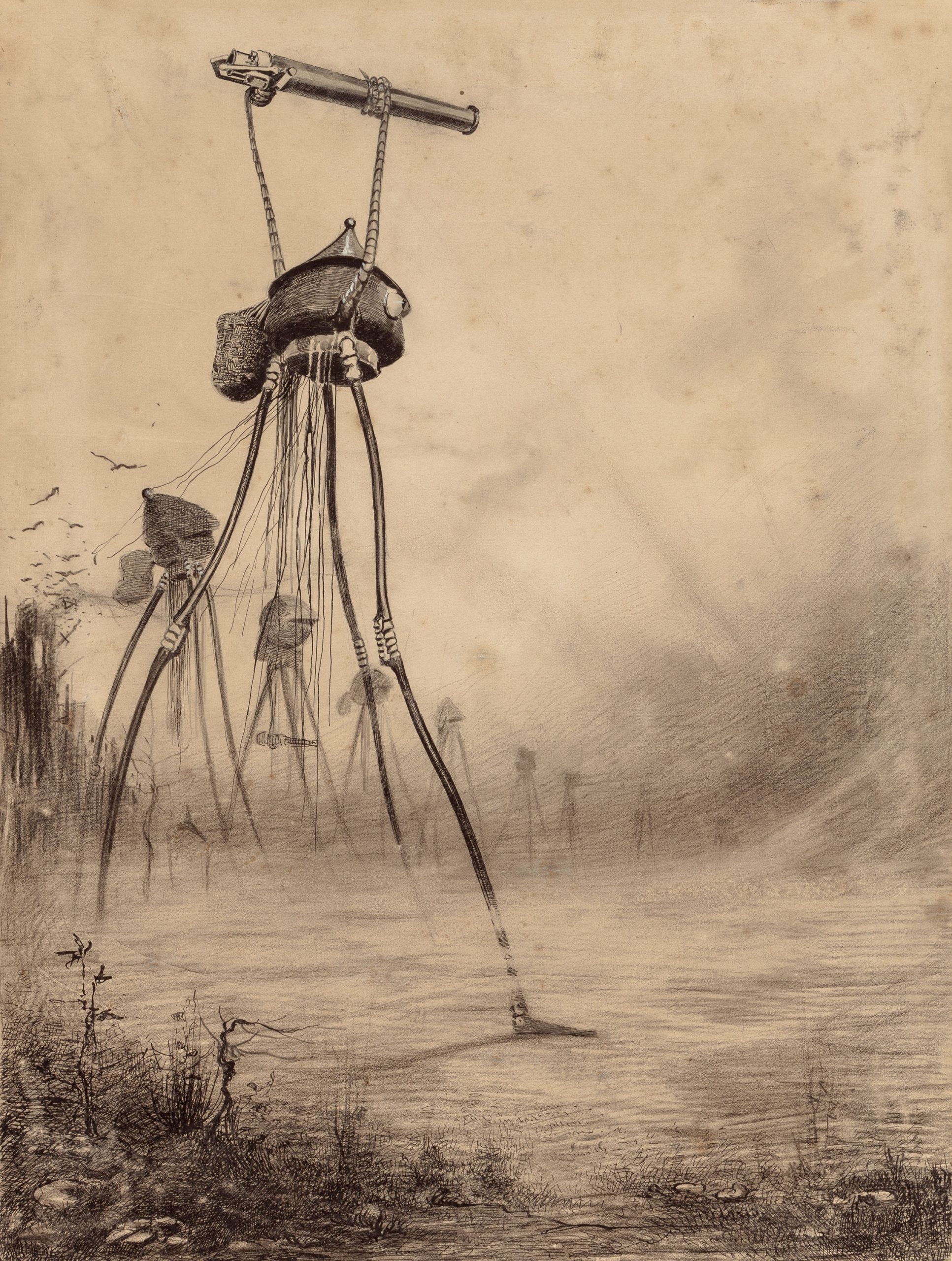
The Fighting Machine, more commonly referred to as the Tripod, is the primary weapon and conveyance of the Martian invaders in The War of the Worlds. It is a towering, mechanical construct with three legs attached to a small central body on which is supported a “head”. From the body dangle articulate tentacles that resemble ropes or cables, and two larger tentacular “arms” are attached one on either side of the head. It is constructed of dull grey or whitish metal which is often described as armor. At full height, the Fighting Machine stands about 100 feet (30 m) tall. It is incredibly strong, able to smash trees with its legs, yet it is dexterous enough to assist with fine mechanical work, or pick up a human without injuring them.
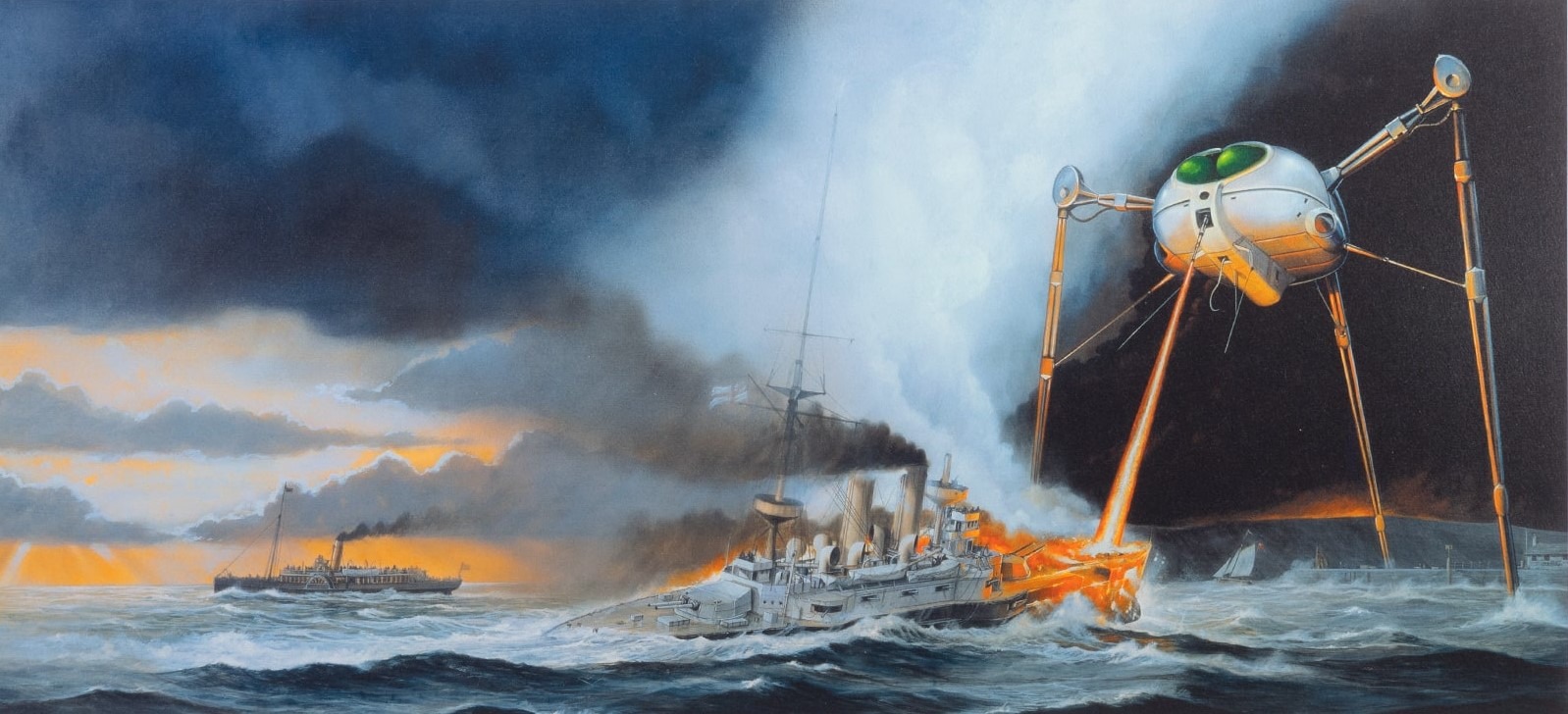
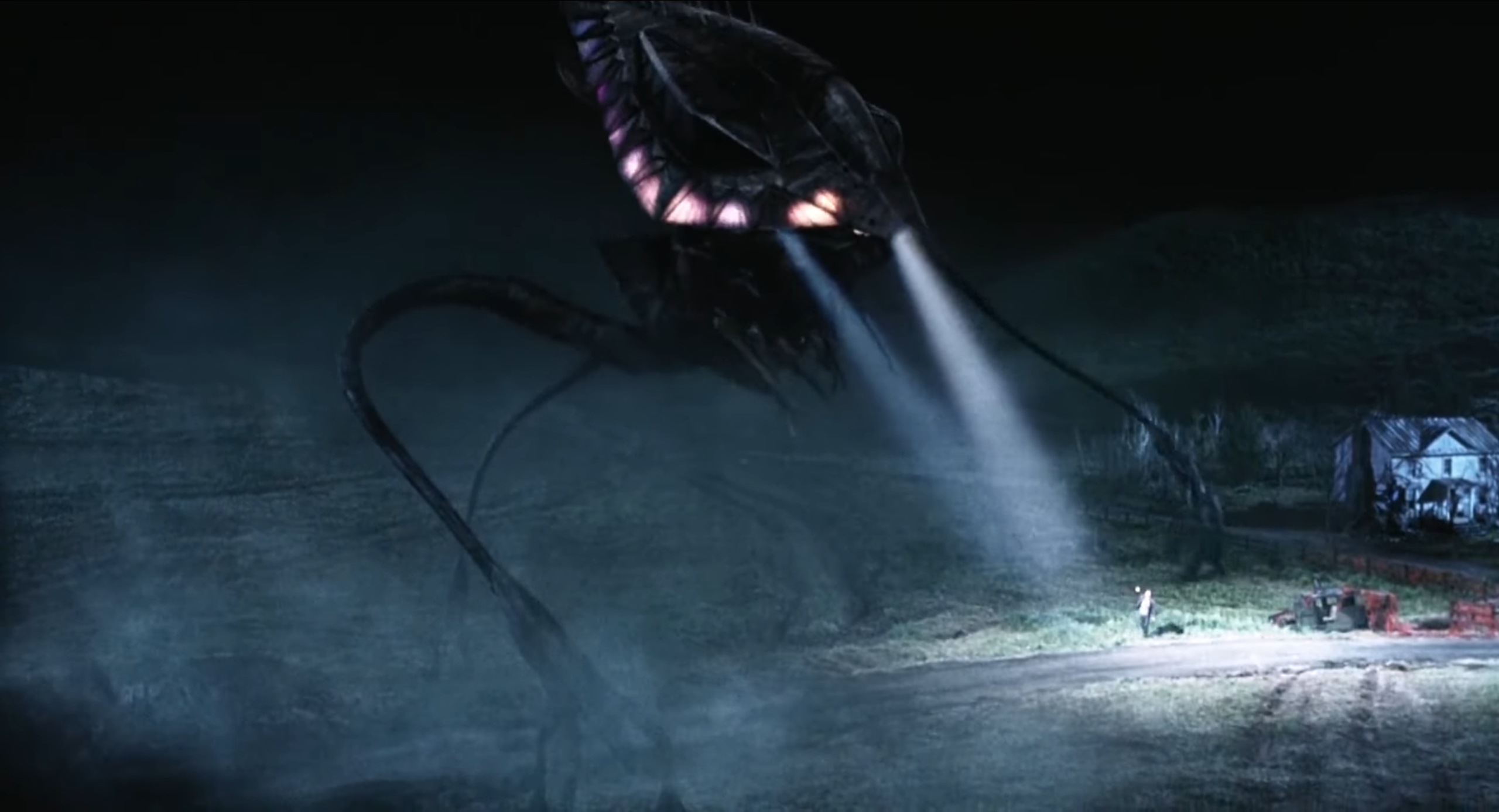
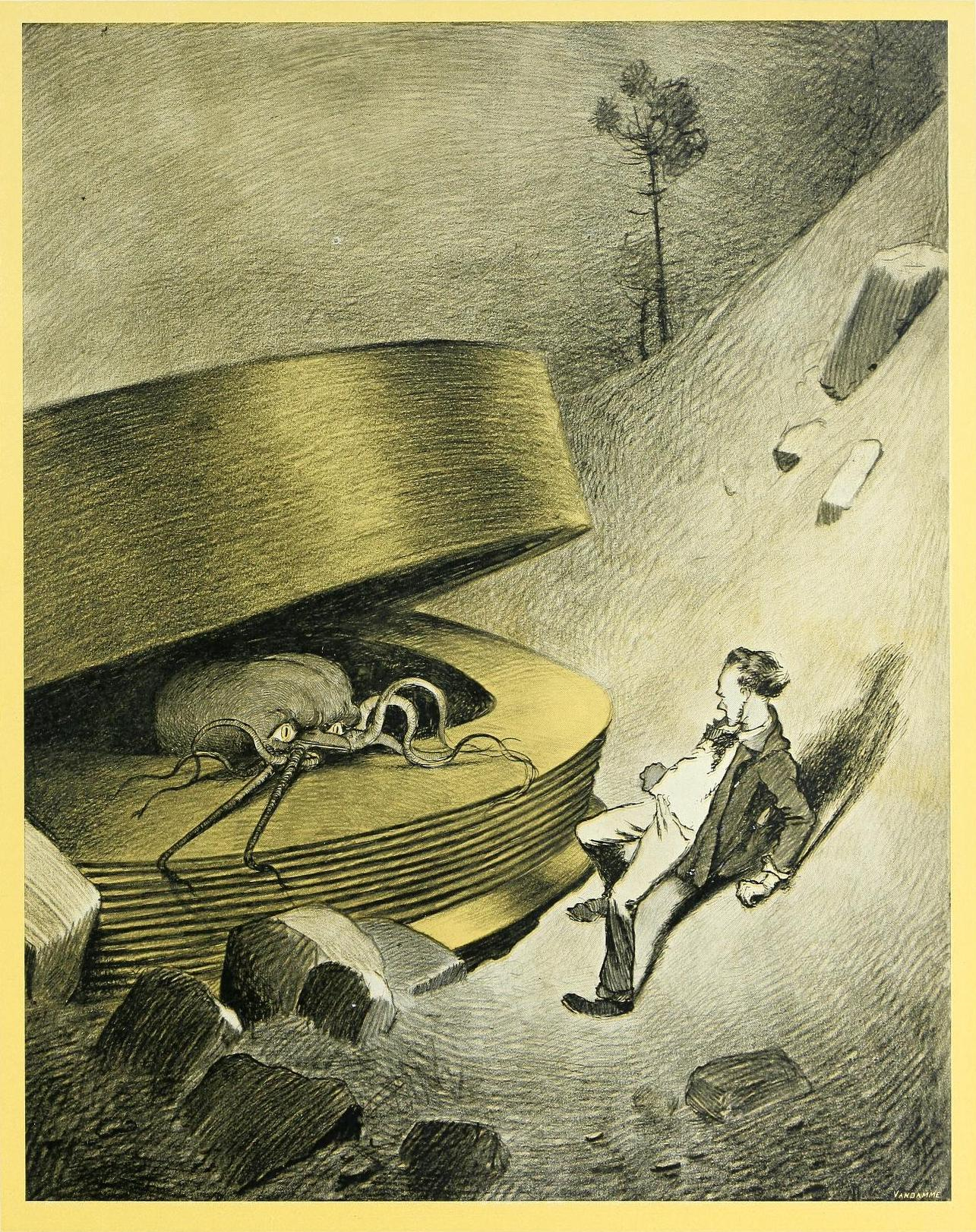
Wells never attempted to draw the Fighting Machine as he envisioned it. He officially endorsed the interpretation created by the Brazilian artist Henrique Alvim Corrêa, who made a large number of illustrations of various scenes in The War of the Worlds in 1903. In 1906, some of Corrêa’s illustrations were included in a special edition of the novel published by L. Vandamme & Co. in French. Despite their somewhat comedic appearance on account of their googly eyes, the Corrêa tripods are regarded by fans as the definitive appearance of the Martian Fighting Machine, and they are one of the few designs to be wholly accurate to the description in the book. Vastly more well-known to the general public are the graceful and imposing tripods from the 2005 Paramount movie, War of the Worlds, starring Tom Cruise. A third interpretation worthy of note is the fan-favorite design created by Mike Trim for Jeff Wayne’s Musical Version of The War of the Worlds, first released in 1978.

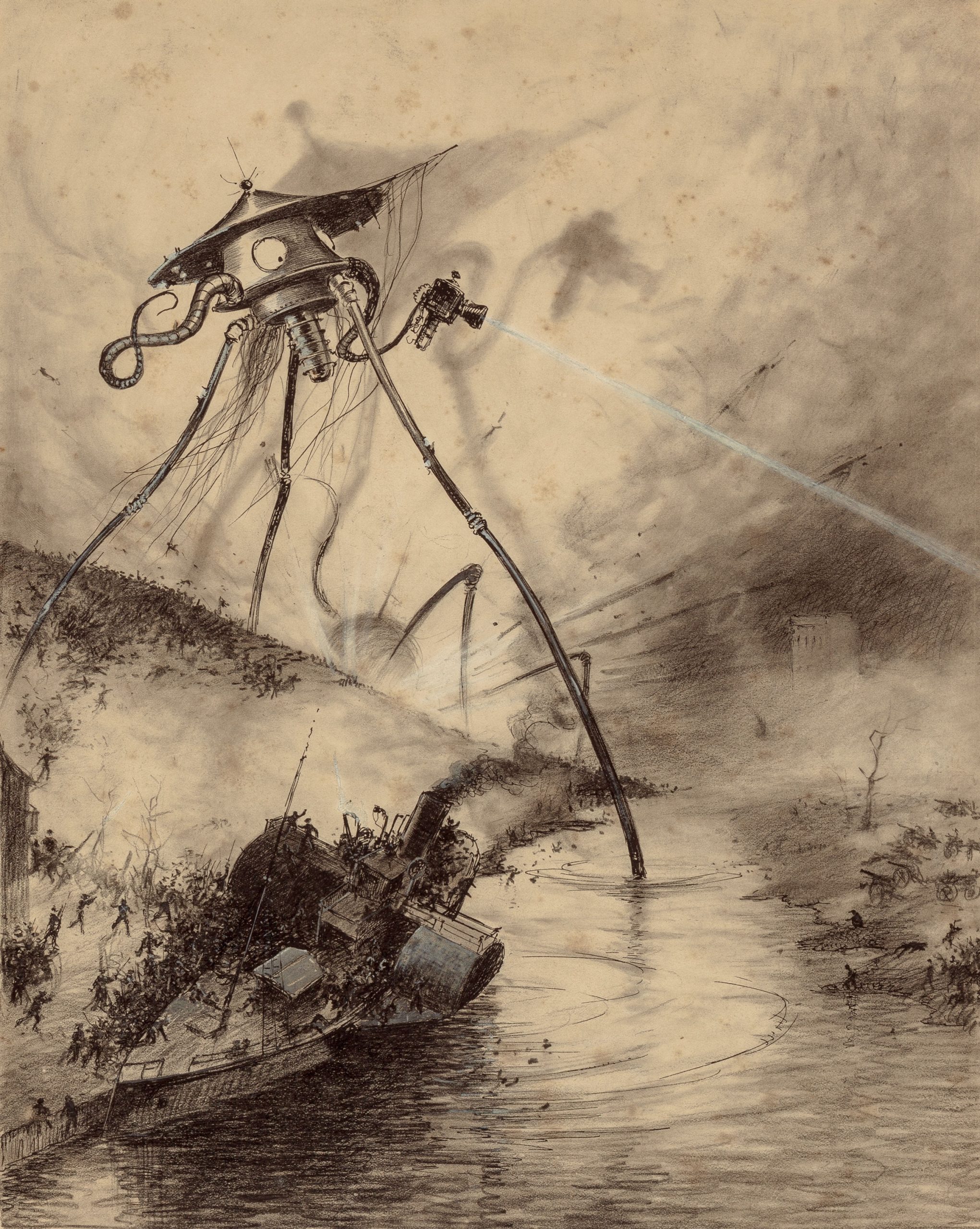 Alvim Corrêa’s Fighting Machine design. Source

Head, Body, and Pilot
The head of the Fighting Machine is mounted atop the body and is able to swivel left and right. At the front of the head, depending on the depiction, are usually illustrated two, three, or sometimes one, illuminated windows, or spotlights, that resemble eyes. Around the top of the head is a cowling that is often likened to a hood, in the sense of an article of clothing. Hanging on the rear of the head, in the manner of a backpack, is a basket for containing collected humans, which are picked up by the machine’s arms and deposited therein. The body, which forms the core of the machine, is usually only depicted to be large enough to sufficiently connect the head to the legs.

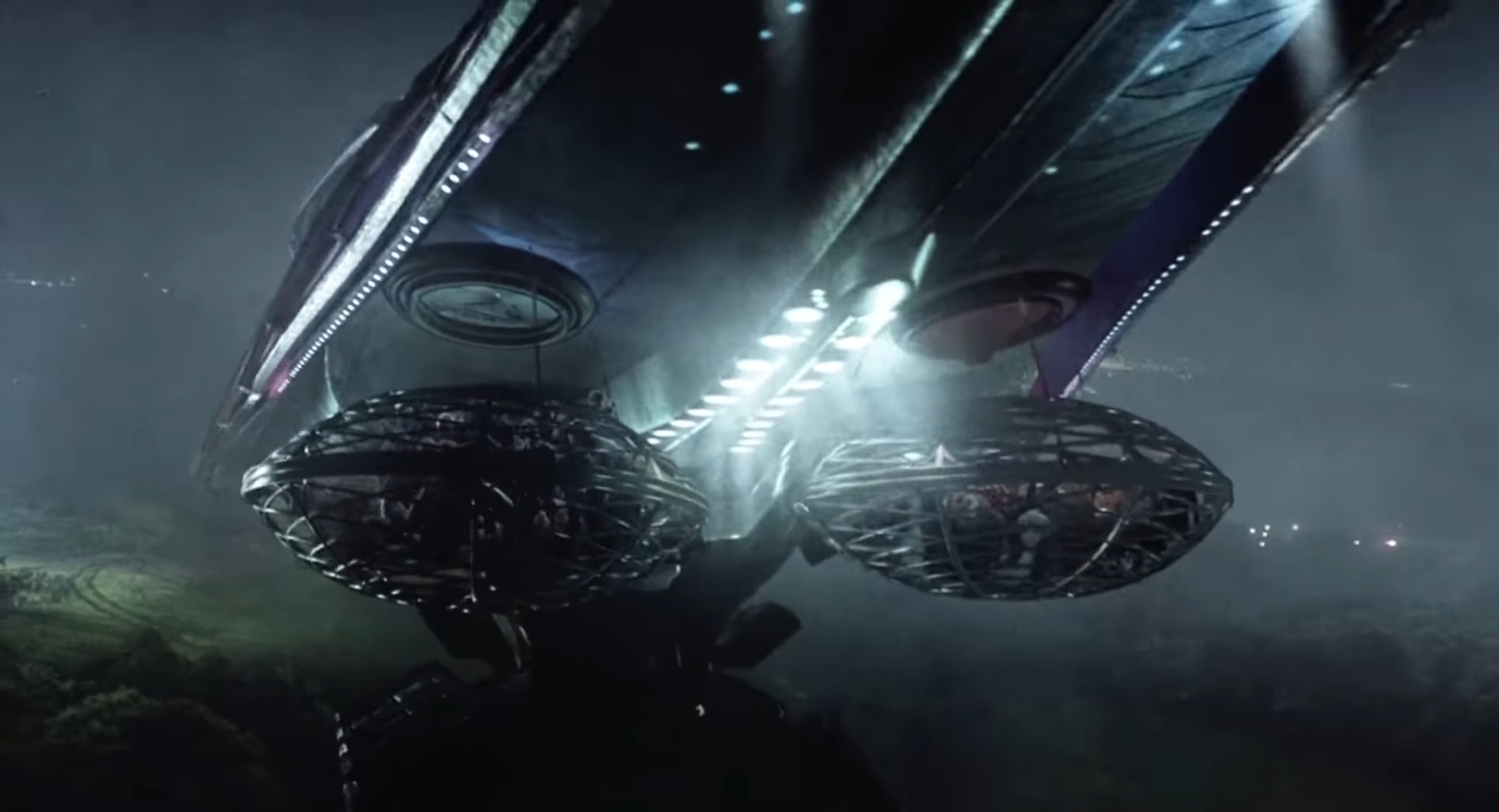
Inside the head is seated the single Martian occupant. The Martians are octopus-like creatures the size of a bear, composed almost entirely of brain. The main body, or head, of which there is no distinction, is solely dedicated to containing the brain and lungs; there are no other organs. At the front of the body is a face having two large, dark-colored, disc-like eyes, and a triangular, beak-like mouth. On either side of the mouth are bundles of eight small tentacles which the Martians use to locomote and to interact with the world. In the gravity of Earth, 2.5 times greater than that of Mars, this is accomplished with great difficulty. At the rear of the body is a circular tympanic membrane that allows the Martian to hear. The Martians have no sense of smell and no sex; reproduction is accomplished by budding. Martian physiology is such that they do not sleep, do not get fatigued, and do not get sick, though the latter fact is due to them having eradicated disease from their planet through technological advancement. Rather than ingesting food for sustenance, the Martians transfused the blood of other beings into their own veins. On Mars, they kept a race of anthropoid beings to feed off of. On Earth, humans would be their cattle.
Method of Locomotion
As no tripedal life forms exist on Earth, it is worth discussing the envisioned gait of the Fighting Machine. The earliest depictions, created by Warwick Goble for the serial publications of the story in Pearson’s Magazine and The Cosmopolitan in 1897, show machines that resemble barbecue grills, with fixed, truss-like legs on which they spin about, one over the other, like a three-legged gyroscope. Wells was very upset with this depiction, as it was totally unlike the fluidly-moving, organic machines he had envisioned. Goble had evidently gotten this impression from the very first time the tripod is described in the story, when the main character observes it during a lightning storm.
“A flash, and it came out vividly, heeling over one way with two feet in the air, to vanish and reappear almost instantly as it seemed, with the next flash, a hundred yards nearer. Can you imagine a milking-stool tilted and bowled violently along the ground? That was the impression those instant flashes gave. But instead of a milking-stool imagine it a great body of machinery on a tripod stand.” – The War of the Worlds Chapter 10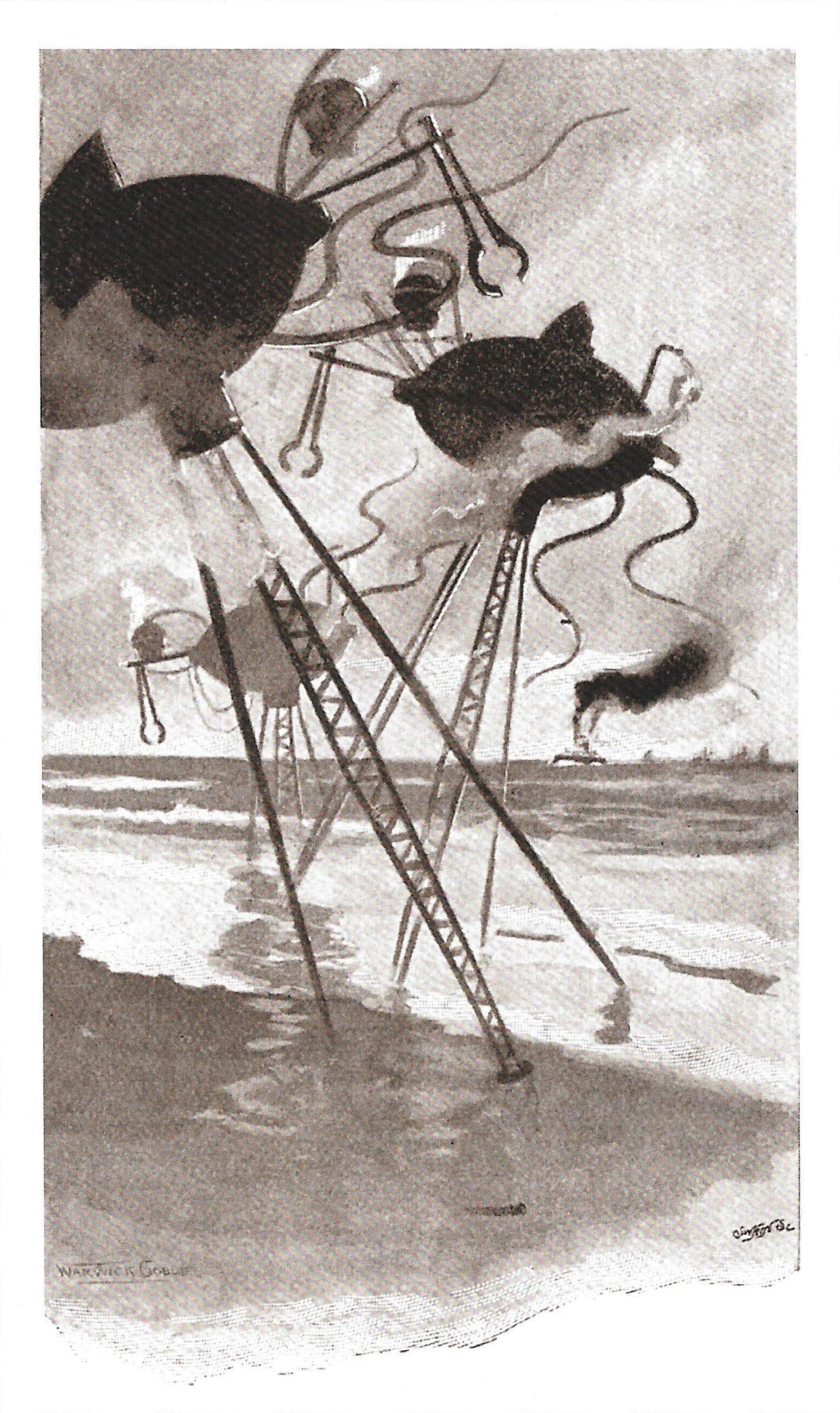
Further descriptions of the machine later in the story totally disprove this method of motion. Goble had simply gone off of the first description he could find. In those days, and for the majority of the time that literature has been accompanied by illustration, working artists would devote little to no time reading the work they were meant to be illustrating. The accompanying pictures could be wildly inaccurate; as long as they were vaguely on-theme, the reader was expected to accept them. Any time the artist spent reading the book was time he was not illustrating, and therefore not getting paid.
Interestingly, the “bowling” method of movement makes several reappearances in other The War of the Worlds-inspired works. First in the 1957 Disneyland television episode, “Mars and Beyond”, when Martian tripods make a brief appearance, their legs are mounted on a rotating base which spins clockwise, allowing them to always lead with the left leg, which then rotates, becoming the right leg, and finally the rear leg. In the series of books known collectively as The Tripods, written by John Christopher and published between 1967 and 1968, humanity is enslaved by aliens which utilize tripedal machines to police them. These aliens, called Masters, are themselves tripedal, and use the “bowling” movement as their form of running. Their Tripods move similarly to the ones from Disneyland, but have legs of variable length to facilitate the unusual gait.
The Fighting Machine is typically depicted walking with two legs in front and a single leg in the rear. The rear leg steps forward, either underneath the body or totally through the two front legs, and one at a time, the two front legs take steps forward, until the motion repeats. In more articulate designs, such as the 2005 Paramount movie, the tripod can spin on its heels by reaching one foreleg over the other to turn, sometimes even with the rear leg extended forwards, leading to a complicated jumble of limbs which would seem certain to trip the machine, though thanks to the Martian’s advanced technology, it always remains on-balance. By spreading its limbs far apart, the Fighting Machine is able to crouch, or squat, in order to investigate an object of interest more closely, manipulate something with its tentacles, or “park” and allow the pilot to disembark.
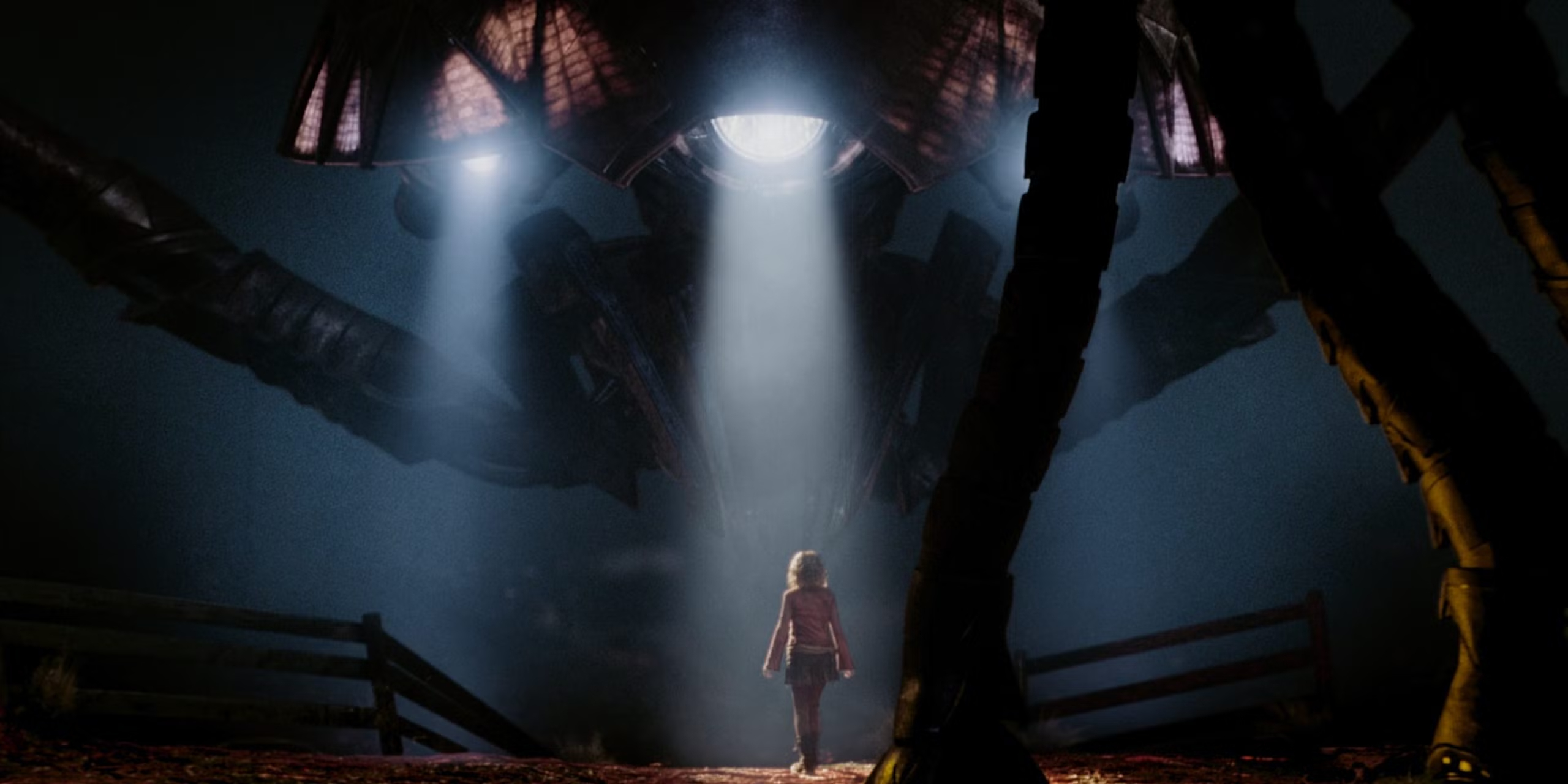

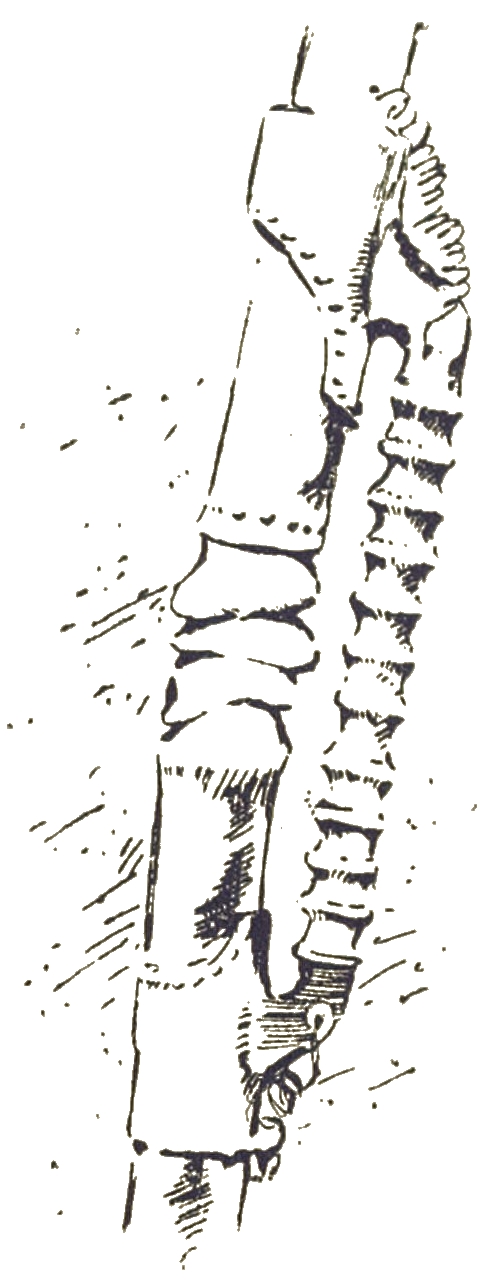
Wells describes the gait of the Fighting Machine as “rolling”, and occasionally wrote them having two feet in the air as they walked. Across all interpretations, this is unique to the novel. This would be a very unstable stance, and may be reserved for when the machine needs to move quickly, as a form of galloping run. Being made of metal, with many dangling parts, the Fight Machine makes a cacophonous noise as it walks. In many depictions the legs are unjointed tentacles similar to the arms, however, in the novel, Wells writes that the legs have knees, and that the joints of the legs produce puffs of green smoke when they move.
Across all Martian technology, they made no use whatsoever of the wheel. Either the Martians had never invented the wheel, which seems unlikely, or they regarded it as inferior to the biological method of locomotion. With the sole exception of high-speed movement over flat ground, this belief may be correct. Nearly all joints in the Fighting Machine consisted of parts sliding over friction bearings, with some limited use of fixed pivots. Power was transmitted through the limbs by means of mechanical muscles. These muscles were long elastic sheaths containing stacks of metal discs. When electricity was passed through the stack, the discs became polarized and contracted, much the same way biological muscles function.

This brief clip depicts the gait of Mike Trim’s Fighting Machine design. It comes from the background video used in live performances of Jeff Wayne’s Musical Version of The War of the Worlds.
Weaponry
The primary Martian weapon was the Heatray. This device generated a beam of extreme heat, which could be aimed in any direction. Any object the beam touched immediately was consumed with a bright white fire. People were reduced to skeletons, trees burst into flame on contact, and solid structures, like brick buildings, were vaporized outright. When the Heatray fired, it produced a flash of light from its origin point, however the beam of the ray was not light like that of a laser, but a clear haze, similar to the surface of a road on a hot day.
Two forms of the Heatray existed. The first was the Heatray mounted on the Martian’s landing cylinders (discussed later), which was fixed on the end of a long, thin, many-jointed arm which raised it high in the air. This form of the Heatray resembled a spinning, inclined, disc-shaped reflector, which appeared to wobble as it spun. It was able to fire in any direction. The other form of the Heatray, carried by the Fighting Machine, resembled a camera and had to be aimed at the target. The Fighting Machine carried its Heatray on the end of one of its arms.
The second weapon the Martians employed was known to humanity as Black Smoke. This was a heavy, extremely dense vapor, inky black in color. It was deployed in canisters fired from a discharger carried by the Fighting Machine. The discharger resembled a gun barrel, but produced no flash when it fired, only a dull ‘thud’ sound. Upon impact with the ground, the Black Smoke canister broke open and released the gas, which would expand upward and outward into a billowing mound, before falling and settling along the ground. As the Black Smoke was very dense, it would flow like a liquid to the lowest point it could find. Inhalation of the Black Smoke caused instant death.
Interestingly, the Black Smoke was rendered inert by water. Whenever a pool of smoke found its way to water it would convert into a powdery brown scum and sink. After deploying Black Smoke, the Fighting Machines would usually disperse it by spraying steam jets over the clouds of gas. If this was not done, it would settle naturally after a day-and-a-half to two days, rendered inert by the moisture in the air, and leave behind a black powder on the ground. The unknown element which composed the Black Smoke produced four blue lines and three green lines when run through a spectrometer. As Wells had predicted the invention of the tank, so too did he predict the use of chemical warfare, which claimed so many real lives in World War I.
Communication
The Martians, as a species, had no ability to vocalize, with the sole exception of a “hoot” sound they emitted prior to feeding. This is believed to have been an involuntary response without meaning. The Martians communicate telepathically, sometimes sitting still for long periods of time while they have their private conversations. The range of this telepathy is not known, though from accounts given in the novel, it seems to be able to reach between Fighting Machines when they are not spaced too far apart. At a distance, the Fighting Machines are able to signal each other with a loud, howling call, the meaning of which depends on the pitch. In the novel, this is variously given as “aloo!” or “ulla!”, the latter form being far more common and well-known thanks to its use in Jeff Wayne’s Musical Version of The War of the Worlds. This ululation can be a greeting, a cry for help, or an exaltation of victory. Whether intentional or not, it serves as a terror weapon, similar to the Jericho Trumpets used on German Ju-87 dive bombers. In the 2005 Paramount movie and some depictions which came after, the ululation is replaced with a deep, three-tone horn, which serves only as a terror weapon.
The “ulla!” cry of a Fighting Machine.
Combat History
Historical Background: The Mars-Earth War
The first shot in the war between two worlds was fired at midnight, 12 August 1900, Earth time. An enormous spacegun, with a bore somewhere in the range of 27,400 mm (90 ft), fired from Mars a projectile containing three Fighting Machines, a contingent of Martians, their supplies, and other vehicles and equipment, aimed for the outskirts of London, United Kingdom.
The Martian spacegun had been cast on 20 October 1894, and a flash of light from its creation had been seen on Earth, though observers at the time had not known what caused it. Mars was in opposition at that time, meaning Earth was between Mars and the Sun, the closest the two planets got to each other along their orbits. Mars was again nearing opposition in late 1900, when the opening salvo was fired. The next closest approach between the two planets that year would occur in February 1901, however the Martians had fired early, as, relating to the complicated orbits of the planets, an oblique angle of fire would be preferable. The first shot was followed by nine more, spaced 24 Earth hours apart, so that, to account for the rotation of the Earth, all would land in the same place, with one day’s delay between them. The final shot was fired on 21 August 1900.
Despite all ten shots from Mars being observed around the world on Earth, humanity had failed to even conceptualize the danger. Comparisons were drawn to the flash from a muzzle of a gun, precisely what had occurred, and yet mankind’s conceitedness had prevented them from believing they were anything other than the lone, preeminent species in the universe.
“The chances of anything coming from Mars are a million-to-one.” said one Mr. Ogilvy, a notable astronomer at Ottershaw. He was among the first people to be killed in the war, when he attempted to make first contact with the Martians. This quote is merely representative of the opinions of the time, the same sentiment was expressed by millions of other learned men.
The impetus for the Martian invasion was simple: survival. Mars, once beautiful and teeming with life, was dying. It was an old planet, on which the Martians had arisen while the crust of the Earth was yet still molten. But now, Mars had lost most of its vigor through secular cooling, the inevitable process which robs the molten core of a planet of its heat. Mars’ oceans had shrunk to the point where liquid water only covered one-third of the planet’s surface. All the while, only 35,000,000 miles (56,300,000 km) sunward of them, there lay another planet that was as young and vibrant as their own had been; from the Martian’s perspective, populated only by insignificant wildlife.
The first Martian projectile landed on a Thursday night in June 1901, after 11 months of transit time, embedding itself in the sand on Horsell Common, near Woking, 22 miles (35 km) from London. The projectiles, usually referred to as “cylinders”, as the cylindrical rear section was all that could be seen of them once they had landed, measured about 90 feet (27 m) across. The length is unknown, but must have been considerable. The rear of the projectile consisted of a cap threaded onto the body of the shell, and it was via this that the crew and cargo entered and exited. The first cylinder took nearly a full day to unscrew, and shortly after the first Martian had exited and breathed the air of Earth that Friday evening, the cylinder unleashed its heatray on the people who had gathered around it.

The Battle at Horsell Common
Prior to the initiation of hostilities, a contingent of soldiers had already been called for to keep the peace surrounding the cylinder. At 11:00 PM on Friday, an infantry company of the British Army came through Horsell and set up on the western edge of Horsell Common. Later, a second company arrived through Chobham and deployed on the north edge of the Common. At the same time as the first company arrived, a force was leaving from Aldershot on its way to Horsell, consisting of a squadron of Hussars, 400 men of the Royal Cardigan Rifles, two Maxim machineguns, and a small detachment of sappers. All the while the British forces were reluctant to strike, the Martians were assembling their Fighting Machine.
At midnight, the second cylinder landed in the woods north of Sheerwater, in the vicinity of the New Zealand Golf Club. Despite authorities still hoping to make peaceful contact with the Martians in the first cylinder, shelling of the second cylinder commenced at 3:00 PM on Saturday, with the aim to destroy it before it could open. This was ineffectual. At about 6:00 or 7:00 PM, there was an explosion on Horsell Common, followed by gunfire and a sweeping of the Heatray across the town of Woking, demolishing the Oriental Institute and chopping the roof off the Shah Jahan Mosque. The first Fighting Machine had crawled out of its cylinder and was making its way, resting on the ground, toward the site of the second cylinder. A field gun of Battery 12 of the Royal Horse Artillery had just arrived near Horsell and unlimbered, getting ready to fire on the Martians. Before the gun could be set up, the Heatray mounted on the cylinder fired upon it, detonating the ammunition supply. The explosion of the gun kicked off the action, and the rest of the men quickly went in to fight. The men of the Cardigan Rifles tried to rush the cylinder in a skirmishing formation, but were vaporized by the Heatray.
At this point, the Fighting Machine, which had been crawling in a manner which resembled a shield sliding across the ground, stood up. The two machineguns opened up on the machine, but their fire was ineffective against its armor. The tripod flourished its Heatray, and in very short order, any soldiers which had been left alive were dead. The Fighting Machine then turned its Heatray on the town of Woking, first demolishing the train station, then a great many houses. Satisfied, it turned to resume its course toward the second cylinder, at which point a second Fighting Machine rose up from the cylinder on Horsell Common and headed after the first. After their foray to the second cylinder, the two Fighting Machines returned to Horsell Common. At that time, midnight on Saturday, the third cylinder had just landed north of Pyrford. The two machines journeyed out to it, going southward over Maybury Hill. At the third cylinder, they stooped down over it, presumably to assist in its unscrewing. After this, the two machines returned again to Horsell Common, where the third and final machine from that cylinder had been built. The three machines stood guard Saturday night, while the Common was expanded and prepared as the Martians’ base of operations.
Interactive map showing the locations of each Martian cylinder and the general direction of their conquest. Source
The Destruction of Weybridge and Shepperton
On Sunday morning, the military response to the crisis was in full swing. Word had not yet reached command of the destruction of the force at Horsell, mainly because there was no one left alive to report it. The closest military presence to the first cylinder was a small scouting group from the 8th King’s Royal Irish Hussars, though further afield, artillery batteries were being deployed, with more on the way. Along Byfleet Road (A318) near Addlestone, six BL 12-pounder guns were deployed in a meadow, ready to meet the Martian’s advance. Further behind, just past the rail bridge over the River Wey, more guns were emplaced behind a defensive embankment which was being built. Grenadiers attempted to get the people of Weybridge to flee or take shelter; this was complicated by passenger train traffic through Weybridge being closed, to allow trains carrying soldiers and cannons to pass through to Chertsey.
At midday, the Martian advance came. Guns near Chertsey were the first to fire, followed by many more batteries hidden across the countryside, some as far as Hampton Court railway station in Molesey. Four Fighting Machines from the first and second cylinders approached Weybridge from the meadows in the direction of Chertsey. A fifth machine came from another direction, presumably from Pyrford. It raised its Heatray above its head and fired into the town of Chertsey. When the lead machine reached the River Thames, between Weybridge and Shepperton, another battery of six 12-pounders, hidden behind Shepperton, fired upon it. Three shells burst in the air around the machine’s head, and a fourth impacted directly. The tripod’s head burst apart in a shower of metal and blood; its headless body stumbled forward automatically, walking until it crashed through the tower of St Nicholas Church in Shepperton, then careened sideways and fell into the Thames and exploded. The downed machine’s Heatray misfired on impact, causing the water around it to boil and steam. Its limbs continued to flail automatically as it sprayed out hydraulic fluid.
The other four Fighting Machines advanced down the river from Chertsey. The guns at Shepperton fired again, but they would have no more such luck. Two of the machines moved to assist their fallen comrade, one stopped in the middle of Weybridge, and another stood upriver in the direction of Laleham. All four of them let loose their Heatrays on Weybridge, bringing down the town in a storm of fire. Having been given a bloody nose, and having made humanity pay for it, the Martians retrieved the wreckage of the destroyed Fighting Machine and retreated back to Horsell Common.
Silent film depicting the Martian attack on Weybridge. Source: kevinmccullen1 on YouTube
The Beginning of the Rout of Civilization
Seriously shaken by the battle at Weybridge, but bolstered by the fact the Martian’s Fighting Machines were not invulnerable, the British Army hurried to deploy all the defenses it could muster. Before the end of Sunday, the suburbs and country around Kingston upon Thames and Richmond were packed with artillery. Around Horsell Common, scouts with heliographs (a device which transmits Morse code using flashes of light) were deployed to give the guns warning of a Martian advance. At 5:00 PM, Waterloo Station in downtown London was closed to allow passage of guns and soldiers coming from Woolwich and Chatham to cover Kingston. Artillery was being railed in from all over the UK — Windsor, Portsmouth, Aldershot, among those already mentioned, and from further north in the country. Coming from Woolwich were several 95-ton siege guns*. One hundred and sixteen guns in total were emplaced by the end of day.
(*No such weapon existed in real life. The closest gun to this description is the 100-ton Gun built by Armstrong Whitworth. This was a 450 mm battleship gun, of which two were used on land mounts. No guns of this type would have been available in the United Kingdom in 1901.)
The Martians, meanwhile, were leisurely transferring their supplies from the second and third cylinders at Sheerwater and Pyrford, and collecting them at their main base on Horsell Common. When finished, three of the Fighting Machine operators parked their machines and entered the cylinder to assist with the work, while the fourth Fighting Machine stood guard.
At 8:00 PM Sunday night, three Fighting Machines resumed the offensive, first cautiously heading south through Byfleet and Pyrford, toward Ripley, then turning east toward Weybridge. Guns emplaced at Ripley fired a single salvo prematurely, then their inexperienced volunteer artillerymen abandoned them and fled. The three Fighting Machines spaced out line abreast with about a mile and a half (2.4 km) between them in their advance on Weybridge. The southernmost machine encountered guns placed in Painshill Park at Cobham, which it destroyed with the Heatray. Next to fire was the gun battery in St. Georges Hill, hidden in a pinewoods. They opened up on the approaching tripod, likely the northernmost machine in the Martian formation, at about 1,000 yards (914 m). Shells impacted around the Fighting Machine, one of them hitting it in the leg. The machine staggered a few paces and fell down. The guns reloaded and fired again at the downed machine, but missed. The fallen Martian cried out for assistance, and the nearest Fighting Machine to the south quickly approached. Both machines still standing fired their Heatrays on the gun battery, detonating the ammunition supply.
After this loss, the Martians’ advance halted for the next half hour. The machines stood still and silent, their operators apparently conversing telepathically and formulating a plan. The Martian in the downed machine crawled out and set about repairing the leg, which he did with surprising speed. It was about 9:00 PM when the Fighting Machine again arose. Several minutes later, four more machines approached, each armed with a Black Smoke discharger. They brought with them three additional dischargers for the other three machines. Once these had been passed out, the seven Fighting Machines arranged themselves in a crescent formation, bowing outward from Woking, with Weybridge on one end and Send, southwest of Ripley, on the other.
In the north, four more Fighting Machines armed with Black Smoke dischargers crossed the Thames and joined the crescent formation, now 12 miles (19.3 km) across. The northernmost machine was at Staines-upon-Thames. Human scouts sent up signal rockets, warning the guns that the Martians were on the move. All across southwest London, opposite the Martian formation, guns were hidden and ready to fire. In Staines, Hounslow, Esher, Ditton, Ockham, and every town and woods in between, artillerymen were looking out at the tripods, ready to fire as soon as they moved forward. For a long moment both sides stood facing the other in the silence of the night. Then a Fighting Machine fired its Black Smoke canister, followed by its neighbor machine, then its neighbor, on along the formation. This was the first use of the Black Smoke, a weapon the likes of which no one on the human side had ever even conceived of. Some of the Fighting Machines fired a second canister; the one at Ripley fired no less than five. The canisters were lobbed over every hill and into every woods the Martians suspected might hide a battery of guns. On the southwest end of the line, the gun batteries fired frantically, trying to strike back at the Martians before death took them. This may explain why the tripod at Ripley fired more canisters than the others: the artillery batteries had shown themselves. After all of the soldiers had succumbed to the Black Smoke, the Fighting Machines waded into the gas and dispersed it with jets of steam.

Searchlights on Richmond Hill and Kingston Hill peered through the darkness, trying to ascertain what had happened. At about 11:00 PM, the 95-ton siege guns, which had been emplaced on those two hills, began firing blindly into the night, hoping to hit the Martians which were now in Hampton and Ditton. The firing continued for 15 minutes before the Martians hit back with their Heatrays and the guns fired no more. At midnight, the fourth cylinder landed in Bushey Park, in Hampton.
The Martians continued their advance through Monday morning. The crescent formation spread out into a line abreast, reaching from Hanwell in the north to Malden in the south. The Martians would not again be taken by surprise. Anywhere there could be hidden guns they smothered with the Black Smoke, and anywhere there were exposed guns they cut down with the Heatray.
It was only then, with Richmond and Kingston destroyed and the Martians bearing down on London proper, did the people of London finally realize the grave danger they were in. What little news had come regarding the events in Woking and Weybridge had not roused in the Londoner anything other than ‘pity for them’. It was inconceivable, until it happened, that anything should threaten that unmovable, greatest city on Earth. In the pre-dawn hours that Monday morning, the population of London, six million strong, were raised from their sleep by the frantic clanging of sirens and church bells, and began a stampede for their lives out of the city. With the gun batteries destroyed, no one stood to oppose the Martian advance. Destroyers and torpedo boats of the Royal Navy had sailed up the Thames to lend their cannons to the fight, but now their crews mutinied and fled with the rest. Only sporadic attempts to set mines and traps for the Fighting Machines continued, wholly ineffectively. In one such instance, on Wednesday, the Royal Gunpowder Mills at Waltham Abbey were blown up to try to destroy a Fighting Machine. The machine survived. By midday on Monday, the Martians had taken London.
The Battle in the Thames Estuary
On Wednesday came the final and greatest battle of the war. With access to the Thames blocked by the Martians, ships attempting to aid in the evacuation of London began loading on the Essex coast, at Harwich, Walton-on-the-Naze, Clacton-on-Sea, Foulness, Shoeburyness, and up the Blackwater River. In a reverse foreshadowing of the great Dunkirk evacuation 39 years later, up and down the coast, every form of vessel imaginable was there to lend their assistance. Ocean liners, ferries, colliers, oilers, bulk freighters, merchantmen, tramp freighters, cattle ships, fishing boats, yachts, steam launches, and dinghies. The smaller vessels were closer in to shore, transferring people out to the larger ships.
The might of the Royal Navy was notably absent. The only warship among the evacuation fleet was the ironclad torpedo ram HMS Thunder Child, laying low in the water several miles off shore. Extending in a picket line to the south were three more ironclads of the Channel Fleet, laying across the Thames Estuary. Sometime after 2:00 PM, gunfire was heard from the direction of Shoeburyness. HMS Thunder Child fired a signal cannon, raised a string of signal flags, and began to steam up. A Fighting Machine appeared from Foulness and waded into the water, headed for the assembled shipping. A second machine approached from the River Crouch, followed by a third.
With the appearance of the Martians, the evacuation ships began to scatter in a panic. A small paddle wheel steamer that had been extorting evacuees on the Blackwater River for passage was the nearest substantial vessel to shore. With unfaltering bravery of the kind seldom seen in the history of naval warfare, HMS Thunder Child had swung about and was driving at full speed toward the Martians, her twin funnels shooting fire. She passed by the steamer within 100 years to starboard, knocking many of the cheering passengers off their feet as the smaller vessel rolled in the wake of the ram’s cutting bow.
The three Fighting Machines formed a group as they converged on the ironclad from their original directions. They had now waded so far out to sea that only their heads and bodies were above the surface, seeming much less imposing without the legs. As to why they did not fire their Heatrays straightaway, it has been said in jest that, coming from such an arid planet, the Martians had no concept of what a boat is, and were dumbfounded by what approached them. This is not true of course, Mars has oceans, though far smaller than those of Earth. The reason the Martians did not fire is likely because Thunder Child did not fire; they were waiting to see what she would do.
When HMS Thunder Child pressed her approach, the Fighting Machine nearest her fired a shot from its Black Smoke discharger. The canister broke upon the ship’s starboard side, but Thunder Child was through it so quickly it had no effect. Seeing this, the three Fighting Machines began to separate and retreat away from the ironclad. One of them raised its Heatray and fired, punching a hole straight through Thunder Child’s deck and out the side. Thunder Child’s guns answered in a rolling volley. The tripod that had injured her went reeling backward and crashed into the water. Burning, Thunder Child drove on through the smoke and steam thrown up by the first Fighting Machine. She neared within 100 yards of the second machine when it fired its Heatray. The Martian’s shot hit Thunder Child’s powder magazine, and the ship went up with a bright flash. The Fighting Machine staggered from the force of the explosion, only to steady itself in time to be run down under the still-moving hulk of the ship. The ram-shaped bow cleaved straight through the Martian, and again the whole battle was obscured in steam and black smoke.

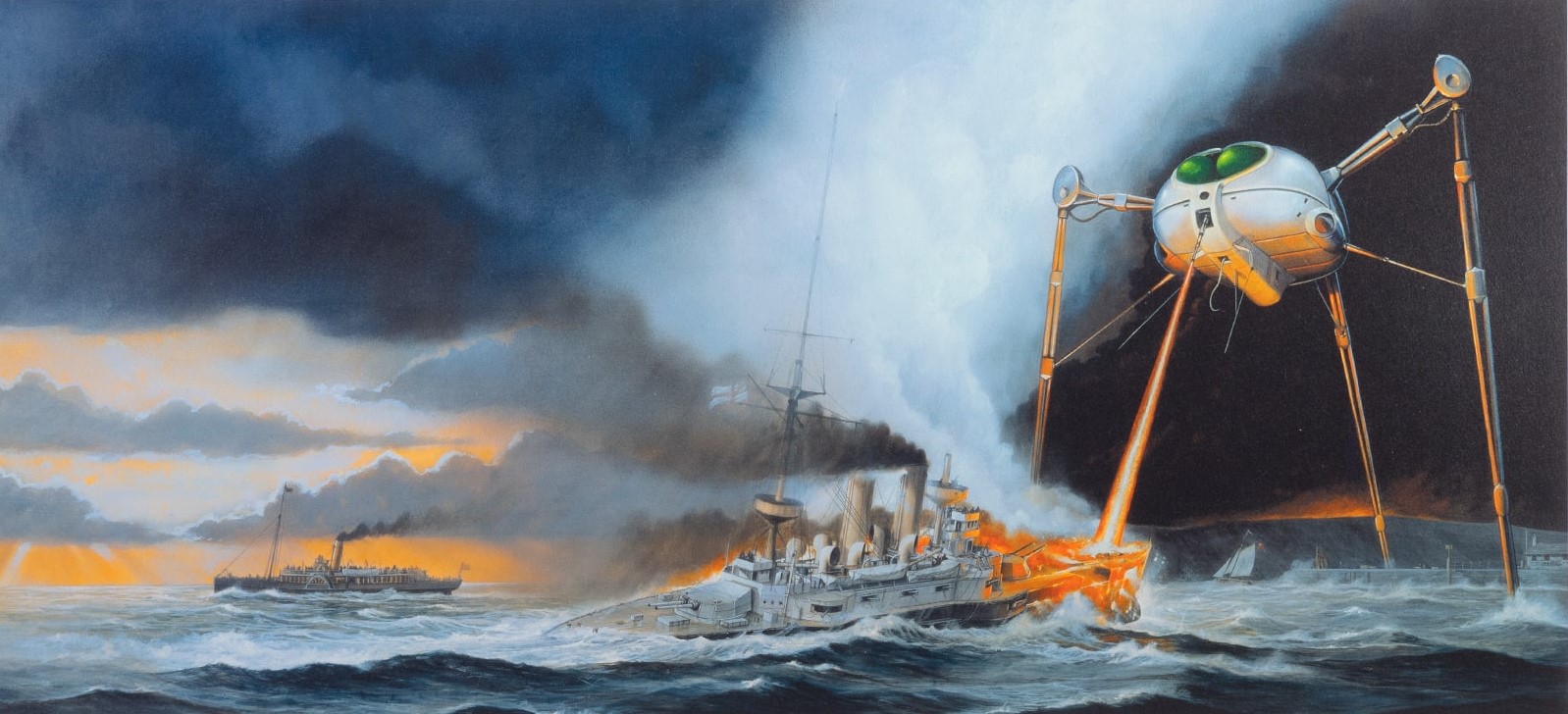
When the smoke and steam had cleared away, the third Fighting Machine was gone. With there scarcely having been enough time for it to retreat, many people choose to ascribe this kill to Thunder Child as well: The ship, in her death throes, reaching out to strike down the last invader that stood to threaten the people she sacrificed herself to protect. Despite this tremendous victory, it would not be repeated. The Martians would never again allow a ship to get so close. They had made the same mistake with field artillery, and had learned the lesson there as well. Command of the oceans was not necessary to their conquest; once the ships had no more place to dock, they would succumb in short order.
“The leaden sky was lit by green flashes. Cylinder following cylinder, and no one and nothing was left now to fight them. The Earth belonged to the Martians.”
 HMS Polyphemus is usually regarded as the inspiration for HMS Thunder Child. Polyphemus was the only torpedo ram operated by the Royal Navy, and despite over 20 years of service, it is pretty much only spoken of in comparison to Thunder Child. The concept of a torpedo ram, a coastal raiding ship meant to storm enemy harbors, torpedo and ram their ships, was not a viable one — especially by the late 1800s, when Polyphemus was launched. Source
The Earth Belongs to the Martians
With the foremost military power on Earth defeated, the Martians viewed their conquest as complete. Further extermination of humanity would only rob future Martian colonists of food. Hereafter, the role of the Fighting Machine shifted from an engine of destruction, to a sentinel. The tripods stood guard over the construction works at the cylinders, and occasionally ventured through their conquered land to pluck whatever humans they desired for consumption.
At midnight on Monday, the fifth cylinder landed on a house in Sheen, on the road toward Mortlake. Within hours, a Fighting Machine arrived to stand guard over it. It is at this cylinder we have the most detailed description of the Martian’s operations. Very quickly, the Martians set about their construction operations, with loud noises and hammering and machining ringing out from the pit the cylinder had blasted into the ground. The work, like all Martian machinery, produced a green smoke.
By the break of day on Tuesday, the cylinder had produced its first Handling Machine. The Handling Machine was the Martian engineering vehicle, far smaller than the Fighting Machine. It had five tentacular legs and a large number of arms, tipped with claws, spatulas, and all manner of other implements. The arms were retractable, allowing them to clear out of the way for when only certain appendages were in use. Except for its metallic construction, everything about the Handling Machine’s movement seemed organic, even more fluid and lithe than the Fighting Machine. The Martian operator sat exposed on the machine’s back, and rearward of him was the cargo compartment, where collected humans could be deposited by the machine’s arms.
The first Handling Machine assembled by the fifth cylinder was busily disassembling part of the cylinder walls, pulling out plates, rods, and bars which formed part of the structure. It then set about “unpacking” the equipment from inside the cylinder; from these it assembled a second Handling Machine. While the Handling Machine worked, an Embankment Machine was making its way in a circle around the pit, excavating the dirt and enlarging the Martian’s fortification. The Embankment Machine was a small, autonomous earthmoving vehicle, of which there is no further description. A second Fighting Machine eventually arrived at the cylinder to stand watch, as the operator of the first had disembarked to help with the construction.
Among other things, this video shows the operation of the Handling Machine. In this iteration, The War Of The Worlds 1934, the Martians make prodigious use of Flying Machines. In the original novel they also had a Flying Machine, which was deployed about the time of the loss of HMS Thunder Child, however they were unable to make it function properly in Earth’s atmosphere.
Three more Fighting Machines transported in machinery from some of the other cylinders, then parked and the Martians aided themselves to their assembly. The second Handling Machine had built an aluminium refinery and was engaged with putting clay through the device and pulling out refined bars of metal. Later in the day, most of the Fighting Machines departed. Another came into the pit and parked; with its arm it reached into the cage on its back and pulled out a man, screaming and fighting for his life. The Fighting Machine deposited him on the ground, and the Martian work crews feasted on his blood.
Thus continued the Martian operations at this cylinder for 12 days. At midnight on Tuesday, the sixth cylinder landed at Wimbledon. The next day, the seventh on Primrose Hill. That Thursday, nearly one week from the beginning of the invasion, a Martian plant known as the Red Weed grew explosively starting from the pit. Whether the Martians had brought it purposefully or if it had hitchhiked on their machinery is unknown, but within days, it covered for miles the area around the cylinder, extirpating all native Earth plants. The Red Weed originated entirely, or almost entirely, from the fifth cylinder.
Late at night on Friday or Saturday, a surviving human witness at the cylinder recalled hearing two volleys of six artillery shots. Where these guns were located is not known, but this was the last resistance offered to the Martians in the London area. The next Saturday a week later, the Martian operation at the fifth cylinder picked up and departed, leaving only scattered refuse behind. The Martians had for the most part abandoned south London, concentrating at a larger base around the seventh cylinder on Primrose Hill. Where the eight, ninth, and tenth cylinders landed is not recorded.

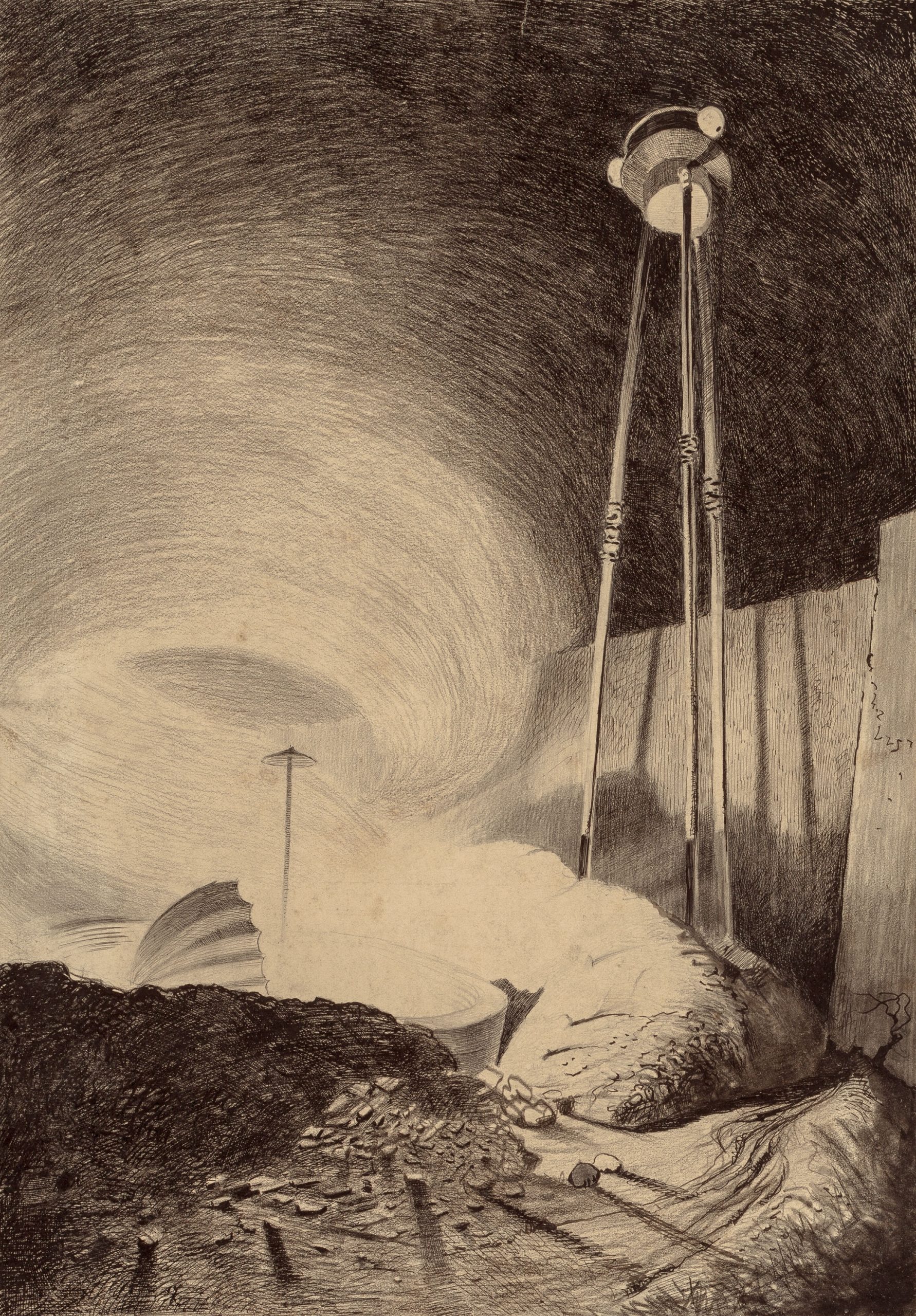 A Fighting Machine observes a drunken party on Regent Street in London, where some people had managed to restore power in the second week after the Martians landed. Illustration by Alvim Corrêa. Source
Three Weeks
On the third Friday, three weeks after the beginning of the invasion, the Martians ceased. Around their camp on Primrose Hill, Fighting Machines stood motionless. The few eyewitnesses alive in London reported that for part of the day the idle machines stood and screamed, “Ulla! Ulla! Ulla!” over and over, in a long mournful howl. They were crying for help, but none came. Many of the Fighting Machines collapsed, almost 50 in total in the camp. Some remained on their feet by the time the vocalizations went quiet. Every Martian on the Earth was dead, killed by the bacteria they had so long ago eradicated on Mars they had forgotten ever existed.
 “Slain, after all man’s devices had failed, by the humblest things that God, in his wisdom, has put upon this earth.”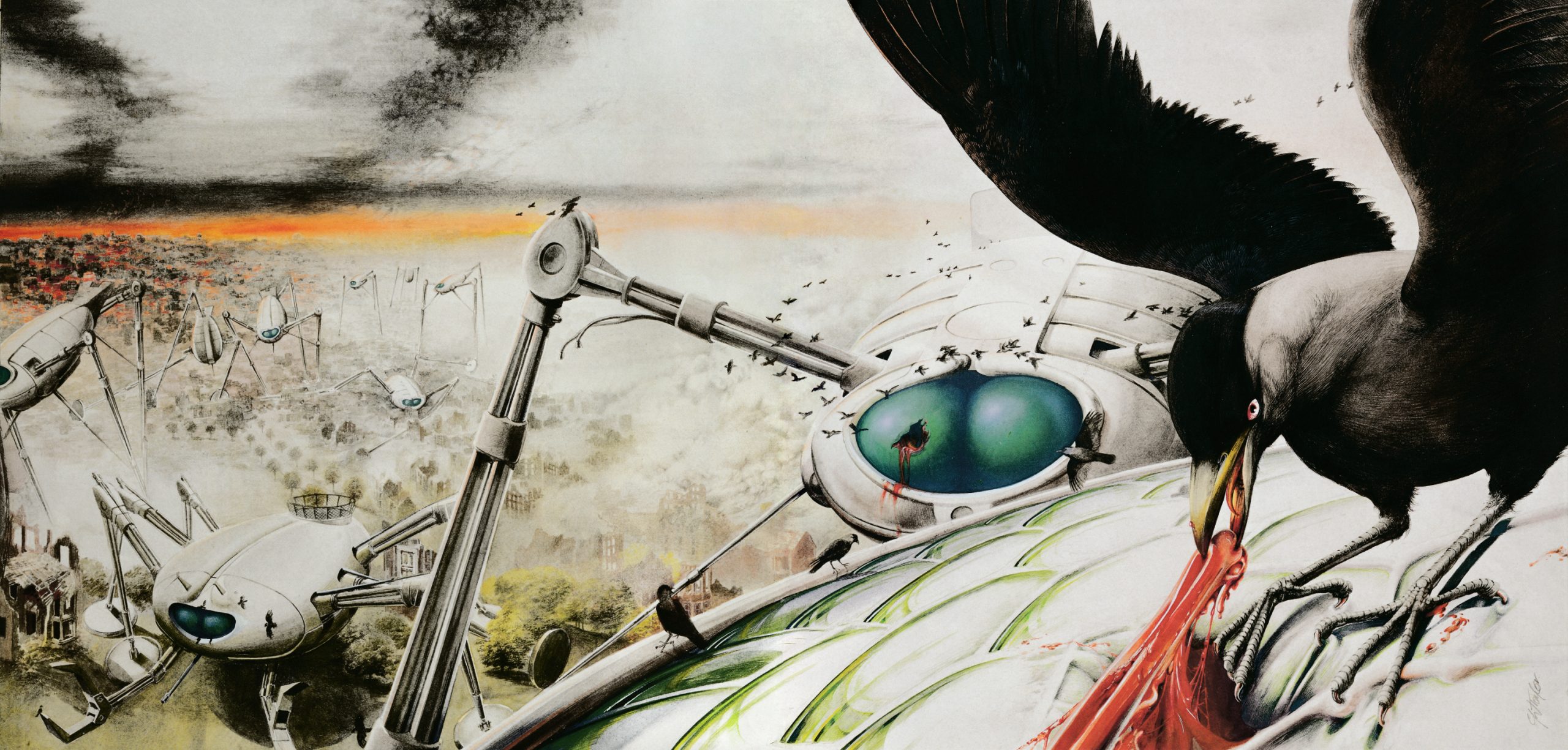
Not hours after the first Martians started to die, word spread to the rest of Britain and around the world of the news of human victory. The disheveled people of London poured back in to reclaim their homes. From France, Ireland, and the United States, food was being sent by ship to aid relief efforts; the governments of those countries, and of the rest of the world, now breathing a sigh of relief the Martians would not be starting on them next.
This assurance of safety was, perhaps, taken for granted too quickly. In the wake of the war, few people of import spoke seriously of a possible second Martian invasion, though the possibility was obvious in everyone’s mind. Some banked on the Martians having learned their lesson in their defeat, while others believed the first invasion was only an initial probing strike. Certainly, the Martians had lost the element of surprise. Further shots fired from Mars would be observed long in advance from Earth, and the cylinders attacked as soon as they landed. Several months after the war, Mars came into opposition with Venus, and a luminous mark was observed on the surface thereof; a corresponding dark mark was found on photographs of Mars. Some astronomers put forth the assertion that this indicated a Martian landing on Venus. Perhaps they found less resistance there.

 Defeated Fighting Machines in London are disassembled after the war. Human knowledge made many great leaps thanks to the study of Martian technology, though some of their devices, like the Heatray, proved too dangerous to reverse engineer. Illustration by Alvim Corrêa. Source
Author’s note: This article supposes the Martians landed in 1901, an assertion which will be controversial to some fans who have their own beliefs. This conclusion was reached through the known facts given in the novel: That the Martian spacegun was seen cast in October 1894; that at least two oppositions of Mars occurred before the first cylinder landed; that the novel takes place in June; that the ‘great disillusionment’ took place in the 20th century. In addition to this, taking from Jeff Wayne’s Musical Version of The War of the Worlds, which, although it has a slightly different story, is meant to take place in the same event portrayed in the novel, we know the first cylinder was fired in August. At the beginning of the novel, which is written as a first-hand account of an unnamed man who survived the war, the narrator writes, “The storm burst upon us six years ago now.” Many people take this to mean that he was writing his account of the war six years after the fact. Not only does this seem like an inordinate amount of time to wait for such an important story as what the narrator experienced, but it is contradicted by the epilogue, where he expresses his concern for a second Martian attack as soon as the next opposition of Mars and Earth. Directly prior to this statement of six years, he writes of the casting of the Martian spacegun in 1894, and directly afterward, of its firing. The author of this article has interpreted this to mean it was six years since 1894 that the first cylinder was fired, meaning August 1900. This is in agreement with the novel stating the invasion took place in the early 20th century.
The alternative interpretation is that the author was indeed writing his book six years after the first cylinder was fired, and the firing took place at or near the opposition of February 1897, rather than in August. The problem with this version of events is that launching a spacecraft from Mars to Earth directly at opposition is more difficult than launching it prior; as Earth orbits faster than Mars, at opposition Earth is catching up to, and passing Mars. It would be easier from the Martian perspective to fire prior to opposition, and so allow their shots to “fall ahead” of Earth and allow Earth to catch up to them, rather than trying to impart all the necessary velocity for their shots to catch up to the passing Earth. For the cylinders to land in June, they would either have to have an extremely short transit time of only five months, or a very long transit time of seventeen months. As modern human spacecraft take seven months to get to Mars, it is reasonable to assume craft launched by a more primitive spacegun would take longer than this. Whatever the interpretation, the conventional belief that the Martian invasion landed in 1898 is untenable, as it would be far more likely for the Martians to land in an odd-numbered year than an even-numbered year, on account of the opposition of Mars always taking place at the beginning of an odd-numbered year.
History of Depictions of the Fighting Machine
As one of the foundational works of science fiction, and being in print for over 125 years, The War of the Worlds may be one of the most reinterpreted and transformed works in history. There are hundreds of known issues of the original novel, and countless adaptations that translate the story to another time and place. Most of these have their own unique depictions of the Fighting Machine, though often only as a cover image. To list them all would be impossible.
Presented here is a table of the majority of notable depictions and adaptations of the Fighting Machine, along with the publication they first appeared in. Many of these designs, particularly the ones which accompany the novel or originate from comic books, reappear multiple times in unrelated publications, sometimes with additional art added by artists other than the one who created the design.




.jpg)

.jpg)

