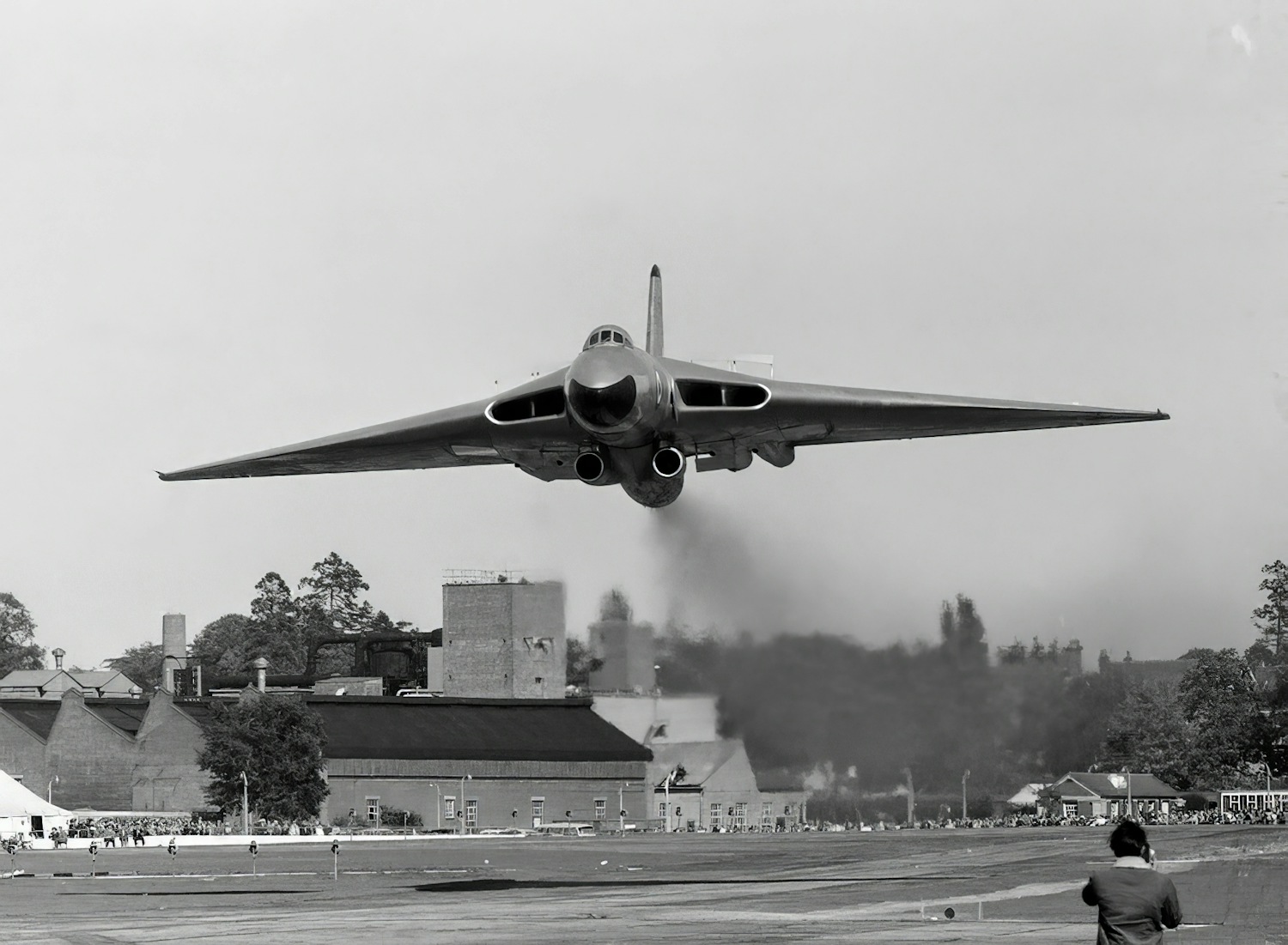

For the same reason that they decommissioned the Supermarine Spitfire and the Avro Lancaster and all the other aircraft they have flown over the years.
It had become obsolete and was superceded by either a newer aircraft or a different weapons system.
Having looked at your profile, Balthazar Thackeray, I believe that I can honestly say that you are not as big a fanboy for the Avro Vulcan as I was. You may have seen them at airshows but…
I grew up with them as I used to live three miles from the factory at Woodford that made them.
Nor was that all. My father was one of the Draughtsman who worked in the Drawing Office at Avros when the Vulcan was designed. So Vulcans were part of my life from an early age and I grew up with the sight of that great Delta Wing flying close overhead.
However, even with all of that background I still recognised that the Avro Vulcan had reached the end of its service life. Designed in the Late 1940s and early 1950s it was intended as a High Altitude Nuclear Bomber. Improved Soviet Air Defences meant that it had to switch to Low Level attacks; something which it could have done. However it was getting more vulnerable and, just as importantly, the airbases from which they would have flown were becoming vulnerable: (It was recognised that, had the balloon gone up and the Vulcans flown missions for real, it would have been a one-way trip. There wouldn’t have been anything for them to return to).
Another illustration of the Vulcan’s vulnerability was the Eye Drill that each crew practised. In the event of a nearby nuclear explosion, each pilot would wear an eyepatch so that they would have one good eye to still use.
By contrast, when the Polaris system was introduced into service in 1968 it was a more secure and survivable system. By having all of the oceans to hide in a Polaris Boat could remain undetected and invulnerable to attack unlike the Vulcan whose bases were known and open to attack. Also one of the Polaris Boats would always be on patrol; (something not possible for the RAF with their Vulcans).
Having lost their primary role, Vulcans did continue in service with a conventional bombing role. However again evolving weapon systems and improved air defences; (plus the cost of operating such a large aircraft for a cash-strapped country as the UK) meant that the Vulcan would eventually be replaced by the Panavia Tornado GR1 in the 1980s. The Falklands Conflict would be a surprising and unexpected swansong that brought them back into the British public’s gaze. But, other than the five Black Buck Missions, thankfully they were never used for their intended purpose.
A photo of 3 Avro Vulcans in all their glory flying in close formation during their heyday as part of V Force.