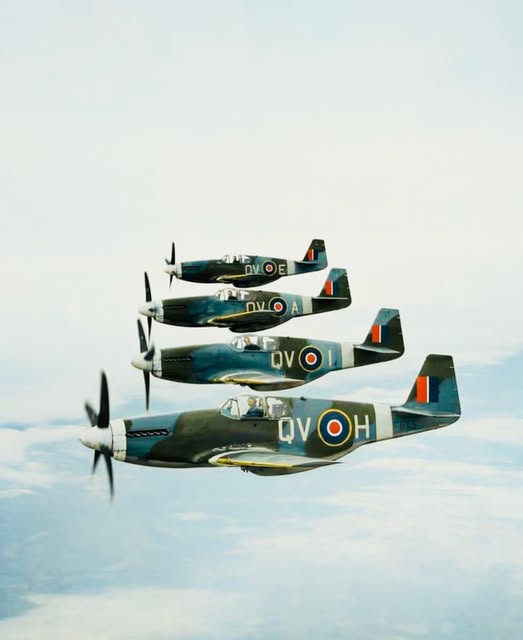
The Supermarine Spitfire, a British fighter that fought in the second world war, can claim to be the most significant combat aircraft in history.
It was a brilliant design, a formidable combination of manoeuvrability, speed and firepower, with handling that left pilots besotted. It is fair to say, that the Spitfire had an instrumental role in both Britain’s survival and the fate of the Allied forces in the war.
Doubling in power and weight across the war, with speed increasing by around 33%, the final members of the Spitfire family were astonishing machines, up there with the very finest piston-engined fighters ever made. Here are 10 of its highlights:
10: Elliptical wing
The most visually distinctive feature of the Spitfire is the elliptical wing. It was probably the most advanced wing design in the world at the time of the Spitfire’s first flight. In addition to making the Spitfire beautiful, the wing was a key factor in its exceptional handling qualities.
The chief designer of the wing was the Canadian aerodynamicist Beverley ‘Bev’ Shenstone, who previously worked in Germany with the firm Junkers and with Alexander Lippisch (delta wing pioneer and designer of the Messerschmitt Me 163). Intriguingly, Shenstone consulted with Lippisch on the design of the Spitfire’s wing.

To reduce drag, a low thickness-to-chord ratio is desirable; thickness refers to the vertical depth of the wing, and chord refers to the distance from the front to the back. The wing has the depth to hold the undercarriage and the guns before tapering towards the narrow tip.
The wing offered aerodynamic advantages: it reduced induced drag. The ellipse was the shape which allowed the thinnest possible wing with room to contain all that was needed. It also offered excellent performance at both high speed and high altitude. Clipped-wing Spitfire variants were better suited to low-altitude missions.
9: Production miracles
Labour-intensive and with a bewildering number of subcontractors involved from across the United Kingdom, creating the Spitfire in vast numbers during wartime conditions was a miracle. One of the Spitfire’s most significant failings was its complex and long-winded production process.
Supermarine subcontracted the production of many parts to other companies around the country. This ranged from tiny parts to the complex main wing spar made by Reynold’s Tubes Ltd, a bicycle frame company in Birmingham to the sub-contracting out of the manufacture of the entire aircraft.

The Castle Bromwich Aircraft Factory (pictured) in Birmingham was the largest Spitfire factory, with production rates that peaked at an impressive 320 aircraft per month. It built over 50% of the total number of Spitfires produced. A national crowdfunding campaign was launched for Spitfire production, known as the Spitfire Fund (similar campaigns are carried out in Ukraine today to support drone production).
No other British aircraft was created in greater number than the Spitfire, and it ranks at an impressive number seven in the list of the most produced aircraft of any nation. By the end of production, in 1948, 22,685 Spitfires (including 2646 Seafires) had been made. This is especially impressive considering the Spitfire took around three times longer to build than other fighters. After the war the factory moved to car production; it built Jaguar saloons and sports cars between 1977 and 2024, some also featuring V12 engines like the Spitfire.
8: Future-proof
The Spitfire was one of the few combat aircraft that saw continuous production, development, and operational service throughout the war. As it faced ever more capable threats, it evolved to meet them with greater power, performance and firepower. Despite six years of rapid technological changes, the Spitfire was never outclassed.

Weight also dramatically increased from the maximum loaded weight of 5200Ib (2359kg) to 12,530Ib (5683kg) for the Seafire F.Mk 47. The engine changed from the Merlin to the Griffon; late models had a new wing. The most refined Merlin variant was the Mk VIII with larger rudder.
The top speed also went up from the 349mph (562 km/h) of the prototype to the somewhat alarming 494mph of the Spiteful, the ultimate propeller-powered variant. The final Spitfire offshoot even provided the basis for Supermarine’s first generation jet aircraft, the Attacker.
7: Photo recce star
Aerial reconnaissance is vital for victory in warfare, helping to determine the state of the enemy’s forces and infrastructure. Due to the size of 1930s cameras and the need for a dedicated camera operator, long-range reconnaissance needed to be carried out by twin-engined aircraft. At the start of the war, the RAF used the Bristol Blenheim for the role, a converted light bomber.
But the Blenheim was extremely vulnerable to smaller, faster and more manoeuvrable enemy fighters, notably the Messerschmitt Bf 109. Australian Sidney Cotton, commander of 1 RAF Photographic Development Unit proposed a radical new solution to strategic reconnaissance: unarmed single-seat fighters relying on high speed and altitude for survival.

Fitted with cameras in the wings, the Spitfires were tweaked and polished for maximum speed, and proved 30mph faster than the standard Mk 1. On 18 November 1939, a recce Spitfire took off from Seclin in France to photograph Aachen in Germany, and became the first Spitfire to fly over enemy territory. Though this first mission was thwarted by bad weather, later flights proved the concept.
Developed across the war with great scientific rigour by some of the greatest minds in their field, the photo reconnaissance Spitfires proved a massive success. They were eventually able to fly at 40,000 feet at a steady 370mph, making them very hard to intercept. They provided an abundance of vital reconnaissance that proved pivotal to many of the Allied actions and even served on into the Cold War.
6: Performance & manoeuvrability
In military aviation there is a saying, ‘speed is life’. A fighter must be fast to catch or escape from its opponents. Speed is vital for catching intruding bombers before they can unleash their deadly cargo, and essential to meet opposing fighters on their own terms. A fast surprise attack is always the tactic of choice.
When the Air Fighting Development Unit (AFDU) tested the Spitfire V against the Mustang I, they found that the Spitfire could outturn the Mustang at every altitude. Even when the Spitfire was temporarily outmatched by the Focke-Wulf Fw 190 in other metrics, it retained a superior sustained turn rate.

Despite its high performance, the Spitfire was a delight to fly and virtually viceless. The Spitfire’s turn rate was spectacular, and it could out-turn virtually any other fighter of the war. Its sustained turn rate was considerably superior to its two main threats, the Focke Fw 190 and Messerschmitt Bf 109.
The Spitfire’s wing with its low thickness-chord ratio performed well at high speeds; in a Mach 0.89 dive a Spitfire pilot needed to pull the stick with 60 Ib of force to keep the aircraft controllable, for the P-47 Thunderbolt it was over 200 Ib. A recce Spitfire that suffered a severe mechanical issue endured a dive at Mach 0.92 and landed on its wheels, an achievement not matched by any other aircraft in the war.
5: Supermarine Spiteful
The American North American P-51 Mustang was brilliant, much of which was due to its laminar flow wing. Attempts to incorporate this into the Spitfire family member had mixed results, though it did result in the astonishingly fast Spiteful, that first flew on 30 June 1944.
But the Spiteful ended up with worse low-speed handling than the Spitfire and a notoriously vicious stall, yet had more problematic compressibility effects at high speed – wherein localised airflow exceeds the speed of sound causing drag – than the Spitfire.

The speed of the Spiteful comfortably exceeded contemporary Spitfires, but not as much as had been hoped. Production Spitefuls utilised an enlarged fin and rudder which cured the persistent directional instability of the Griffon-powered Spitfires, and had a raised cockpit, which improved pilot view over the nose.
Despite this, a development airframe fitted with a Griffon 101 and Seafang-style curved windscreen achieved 494 mph (795 km/h) at 27,800 feet (8473 metres), believed to be the highest speed in level flight ever attained by an unmodified British piston-engined aircraft (modified racers are a different story) . Most of the Spitefuls were sold for scrap in 1948. None survive today.
4: Member of the 450 club
A tiny number of piston-engined aircraft reached the extreme of performances of a top speed exceeding 450mph. The ultimate members of the Spitfire family, and the closely related Spiteful (and its naval Seafang version) were members.
Other than the Supermarine aircraft there were only three other British piston-engined fighters that could reach such speeds, they were the Hawker Sea Fury (and the land-based Fury), the de Havilland Sea Hornet, and the cancelled Martin-Baker MB5.

Other piston-engined fighters (not modified racers) that could reach or exceed 450mph included the American P-51H, North American P-82, Vought F4U-4/5 Corsair, Grumman F8F Bearcat, Grumman F7F Tigercat and ultimate members of the Thunderbolt series.
Germany had the bizarre Do 335 and the freakish Messerschmitt Me 209 of 1938. There were only two Soviet fighters in the 450 club: the Mikoyan-Gurevich I-225 and Yak-3 VK 108. Argentina created the I.Ae. 30 Ñancú.
3: Post-war service
Spitfires didn’t evaporate at the end of World War II. Spitfires were everywhere. Though pushed from the sharpest edge of domestic defence by jet-powered Meteors and Vampires, they served in vast numbers in auxiliary units and remained the most numerous aircraft of the RAF; huge number of surplus aircraft served around the world with other nations.
The raid caught the pilots hungover from a Dining-In Night (culminating in the drunken destruction of the Officers Mess to prevent it falling into the hands of the Israelis). The Egyptian raiders destroyed two RAF Spitfire Mk XVIIIs on the ground. The surviving Spitfires took off for a combat air patrol and shot down four Egyptian aircraft.
A later attack by five Egyptian Spitfires saw all five of them destroyed, three by ground fire, and two by British Spitfires. One of the pilots involved in the first incident was Geoff Cooper who later that year was shot down by the American pilot Chalmers Goodlin, flying an Israeli Spitfire Mk IX. Cooper was found by Bedouins and returned to his base. Like the Spitfire, he would later fight in Malaya.
2: Winning battles across the world
The Spitfire was born a winner back in 1936, and kept winning, even when all else was going wrong, and winning and winning. Dunkirk, North Africa, Australia, Burma, Sicily, Italy, Normandy, the crumbling Reich, even the final days over Japan, all ended up with the Spitfire triumphant.
The Spitfire was likely the most successful Allied fighter, both in terms of number of air-to-air victories and its

The Spitfire served in the Pacific Theatre, where, for once, the Spitfire met a superior turning aircraft, the Mitsubishi Zero. Tactics had to be changed; instead of focusing on the turn, Spitfires employed their superior speed and diving ability to “slash and run” which worked well. In one encounter, New Zealand ace Alan Peart (1922-2018) single-handedly fought against two dozen Japanese aircraft, shooting down one, and surviving.
The Spitfire was the mount of many ace pilots, including James “Johnnie” Johnson (1915-2001) of the RAF, who shot down 34 enemy aircraft. Johnson flew the Spitfire right throughout his war from the end of 1940 right up until 1945. Douglas Bader (1910-1982, who shot down 20 aircraft) and “Bob” Stanford Tuck (1916-1987, 27 victories) flew Spitfires (and Hurricanes) during the major air battles of 1940.
1: Battle of Britain
Following the fall of France, Britain was next on Hitler’s hit list. So far, the Luftwaffe had seemed invincible, so the prospect of facing it was daunting. From 10 July to 31 October 1940, Britain’s freedom from Nazism hung in the balance as it faced a brutal aerial onslaught.
Germany launched massive attacks against England with bombers and fighters. Facing this was an integrated

The Hurricane (pictured at top) was the most numerous British fighter, equipping 33 Squadrons, with the superior Spitfire in service with 18 squadrons. The ratio of victories per squadron is telling: the far greater number of Hurricanes achieved 656, the Spitfires 529. This equates to 29.3 victories per Spitfire squadron, considerably more than the 19.8 figure for Hurricanes.
In the battle, the Spitfire became a powerful (and elegant) symbol of Britain’s defiance to the Hitler and the Nazis. Victory in the Battle of Britain cemented the Spitfire as a symbol that lasts to this day. Search the internet ‘Spitfire’ or visit a bookshop and you will see the word Spitfire often attached to the words ‘legend’ or ‘myth’ such is its totemic power to the British.