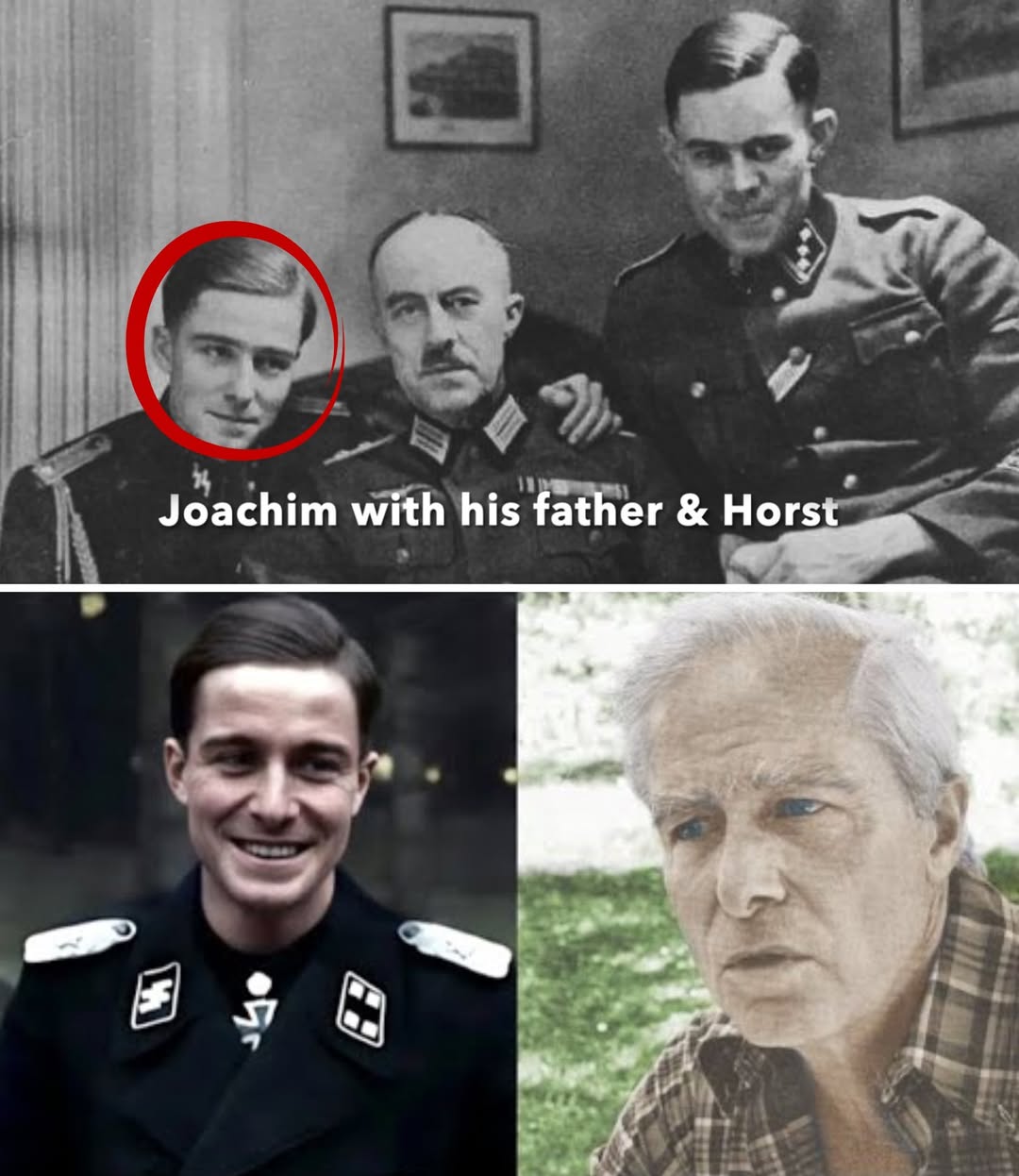
Who Murdered Joachim Peiper? The Strange Death of an Infamous Waffen-SS Officer
In the summer of 1976, a man once celebrated by Nazi propaganda and later condemned as a war criminal died with a pistol in his hand—not on a battlefield, but in his own living room.
The house was not in Germany. It was in rural France, in the village of Traves. By morning, the home was burning, and Joachim Peiper was dead. The scene felt like a dark epilogue to the European war that had ended more than three decades earlier. Yet the questions it raised did not belong only to the past: who killed him, why did they strike then, and how did a former Waffen-SS commander end up living in France at all?
Peiper’s death has often been described as mysterious because it sits at the intersection of two unresolved forces. One is the long memory of wartime violence, especially in places that had suffered under German occupation. The other is the postwar reality that many perpetrators lived long enough to build second lives—sometimes quietly, sometimes openly, and sometimes in ways that provoked rage.
If you begin the story at the end, the facts are stark. Peiper, born in 1915, died in July 1976 in Traves, France. Reports describe him being killed in an attack in which his house was set on fire, and the perpetrators were not definitively identified in the public record.
The “why” requires a rewind.
The Making of a Nazi Career
Joachim Peiper was born on January 30, 1915 in Wilmersdorf, a district of Berlin. His upbringing was shaped by interwar German militarism. His father had served in the Imperial German Army, and the family world included veteran networks and the paramilitary culture that flourished after Germany’s defeat in World War I.
Peiper joined the SS in 1933, entering the organization at the point when the Nazi state was consolidating power and transforming ideology into institutions. It is easy to describe this as a “career move,” but the SS was not a normal employer. It was an elite political and racial organization whose purpose included repression, terror, and—in time—mass murder.
By the mid-1930s, Peiper’s trajectory intersected with the most powerful SS figure after Hitler: Heinrich Himmler. In later accounts, Peiper was often portrayed as one of Himmler’s favored aides, a young man whose proximity to power accelerated his promotions.
The core point is this: Peiper was not an apolitical soldier who happened to wear the wrong uniform. He was embedded in the SS system early, and his career grew inside its worldview.
That matters because postwar defenders of Waffen-SS veterans frequently tried to separate “frontline combat” from “political crime.” Peiper’s biography resists that separation. His path ran through the political heart of the SS long before it ran through the front line.
From Aide to Combat Commander
During the war, Peiper moved between staff roles and combat commands. He served in the Leibstandarte SS Adolf Hitler (LSSAH), the Waffen-SS formation that began as Hitler’s personal guard unit and evolved into a major armored division.
Peiper’s reputation as an aggressive leader developed on the Eastern Front, where brutality was not a side effect but a policy environment. German occupation and anti-partisan warfare blurred into campaigns of annihilation, and SS formations were central to that effort.
Accounts of Peiper’s units include multiple incidents in which civilians were killed and villages destroyed as reprisal or as part of broader anti-partisan operations. One of the better-known incidents connected to his command is the Boves massacre in Italy on September 19, 1943, where civilians were killed and parts of the town were destroyed after German soldiers were captured and then released.
When discussing these events, the language matters. “Reprisal” can sound procedural. In practice, it often meant killing civilians to send a message. Peiper’s career advanced in a system that rewarded ruthlessness and speed, and his postwar reputation became inseparable from the actions taken under that system.
The Ardennes and the Crimes That Would Follow Him
Peiper is most widely known outside specialist history for his role in the Battle of the Bulge in December 1944, when he led Kampfgruppe Peiper, an armored spearhead in the German offensive through the Ardennes.
The offensive was Germany’s last major attempt to reverse the war in the West. It relied on surprise, speed, and the hope of splitting Allied forces. Peiper’s unit pushed aggressively, but the campaign also produced some of the most notorious war crimes committed against U.S. troops in the European theater.
On December 17, 1944, American prisoners of war were killed near Malmedy (often referenced via the Baugnez crossroads). The killings became known as the Malmedy massacre. The U.S. Holocaust Memorial Museum notes that SS men were later tried not only for the POW killings but also for murders of Belgian civilians during the offensive.
The larger truth, often lost in internet retellings, is that the Malmedy massacre did not remain a single incident in isolation. It became a focal point for investigation and prosecution of Waffen-SS personnel associated with Peiper’s unit, and it shaped how American authorities and the public viewed the crimes of the Battle of the Bulge.
Trial, Death Sentence, Commutation, Release
After the war, U.S. authorities investigated the Malmedy killings and prosecuted members of Peiper’s unit in the Dachau trials. Peiper was among those convicted, and he was sentenced to death. The verdicts were delivered on July 16, 1946, and Peiper was one of the defendants sentenced to hang.
What happened next is a major part of why Peiper’s later life remained politically explosive.
His death sentence was ultimately commuted. Over the following years, the sentences of many defendants were reduced. Peiper’s sentence was commuted to imprisonment, and he was released in December 1956.
To survivors’ families and many observers, these commutations looked like justice diluted. To other postwar voices, they were framed as corrections to a process shaped by the anger of the moment. The debate over the Dachau trial procedures became its own chapter in postwar politics.
But for Peiper, the practical result was simple: he was free.
A Second Life in West Germany
After release, Peiper returned to civilian life in West Germany. He sought work, and like many former Waffen-SS men he moved through veteran networks that aimed to rehabilitate reputations and provide assistance.
Reports describe him working for Porsche as a salesman in the late 1950s. To some, that fact became another symbol of postwar contradiction: a man convicted in a war-crimes case returning to a respected corporate environment.
Peiper’s postwar existence did not erase his wartime identity. The name carried weight. It attracted attention from far-right sympathizers who mythologized him, and it provoked anger among those who remembered what his unit had done.
That tension grew more dangerous once he moved to France.
Why France?
The decision to relocate to France in the late 1960s has always invited suspicion and fascination. Why would a former Waffen-SS commander, convicted in a high-profile war-crimes case, choose to live in a country that had been occupied by Nazi Germany and where memories of wartime collaboration and resistance remained vivid?
Some accounts suggest he sought anonymity, distance, and quiet. Other interpretations view it as a miscalculation of how quiet postwar Europe really was.
In Traves, the rural setting could look like a hiding place. Yet hiding is fragile. A single recognition can collapse it. Accounts associated with the Traves property describe how Peiper’s presence became known locally and how he faced hostility and threats, with his family leaving while he remained.
Those details matter because they frame the final night not as random violence but as the end of a building pressure.
The Night of Fire
Accounts of Peiper’s death describe an attack on the house during the night of July 13–14, 1976. Peiper was killed, and the house burned. The attackers were not conclusively identified in public reporting.
In the barest outline, the scene is haunting: a man who had once led armored columns in war now fighting alone in a living room, a pistol in hand, as the home that sheltered him turned into a trap.
The location has since become a kind of grim landmark in online memory culture—overgrown, ruined, “given back to nature,” as some descriptions put it.
But ruins can romanticize if you let them. The reality is less cinematic and more morally tangled: Peiper’s death was violent, and his life before it was violent in ways that did not end with his prison release.
Who Would Want Him Dead?
Because the perpetrators were not clearly identified, Peiper’s death invites competing theories.
One theory points to political militancy in 1970s Europe, when radical groups and violent acts were part of the landscape. Another points to local resentment—people who remembered occupation and could not accept that a man associated with SS crimes lived nearby. Another suggests a personal vendetta. Another suggests a combination: local anger meeting broader ideological hostility.
The problem with these theories is that “motive” is easy to invent in hindsight. The harder question is evidence: who had access, who knew his routines, who had the capacity to carry out the attack, and what did investigators conclude at the time?
Public discussions often blur those distinctions. The death becomes a Rorschach test: people project their preferred narrative onto the unknown.
The Ethical Trap of “Mysterious Death” Stories
There is a reason stories like this go viral. They combine three ingredients that audiences can’t resist: a notorious figure, a shocking setting, and an unanswered question.
But there is also an ethical trap. Turning Peiper into the protagonist of a mystery can inadvertently center him, as if the most important question is what happened to him, rather than what happened because of him.
Any serious retelling must keep the scale of harm in view.
Peiper was not simply a “soldier.” He was a Waffen-SS officer whose units were involved in atrocities and whose name is linked to a major war-crimes trial after the Battle of the Bulge.
That does not mean he “deserved” extrajudicial killing decades later. It means that the anger surrounding him did not come from rumor alone. It came from victims, survivors, and histories that never felt finished.
The Postwar Question: What Does Justice Look Like?
Peiper’s story is also a reminder that the end of a war does not end the war’s moral accounting.
The Dachau trials were one attempt at accountability. The commutations and early releases were, to many, evidence that accountability weakened under political pressures of the Cold War and the rebuilding of West Germany.
For others, the trials were viewed through a legal lens that emphasized procedural fairness. This debate—justice versus procedure, punishment versus politics—did not end in the 1950s. It persisted in how postwar societies talked about perpetrators.
Peiper living openly, working a corporate job, attending veteran gatherings, and then moving abroad created a sense that history had failed to close the file.
That sense, fair or not, is part of why his death still attracts attention.
The Reputation Machine
Another thread in this story is propaganda—first Nazi propaganda, later postwar mythmaking.
During the war, Nazi media promoted certain officers as ideal warriors: handsome, fearless, decisive. That image was useful to a regime that needed heroes to sell sacrifice.
After the war, fragments of that image survived in certain circles, sometimes stripped of context and presented as “military excellence.” The crimes were minimized, reframed, or separated from the man.
This is not unique to Peiper, but his case is a particularly sharp example because the record includes both battlefield notoriety and courtroom conviction.
When a figure is mythologized, even condemnation can become fuel. Every mention keeps the name alive. That is why telling the story requires discipline: describe accurately, condemn clearly, and do not let narrative glamorization creep in through aesthetics.
The Move That Triggered the End
Peiper’s relocation to France is one of the most consequential decisions in the arc. In a quieter country, he might have lived out his years in obscurity. In France, his presence carried symbolic weight.
France’s postwar memory culture includes both resistance pride and painful conflicts over collaboration. By the 1970s, those issues were still emotionally charged. A former Waffen-SS officer living on French soil was not simply a private fact. It was a provocation.
Descriptions associated with the Traves house emphasize that Peiper’s anonymity was compromised—recognized, threatened—and that his family left while he stayed.
That detail gives the ending a tragic inevitability. A man with a contested identity remains alone in a house that cannot protect him, and the people around him are not obligated to forget.
What We Know, What We Don’t
What we can say with confidence is limited.
Peiper was born in 1915 and died in 1976 in France.
He served as a Waffen-SS officer, led Kampfgruppe Peiper in the Ardennes offensive, and was convicted in the postwar Malmedy trial, initially sentenced to death, then commuted, and released in 1956.
He was associated with atrocities beyond the Ardennes, including the Boves massacre in Italy in September 1943.
He moved to France later in life, and he died when his house was attacked and set on fire, with the perpetrators remaining uncertain in public accounts.
What we cannot say with confidence—at least not from the episode’s framing—is the identity of the killers. The lack of certainty is what turns the story into a magnet for speculation.
Why the Mystery Endures
Even without a named killer, the story endures because it exposes something uncomfortable about the postwar world.
Societies attempt to close chapters through trials and sentences. But when sentences are reduced and perpetrators return to ordinary life, the chapter does not feel closed to everyone. Some people accept the legal outcome and move on. Others view the outcome as inadequate and carry anger for decades.
Peiper’s death sits in that unresolved space.
To some, it looked like revenge. To others, it looked like terrorism. To others, it looked like the violent return of a past that Europe never fully settled.
The truth may be less narratively satisfying than any of those frames.
The killers may never be definitively known.
But the reasons people still ask “Who killed him?” are clear: it is a question that looks like crime mystery, but it really points toward the bigger question of memory, accountability, and what happens when a society’s verdict does not match the emotional verdict of those who suffered.
An Ending That Isn’t an Ending
Peiper’s death did not close the debate about him. It shifted it.
Instead of arguing only about his wartime actions and postwar sentence, people argue about his final night and the meaning of his murder. The man remains the center, and that is precisely what makes the story dangerous. The more he remains the center, the more victims drift to the edges.
A better way to read the story is as a warning about the afterlife of violence.
Violence creates memory. Memory creates conflict. Conflict can endure long after uniforms are folded away.
Peiper lived long enough to learn that. He also lived long enough to discover that some people do not accept anonymity as redemption.
He died in a French house because the war did not follow him only as a set of medals and myths. It followed him as a record of deeds, and as anger that could outlive prison walls.
And in that, the “mystery” of his death is less a puzzle than a mirror. It reflects what happens when history’s moral debts remain disputed—when some people see the ledger as settled and others see it as unpaid.
Episode one ends with the move to France and the fire to come. The second question—who did it—may never have a satisfying answer.
But the first question—why this life ended in violence at all—has an answer written across the twentieth century: because violence, once unleashed, rarely stays confined to the moment it began.