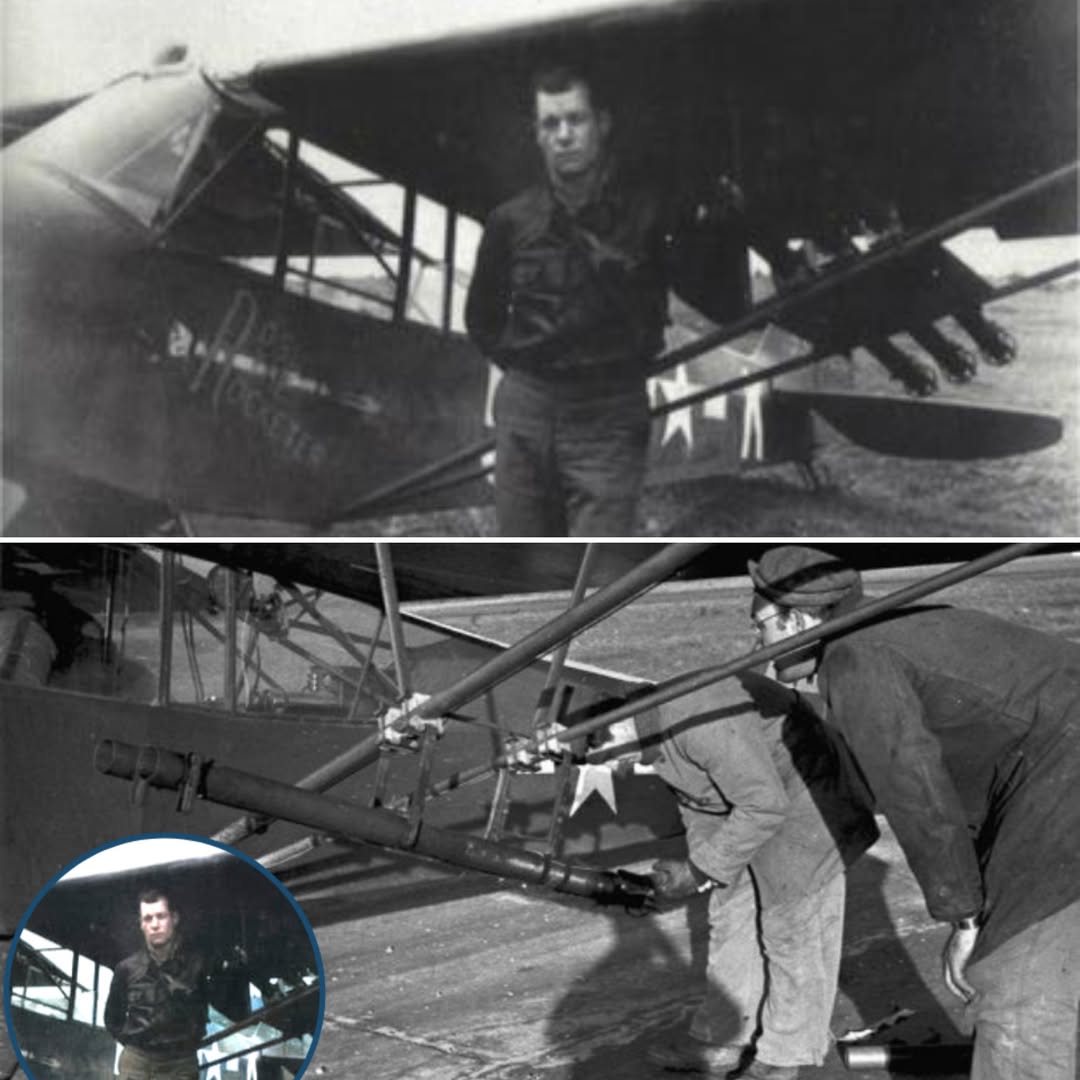
September 20th, 1944 began in a white that did not belong to sky or earth, but to something in between—a blankness that swallowed both into silence. On a strip of churned mud near Arracourt, where tank tracks had torn the fields into long, ugly scars, a small aircraft sat motionless, fragile as a discarded toy. It was a Piper L-4 Grasshopper, fabric-skinned, light-framed, powered by an engine so modest it seemed absurd beside the machines of war surrounding it. But today, it carried something that did not belong to it. Six bazooka launchers were bolted to its wings, crude wires running along the struts into a makeshift firing switch in the cockpit. Beneath the thick fog below, German Panther tanks were advancing, and one man had decided he would no longer just watch.

Major Charles Carpenter stood beside the aircraft, gloved hands resting lightly against the wing as he stared into the white void ahead. He had not always been a soldier. Before the war, he had been a high school history teacher, the kind who explained battles through maps and timelines, who turned chaos into lessons. War had been something distant then—ink on paper, voices from the past. Now it was smoke, heat, and the memory of men burning alive inside steel hulls they had trusted to protect them. For three months, Carpenter had flown above France, watching battles unfold beneath him. He had seen Sherman tanks destroyed at distances where they could not fight back, seen crews scramble out of hatches already on fire, seen black columns of smoke rising from fields that had once been quiet farmland. And each time, all he could do was mark coordinates, speak into a radio, and leave. That helplessness had grown inside him, slowly, steadily, until it became something else.

“You’re sure about this, sir?” the crew chief asked, unable to hide the tension in his voice as he glanced at the bazookas mounted under the wings. “This bird wasn’t built for that kind of load. And the rocket exhaust… it could set the wings on fire.”
Carpenter did not answer immediately. He ran his hand across the taut fabric stretched over the frame. “We weren’t built to stand by and watch either,” he said quietly. Then he climbed into the cockpit, strapped himself in, and checked the switches. Six launchers. Eighteen rockets. Eighteen chances. The engine coughed twice before catching, its vibration traveling through the entire aircraft. He pushed the throttle forward, and the overloaded Grasshopper lurched down the uneven strip, slower than usual, heavier than it had any right to be. In that moment, he understood something clearly: within the next hour, he would either crash… or he would prove something no one had tried before.
The aircraft lifted off with a hesitant bounce and climbed into the fog. At fifteen hundred feet, the world disappeared. No horizon. No ground. No reference. Just white in every direction. Carpenter held the controls steady, more carefully than usual, feeling the difference immediately. The plane responded sluggishly. Every turn required more force. The bazookas dragged against the air, pulling him down, resisting him. He glanced at his instruments, calculating fuel, time, distance. Below, the battle continued unseen. German armor moved through the fog, using it as cover. It was their advantage. And if he wanted to change anything, he had to break through it.
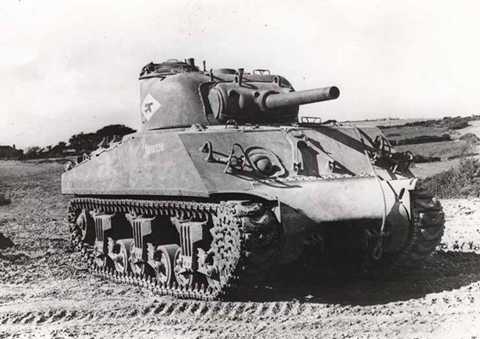
When the fog began to thin, the world slowly returned in fragments—gray shapes, then outlines, then movement. Fields torn apart by war. Tracks carved into the earth. And then, unmistakably, tanks. Carpenter lowered altitude, his heartbeat quickening, but his mind sharpening with it. He picked a target—a Panther moving across open ground, its turret turned slightly, scanning for threats it could not yet see. From above, it looked smaller. But he knew better. He had seen what it could do.
He angled the aircraft downward, not too steep, not enough to lose control, but enough to line up the shot. The distance closed. His hand rested on the firing switch. He waited. At roughly three hundred feet, he fired.
A rocket leapt from the wing, leaving a brief trail of flame. Then another. Then another. The recoil was light but noticeable, a tremor through the frame. He pulled up immediately, instinct taking over, not waiting to see the result. Survival came first. When he circled back, he saw it—the Panther had stopped. A thin stream of smoke rose from its rear. Not a dramatic explosion. Not the kind of destruction he had imagined. But it was enough. He had hit it. He had reached something that had once felt untouchable.
But one tank did not stop a battle. Others kept moving. And now, they knew something was above them. A machine gun opened fire, tracer rounds slicing through the air. Carpenter banked hard, narrowly avoiding a burst. He had no armor. No speed. Nothing but his small size and unpredictability. He picked another target, this time a Panther turning its turret toward a group of Shermans hidden behind a low ridge. He dove again, faster, lower, riskier. He fired the remaining rockets from one wing, then pulled up sharply, the ground rushing past beneath him. This time, the explosion was clearer—a burst of flame from the hull. Carpenter did not know if the crew survived. He did not let himself think about it.
When he returned to base, his fuel gauge was nearly empty. The aircraft shuddered as it touched down, as if it too had been pushed beyond its limits. The crew chief ran toward him, eyes wide at the sight of the empty launchers. “You fired all of them?”
Carpenter climbed out slowly, his legs unsteady. “We need more rockets,” he said, his voice rough. “And we’re doing this again.”
The story spread faster than he expected. Among pilots. Among tank crews. Among infantry. Some called it madness. Others called it desperation. But the men on the ground—the ones facing those Panthers—began to look up differently. Not at a distant observer. But at something that might fight with them.
In the days that followed, Carpenter flew again and again. He refined his approach. He learned to come in with the sun behind him, to blind the gunners below. He learned to adjust his firing angle, to release rockets one at a time instead of in volleys. He learned when to attack and when to pull away. He was not always successful. Some rockets missed. Some runs were aborted under heavy fire. But he kept returning. Because he could not go back to what he had been before—circling above, watching, recording, leaving.
One evening, as the last light broke through the low clouds, Carpenter saw something that stayed with him. A Sherman burned in the field, smoke rising from its turret. Nearby, a Panther turned away, its job seemingly done. Carpenter banked sharply, diving toward it. He fired his last two rockets. One missed. The second struck near the rear of the turret. The Panther stopped, smoke pouring from it. Carpenter climbed, passing overhead, and in that moment, he saw a man crawling out of the burning Sherman, rolling onto the ground—alive. Just one man. But alive.
The war did not change because of what Carpenter did. Panthers were still deadly. Shermans were still vulnerable. Men still died. But something shifted—something small, but real. The idea that you were not limited to the tools you were given. That a reconnaissance plane could become a weapon. That an observer could become a fighter. That ingenuity could bridge the gap between weakness and strength. And for the men who had seen that small aircraft diving out of the sky, firing streaks of flame at machines that had once seemed invincible, that idea mattered.
Years later, when the war was reduced to stories and memories, people would remember the great battles, the generals, the strategies. But somewhere in the quieter stories, someone would mention a small plane with six bazookas, and a man who decided that watching was no longer enough. And perhaps, in that moment, they would understand that the difference between defeat and survival is not always measured in armor or firepower, but in the choices made by the people inside the machine.