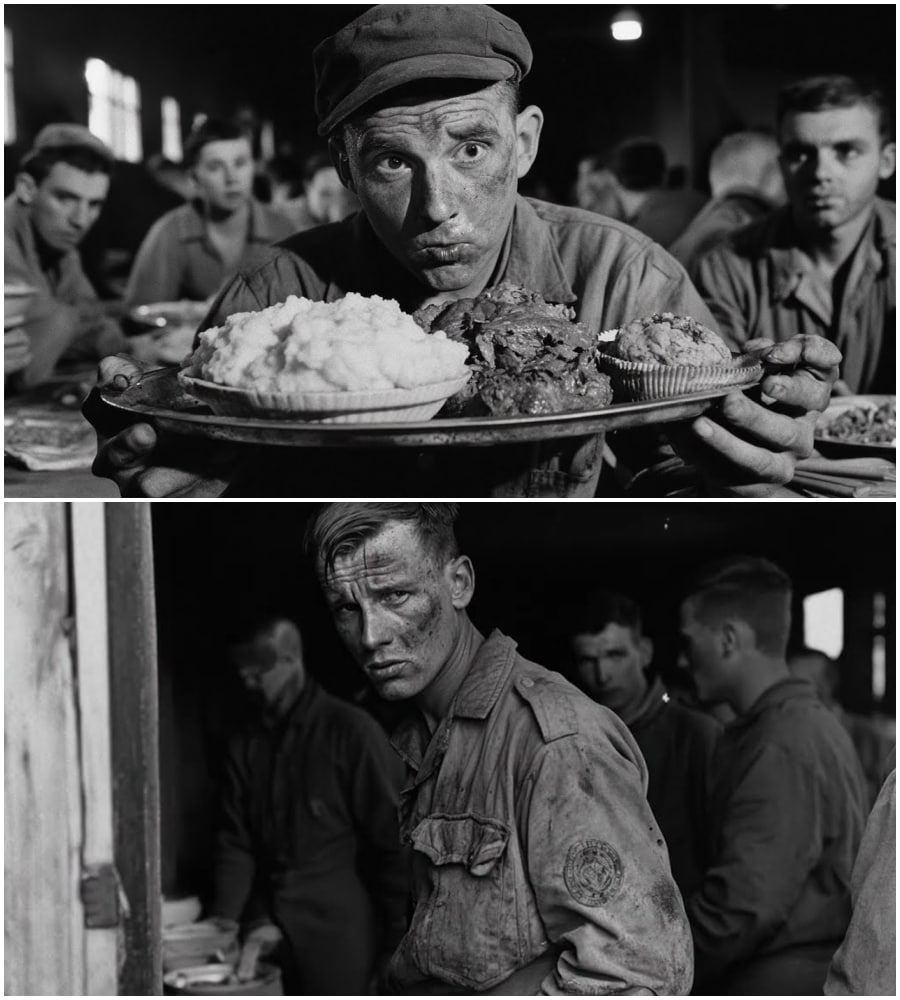
The first German prisoners crossed into Camp Concordia, Kansas on July 4th, 1943. They had eaten nothing but watery cabbage soup for six days. The messaul doors opened at 1700 hours. Sergeant Wilhelm Müller, 21st Panza Division, captured at Cassarine Pass, stopped 3 m from the serving line. His post-war testimony to British interviewers recorded the moment. I thought the tables were decorated like a propaganda photograph. Each tray held 12 oz of pot roast, 4 oz of mashed potatoes, 60 gram of green beans, two dinner rolls, butter, actual butter in a small paper cup, a slice of apple
pie, Miller’s ration in North Africa, per Vermach logistics records from January 1943, 300 g of bread, 120 gram of meat substitute, 15 g of fat. weekly. The American daily caloric load before these men averaged 3,200 calories. German frontline troops in Tunisia received 1,250 on good weeks. They ate in silence. Every scrap. Müller folded his napkin over the two remaining bites of bread and slipped them into his shirt. Around him, 240 men did the same. pockets bulged with rolls, apple cores, buttercups still half full.
Kitchen staff watched through the serving window. One private asked if they should clear the tables. The mess officer, Lieutenant Howard Chen, said, “No.” “Let them learn,” his duty log noted. Morning count revealed the hoarded food, bread hardening under bunks, butter melting into uniform pockets. Oberelitant Ernst Becka, a Luftwaffer navigator shot down over Sicily, had wrapped four rolls in his pillowcase. His barracks inspection report dated July 6th, recorded the discovery alongside the camp interpreters annotation. Prisoner states he was saving for when rations stop.
The Geneva Convention required captain nations to feed PS equivalent to their own garrison troops. US Army regulation 6331 issued February 1943 specified minimum standards meat at least once daily fresh vegetables 3,000 calories minimum. Camp Concordia’s contract with Ellsworth Milling Company supplied 60 lb of flour per 100 prisoners per day. The German army’s entire sixth army at Stalingrad before the encirclement received 30 per 100 men daily at peak supply. Breakfast on July 5th, scrambled eggs, bacon, toast, coffee, orange juice.
Müller’s diary preserved in the Concordia camp archive recorded his confusion in fractured English learned from guards. Eggs again they give yesterday too. His mistake. Guards say no mistake. Everyday eggs. He ate six pieces of toast, drank three cups of coffee, vomited an hour later behind the latrine. The camp medical log shows 43 similar incidents that first week. Digestive systems shocked by fat and protein after months of deprivation. The hoarding intensified. Inspections on July 8th found a systematic smuggling network.
Prisoners transferred food during work details. Burial in hidden caches near the motorpool. One cache discovered when a guard noticed disturbed earth contained 87 bread rolls. 23 partially eaten steaks wrapped in newspaper. 14 apples. Decomposition had begun. The camp commandant, Colonel Paul Newfeld, convened the prisoner liaison committee. His meeting notes survive. Informed prisoners via interpreter that food supply permanent met with silence. Spokesman asked how long permanent means. Stated indefinite. Spokesman asked what indefinite means. Ended meeting. Trust did not come from words.
It came from repetition. Week two, the same portions. Week three, the same. Müller’s diary entries shift in tone. July 14th, steak again. They not run out. July 18th, eggs every morning. Maybe is Kansas rich place only. July 22nd, butter every meal. Where they get so much? The answer sat 200 km northwest. Kansas wheat production in 1943, 241 million bushels, a state record. Beef cattle inventory 3.8 million head. Peak wartime numbers driven by government price supports. Ellsworth Milling operated three shifts.
The camp’s monthly food expenditure documented in Concordia County procurement records. 14 to200 for 2,400 prisoners. That sum would have fed an entire Vermacht regiment, 2,500 men for 3 months under German logistics planning from the same period. Behavior changed gradually. Then suddenly by August inspection reports noted decreasing food hoarding. Miller’s diary August 9th I leave bread on plate today. Mornings still come. Food still there. The psychological shift occurred in visible stages. First men stopped taking extra rolls. Then they stopped hiding butter.
By September they began refusing seconds when offered. The abundance removed the fear and without the fear appetite found natural limits but not for everyone. Geita Hans Layman 334th Infantry Division captured in Italy never stopped hoarding. His psychological evaluation from October 1943 notes persistent trauma indicators from Lennengrad siege. He had survived the northern front winter 1941 to to 42 when German rations dropped to 200 gram of bread daily and men ate leather. Every inspection found food under his mattress rotting despite repeated warnings.
He served 3 days in camp detention for health code violations. The camp psychiatrist’s note subject cannot accept permanent supply concept. Recommends observation but no punishment. Survival behavior too deeply ingrained. The Red Cross inspection of Camp Concordia, November 1943, recorded an unusual complaint from prisoner representatives. The portions were too large. Men were gaining weight, averaging 8 kg in 4 months. Some requested smaller servings to avoid becoming fat. The inspector, Dr. Friedrich Bowman from the Swiss delegation noted the irony in his report.
Prisoners expressed concern about overfeeding. This observer has never encountered such complaint in 40 camp inspections across three continents. The camp’s food supply never faltered. December records show the same procurement numbers. January 1944, the same. By spring, the hoarding had effectively ceased. Müller’s final entry on the subject. April 1945. We eat normal now. Like is always there because it is. The realization spread through other camps at different velocities. Camp Alva, Oklahoma received 3,000 Africa Corps veterans in October 1943.
Their intake processing revealed physical deterioration beyond Concordia’s prisoners. Average weight 58 kg for men whose wearass records showed pre-capture norms of 72. Medical officer Captain Robert Chen documented first meal reactions. 17 cases of acute gastric distress. Prisoners consumed food at speed suggesting fear of imminent removal. One subject ate until unconsciousness, required hospitalization. The difference was sequence. Concordia’s prisoners arrived directly from North Africa via processing centers. Alva’s men came through British custody first, four months in Tunisian P cages where rations reflected Britain’s own shortage economy.
Their last meal before transfer, thin soup, 200 g of bread, tea. Geneva convention standards existed on paper. Implementation depended on the captor’s supply chain. Oberga writer Klaus Vber, 15th Panza Division, kept what he called his mangan listister, quantity list, on torn cardboard hidden in his boot. Entries from Camp Alva, October December 1943. Track his recalibration. Oct 18. Meat 340 g weighed on medical scale. Guard allowed. Impossible number. Oct 25. Counted eight eggs this week. Eight. Ocket 31.
American private on guard duty eating sandwich. Threw half away. Half. Watched him do this. Nova 7. They feed us same as their soldiers. Confirmed by comparing trays through fence at guard mess. Same portions. Nov 15. Butter ration larger than weekly. Vermarked officer allowance. Daily. Nov 22. Three men in my barracks now refuse breakfast. Two full from yesterday. The psychological breaking point came through indirect observation. Prisoners watched American guards at Camp Chaffy, Arkansas. A work detail witnessed kitchen staff scraping uneaten food into waste bins, pounds of it daily.
Enter a physier. Martin Schultz, captured at Anzio, reported this to his barrack group as evidence of impending shortage. They are hiding true supply situation by disposing of evidence, his statement to the prisoner council suggested. But the waste continued week after week. By December, Schultz’s interpretation inverted. They waste because they have too much. This is not hiding shortage. This is normal for them. The waste ratio shocked German logistics officers among the prisoners. Major Friedrich Wolf, Quartermaster Corps, calculated Camp Chaffy’s food waste at 1822% of total supply based on observation of disposal barrels.
His clandestine report smuggled to German intelligence through Red Cross letters using code reached Berlin in January 1944. Decoded excerpts captured by Allied Signals intelligence and now in national archives files. American supply capacity exceeds frontline need by comfortable margin. Waste indicates production surplus, not scarcity management. Implications for war sustainability assessment require revision. The contrast became teaching material. In Camp McCain, Mississippi, Halpman Otto Brener, former instructor at Vermach Logistics School in Munich, organized unauthorized lectures for fellow prisoners. His notes confiscated during barrack search but preserved in camp records.
American system operates on abundance principle. German system on scarcity management. Abundance permits waste. Inefficient but psychologically stable. Scarcity demands efficiency. Optimal but creates hoarding behavior and distrust. Americans win logistics war before first shot. They feed prisoners better than we fed frontline troops. But abundance had costs the prisoners initially couldn’t see. Camp Hearn, Texas, July 1944. Butter rations doubled due to local dairy surplus. Kitchen staff served four butters per meal instead of two. Prisoners interpreted this as final excess before collapse.
Hoarding resurged. Griter Paul Richter’s diary. They give too much butter now. Clear sign of system breakdown. Storage failure or spoilage forces distribution before total loss will stop within week. It did not stop. August brought the same excess. September October. The butter kept coming because Texas dairy production in 1944 exceeded demand by 23 million pounds statewide and the government bought surplus at guaranteed prices. Economics not logistics failure drove the distribution. RTOR’s November entry butter continues my scarcity theory wrong.
Americans simply have this much cannot comprehend scale. scale revealed itself in other ways. Camp Indianola, Nebraska, January 1945. Prisoners processed mail from home. Letters from families in Essen, Hamburg, Berlin, describing rations of 1/200 calories daily. Meat once weekly if available, bread made with sawdust extenders. These men were eating 3,400 calories daily, including Sunday roasts. Lloydant Hans Krueger wrote his wife, “Letter intercepted by camp sensors.” “Do not tell children what we eat here. They will not believe you and it will make them more hungry.” The guilt compounded.
At Camp Opelica, Alabama, prisoners refused meals for 2 days in March 1945. Self-imposed penance after letters described conditions in German cities under bombing. Camp Commandant threatened to report the strike as Geneva Convention violation. Prisoner spokesman Major Wilhelm Langanger explained through interpreter. We eat better as prisoners than our families at home. This is not acceptable to German honor. The common dance response recorded in Camplog. Informed prisoners their starvation does not feed German civilians. Rations will continue per regulation.
Refusal will result in disciplinary action and medical intervention if health declines. The strike ended after 40 hours. The food kept coming. By wars end, the realization was complete and bitter. These men gained weight while their nations starved. Camp Rustin, Louisiana, May 1945. News of German surrender reached prisoners during evening meal. Silence. Then someone laughed. Hi, cracked. We lost, he said in German, translated later by guards. And we eat like kings. 17 months of American portions had added average 14 kg per prisoner.
Their clothes, saved from capture, no longer fit. The irony recorded itself in their bodies. Physical evidence of the imbalance that decided everything. The repatriation camps in Europe forced the final accounting. Spring 1946, American held prisoners transferred to British and French custody for return processing. The food changed immediately. Camp 2227 near Sherborg, France. British administration, French rations. Oberright Vber’s cardboard list resumed. May 3, bread 400 g, soup thin, no meat. May 4th, same. May 5, same. The American time is finished.
Medical examinations at repatriation centers documented the reversal. US Army Medical Corps reports from processing stations in Luava, Marseilles, and Antworp tracked weight loss averaging 1. 2 kg per week among transferring prisoners. Dr. Hinrich Vogel, German physician working under Allied supervision at Luavra, noted the speed of decline. Metabolisms adapted to American rations cannot adjust to European scarcity in healthy time frame. We are processing men whose bodies remember abundance but must relearn deprivation. They carried the memory like shrapnel.
Mueller returned to Dusseldorf in August 1946. 68 kg, heavier than his capture weight of 61, lighter than his release weight from Concordia of 74. His first meal at home, potato soup, no meat, bread with turnip jam. His mother apologized for the meagerness. He ate in silence, then spoke the only English phrase he used in her presence. Is enough, his diary entry that night, last in the American section. She does not know what enough means now. Neither do I.
The cognitive dissonance became a shared veteran experience. Reunions of former prisoners documented in German Veterans Association records through the 1950s returned obsessively to American food. Not the battles, not the capture, not the defeat, the portions. Gria Layman, the chronic hoarder from Concordia, never recovered normal eating patterns. His 1951 psychiatric evaluation from a Cologne hospital. Patient exhibits persistent anxiety regarding food security despite adequate post-war supply. Reports intrusive thoughts about American camp meals. States repeatedly, “They fed us better than we fed ourselves.” That sentence contained the war’s verdict in nine words.
German agriculture subordinated to military production collapsed under Allied bombing and Soviet advance. Civilian rations in 1946 Germany 1,350 calories daily in British zone 1,80 in French zone, American zone 1 toen50 lifted to 2,300 by early 1947 as US agricultural exports flooded occupation markets. The prisoners had seen the future during their captivity. American productive capacity required no choices between guns and butter. Both arrived in surplus. The political implications ripened slowly. Former prisoners became witnesses to American abundance in a starving country.
Their testimonies initially dismissed as capitulation propaganda gained credibility as economic data confirmed them. West German Economic Ministry files from 1948 include PD briefings used to assess Marshall Plan logistics capacity. One assessment prisoner accounts of US supply standards initially deemed exaggerated. Cross reference with USDA production data 1943-45 confirms accuracy. American agricultural output exceeded combined axis production by 340% in key categories. Enemy fed our soldiers better than we did. The camps became legend and warning. By the 1950s, Concordia rations entered German military vocabulary, shorthand for the material imbalance that decided the war before tactics mattered.
Bundeswear logistics manuals from 1956 reference P feeding standards as benchmark for sustainable force projection. Lesson from 1943. Logistical superiority enables strategic patience. Enemy who feeds prisoners at 3,200 calories possesses reserve capacity beyond our offensive reach. But individual memories cut deeper than doctrine. Weber kept his cardboard mangan listister until his death in 1973. His son found it among effects faded pencil marks listing American portions next to vermacharked comparisons. The margins contained calculations. If we had fed troops like this war ends 1942 victory or collapse either way faster.
mathematics of alternative history scratched by a man who once weighed eggs on a medical scale because the number seemed impossible. The last survivors carried the knowledge into scinessence. Mueller gave his final interview in 1998 age 76 to a Dusseldorf historical society. The interviewer asked about his combat experience. He redirected, “You want to know about the war? I’ll tell you about the war. On July 4th, 1943, I walked into an American mess hall and thought the tables were decorated.
I had not seen that much food on one plate in 2 years. They gave me this every day for 700 days. We lost because they could do that. Feed prisoners like officers while fighting on four continents. Everything else is commentary. He died 4 months later. The diary passed to the Bundes archive in Fryberg. Archived under Cre’s GeFangansen Shaft Alag everyday captivity. The camp at Concordia closed in 1946, converted to storage for agricultural equipment. The messole remained standing until 1963, demolished to expand grain silos for wheat harvest.
The County Historical Society preserved one artifact, a metal serving tray, standard US Army issue with compartments for entree, vegetables, starch, and dessert. The plaque reads, “Camp Concordia, 1943, 1946. They came as enemies, left understanding the distance between us. ” That distance was measured in butter grams and steak ounces, in calories prisoners couldn’t comprehend and waste they couldn’t justify and abundance that rewrote their understanding of what war meant. The fighting killed millions. The feeding revealed who could sustain the fighting indefinitely.
The prisoners learned this at 1700 hours daily, one tray at a time, until the lesson became body memory. The feel of enough, then more than enough, then so much that enough lost meaning. They carried that feeling home to a continent that had forgotten what it felt like. Some never forgave the knowing. Most never forgot the taste.