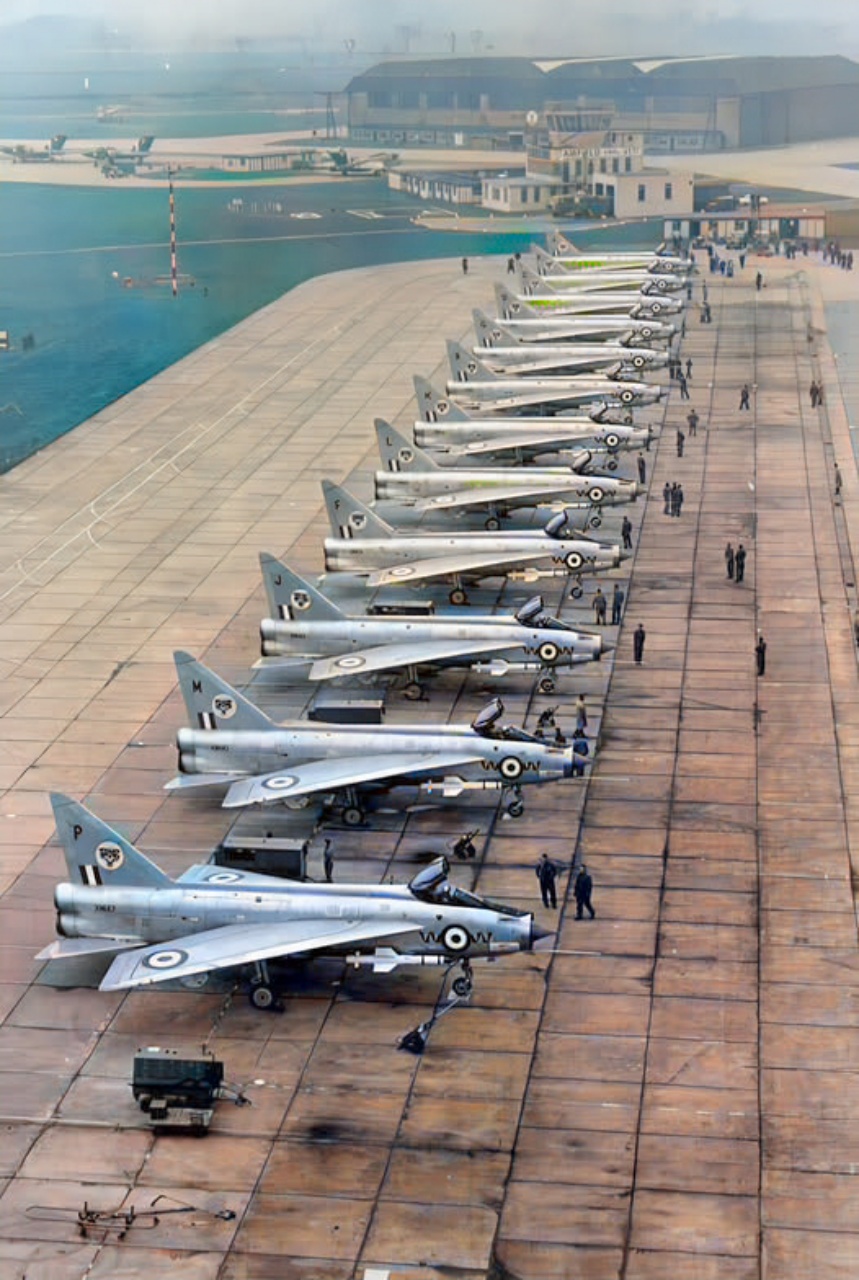

English Electric Lightning, are three words that sit so beautifully together.©BAE Systems
For many, a heady nostalgia is attached to the charged air of skies ripped apart the riveted lunacy of this devilishly fast and brutally handsome Cold War interceptor. The Lightning was quite mad: a greedy machine set on drinking fuel and turning it into speed.
Unlike any other operational fighter, its two Avon engines were staggered and stacked one on top of the other, making it stand monstrously tall on the ground. Here are ten mind-bending features of the English Electric Lightning:
10. The engines
The Lightning was extremely powerful, thanks to its two Rolls-Royce Avon turbojets. The Avon was the first axial flow jet engine created and manufactured by Rolls-Royce, and was one of the most influential of Cold War engines. The Lightning used the Avon Series 300, which were afterburning (known as reheat in the UK) variants.
The Lightning entered service in 1960, with more than twice the thrust of the Hawker Hunter that preceded it, and it was more than twice as fast. Even the Mach 2 capable French Mirage III that entered service a year later had around half the thrust of the Lightning; the British interceptor was a massively overpowered beast of an aeroplane.

9: Overwing stores
The Lightning’s fuselage is essentially a giant propulsion system and does not leave room to contain such fripperies as the main undercarriage. This meant that the undercarriage folded into the wing, much in the same way as the Spitfire. So, with most of the wing busy housing the undercarriage, where to hang very large stores such as extra external fuel tanks?
The chief air-to-air weapons – the two heat-seeking missiles Red Top and Firestreak – were carried on two cheek-mounted pylons at the bottom of the fuselage. The unusual solution was that fuel, and even weapons, could be carried above the wing. Export customers were even offered the alarming option of pods containing explosive rockets in the front section and jet fuel in the rear!

But there are sound reasons why most combat aircraft do not usually carry stores atop the wings (with the exception of the Jaguar fighter-bomber). Loading and unloading the stores is one issue, the above wing location being both hard and long-winded to access for groundcrews. For overwing fuel tanks, safe separation would be an issue, particularly for empty tanks.
On the other hand, the overwing location is not a bad option for self-defence of a strike aircraft, especially with modern all-aspect high off-boresight missile like ASRAAM. Australia successfully shot down a target that was 140 deg off-boresight; over-wing may be a better option for such a missile than a wingtip launcher, where vibration could be an issue. India’s Jaguars carry ASRAAM above the wing for self-defence.
8: Ceiling
In the 1960s, Britain’s Royal Air Force had two English Electric aircraft that excelled at high altitudes: the Canberra and the Lightning. Whereas the Canberra’s high altitude offered it a degree of protection against fighters and surface-to-air weapons, the Lightning’s high ceiling was an offensive asset, allowing it to meet almost any potential adversary at height or from a position of altitude advantage.
The US’s U-2 reconnaissance aircraft was famous for its ultra-high-altitude performance, allowing it to operate with relative impunity over or close to hostile airspace. So, it was something of a shock to a U-2 crew when they were intercepted by a friendly Lightning crew at an altitude exceeding 65,000 feet.
Unofficially, the Lightning has gone far higher, with reports of aircraft reaching an astonishing 88,000 feet (normally fighter aircraft are limited to 50,000 feet). At such extreme heights, air is extremely thin, and the aircraft are operating at their very limit, meaning the difference between maximum possible and stalling speed becomes dangerously small.
With its extreme performance and limited endurance, the Lightning, like the Messerschmitt Me 163 Komet of the second world war, were akin to crewed surface-to-air-missiles. However, unlike a missile, a Lightning could identify an unidentified or intruding aircraft in peacetime, and escort it away from British airspace, and it could be reused.

7: Size
Walking into a hangar and seeing a Lightning for the first time leaves the mouth of the observer the shape of the Lightning’s intake, so overwhelming and unexpected is the size of the aircraft. It stands a massive 19 ft 7 in or 5.97 metres tall.
To put this into perspective, the de Havilland Vampire, an RAF Cold War fighter on the other end of the size spectrum, was 8 ft 10 in (2.69 m) in height. The Lightning F.Mk 6 weighed up to 45,750lb (20,752kg).
It is over eight and half times the weight of the Supermarine Spitfire prototype K5054. Less than 22 years separated the service entry of the Spitfire and the Lightning; even more amazingly, the last Spitfires retired from the RAF a mere six years before the Lightning appeared!
It was even taller than today’s Eurofighter Typhoon (which is 17 ft 4 in or 5.28 metres high); it was even a smidgeon taller than the Tornado, an aircraft famous for its massive fin; the Tornado is 19 ft 6 in (5.95) metres tall. When we asked the former Lightning pilot Ian Black his first impressions, he first thought, “Very big, it sat high off the ground, unlike the Hawk.”
6: Gloriously over-powered
Key to the Lightning being such a pilot’s aeroplane, and such a delight to fly was its massive amount of engine power. Though the Lightning may have been criticised for its small weapons load, primitive systems or small range, it was never considered weedy. It was enormously powerful.
One of the Lightning’s most popular ‘party tricks’ was a near-vertical climb just after take-off, made possible by those powerful engines. The name ‘Lightning’ was an appropriate name for this swift machine
The thrust-to-weight ratio of an aircraft is key to how spritely the aircraft is, and a vital factor in how fast an aircraft will climb. The Lightning was designed to have the highest possible climb rate, largely thanks to the generous thrust-to-weight ratio.
The Lightning’s thrust-to-weight ratio approached unity (one to one) at lighter weights, which, though normal for fighters in 2024, was extremely unusual in 1960. Another fighter of the period with a high power-to-weight ratio was the Soviet Mikoyan MiG-19.
5: Range
The Lightning’s biggest failing was its extremely limited range, due its extremely thirsty Rolls-Royce Avon turbojet engines and lack of fuel capacity. The Lightning’s fuselage was a very clever design, offering the drag of a single-engined design with the power of a twin, but with the volume of the ducting and engines, there was little room left for fuel.
But its thirst for fuel was a problem – even the 1200 gallons of jet fuel was insufficient. At tactical speeds, the Lightning burned 20 gallons a minute; with a full afterburner selected, consumption leapt up to 200 gallons a minute. Fuel was stored wherever possible in the design, including in the flaps.
Though the ability of some Lightning variants to air-refuel from large tanker aircraft like the VC10 and Victor helped a great deal, the Lightning’s ‘short legs’ remained a severe limitation even in later improved variants. Despite this No.74 Squadron deployed from Scotland to Singapore using inflight refuelling, the longer-legged F.Mk 6 model and three stops on the way.
The first Lightning had an extremely low radius of action of only 150 miles, though this was improved by adding a ventral fuel tank in the F.Mk 6 (and F. Mk 2A). The Lightning’s replacement, the Tornado ADV, was almost an ‘Anti-Lightning’, having an extremely long range and a far slower climb rate.
4: Intake & radar
Feeding the greedy Avon engines required a mass of air slowed down sufficiently for the engines to accept it. Most of the Lightning’s internal volume was devoted to the supply of such air to the vertically stacked staggered engines. Nose intakes were popular in the 1950s, but compared to alternative locations, it meant a lot of internal volume was lost to propulsion.
Other aircraft that adopted the Lightning’s style of nose intake included the Soviet Mikoyan-Gurevich MiG-21 (NATO codename ‘Fishbed) and the Sukhoi ‘Fitter’ series (as well as a cancelled MiG fighter prototype of extreme speed). In the 1960s, fighter designs moved to shoulder or chin-mounted intakes.
The cone in the Lightning’s nose slows down supersonic air by creating a shock wave. The centre body directs the flow of air. It also contains the Lightning’s AI.23 radar. The Ferranti AIRPASS was a British aircraft interception radar and fire-control radar system.
The radar’s development was very successful (the later Tornado ADV experienced a nightmare for its Foxhunter radar). The Lightning was operating with the Royal Air Force until the 1980s, at which time the radar was utterly obsolete with a detection range around a quarter of the best fighter radars.
3: Speed
Just seven years before the English Electric began work on what became the Lightning, the RAF biplane Gloster Gladiator had been in frontline service with a top speed of 257mph; the English Electric Lightning was capable of around 1500 mph (2414 km/h) or Mach 2.3 (though there is some debate about the exact speed).
The Lightning took the Royal Air Force into the supersonic age. It had amazing acceleration, being able to leap from Mach 1 to Mach 2 in 3.5 minutes. The Lightning could reach an altitude of 40,000 feet from brakes-off in 3.5 minutes.
‘Supercruise’ is a 21st buzzword for the new generation of fighters like the F-22 and Typhoon that can reach and sustain supersonic speed without recourse to afterburner. The Lightning exceeded the speed of sound without afterburner (reheat) from the 1950s onwards, and it could do it at all altitudes.
In 1985, an RAF Lightning intercepted a Concorde and treated the Concorde aircrew to the novel experience of being overtaken! Key to the Lightning’s high speed was the wing sweep of 60 degrees, and construction from materials able to withstand the high surface temperatures of such high speed.

2: Double-stack engines
The strangest thing about the Lightning is its engine placement. Nearly every other twin-engined jet aircraft that has its engines within the fuselage has them mounted side-by-side. So why did the Lightning opt for a double-decker arrangement with one engine above the other?
The engine placement is the result of ‘Packaging’. Up front, you have the pilot, cockpit, intake and inlet duct. Down the back, two engines stacked, and staggered slightly to slightly reduce height. All of the above sits neatly in the profile established by the front of the aircraft.
A conventional twin (think Phantom) still has the radar, pilot and cockpit up front, but now has a pair of side intakes, intake ducts and engines, all side by side. So Lightning cross-section is a ‘portrait’ form with rounded corners; Phantom starts out that way, but after the intakes, it becomes ‘landscape’ with rounded corners plus a bump on top.
The end result was that Lightning is lighter and slenderer because the packaging is more efficient. It also may have lower wave drag because of a higher fineness ratio. The initial design requirement for the Lightning is as a point-defence Interceptor, so the climb-rate was maximised.
1: Climbs like a homesick angel
The Lightning was designed to counter the threat of bombers attacking the United Kingdom. It was only intended as an interim aircraft as a new super interceptor (for requirement F.155) and advanced surface-to-air missiles (SAM) were expected soon. F.155 was to be a longer-ranged, more sophisticated, aeroplane equipped with a better radar and better air-to-air missiles.
When the F.155 was cancelled, thanks to a controversial 1957 White Paper by Duncan Sandys that believed crewed aircraft would be soon be made obsolete by missiles, the RAF were left with a pressing need for a Point Defence Interceptor able to counter a generation of Soviet bombers in development far faster than the Gloster Javelins then defending the UK.
Countering such threats before they could deliver their nuclear weapons left no margin for error; they had to be met and destroyed as quickly as possible. The Lightning needed an extremely high climb rate, and it certainly did. However, aircraft tasked with air defence on the central front did not require a high climb rate, as they were primarily expected to deal with low-flying intruders.
The Lightning was the fastest climbing fighter-interceptor of its generation and was not seriously challenged by any fighters until the F-15 Eagle entered service in 1976, sixteen years later than the Lightning. The RAF would have to wait until 2003 to have a faster climbing fi