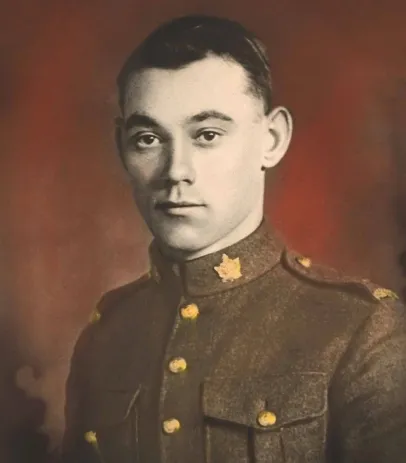
At 6 in the morning on November 11th, 1918, soldiers began to learn that the First World War would end at 11am, but that fighting would continue until that time. The last Canadian to die would be a young Maritimer who was killed only two minutes before the guns went silent..
By the latter part of 1918, the war was very different from the image we have of an unmoving trench warfare that marked the first three years of the conflict. The Germans had broken through Allied lines that Spring, pushing hundreds of kilometres into France, but were now themselves being rapidly pushed back towards Germany.
By 1918, Canadians were also very different; no longer did they fight in isolated units divided among and placed amidst British armies like earlier in the war — now they were working together as the 100,000-strong Canadian Corps.
The Allied High Command had been planning for the war to drag on a whole other year, putting resources into planning a massive offensive for the Spring of 1919. But that changed with the campaign known as Canada’s Hundred Days.
The Canadian Corps had a fearsome reputation as elite shock troops, about which British Prime Minister David Lloyd George would write in his memoirs: “Whenever the Germans found the Canadian Corps coming into the line they prepared for the worst.”
Knowing this, the Canadian Corps was secretly moved to the Battle of Amiens early that August. On their first day in the battle, the Canadians dramatically broke through the German lines, pushing them back a remarkable 13km in a single day, in a war in which progress had for years been measured in meters.
After that, for the rest of Canada’s Hundred Days, the Canadian Corps were rapidly moved from battle to battle, breaking through German lines, then getting moved elsewhere to do it again.
These victories, while incredibly impressive, came at a harrowing cost. The Canadians suffered a staggering 45,835 dead, wounded, or missing during Canada’s Hundred Days.
The last casualty was George Lawrence Price.
George had been born and raised in Falmouth, in Kings County, Nova Scotia, the son of James and Anne Price. Like many Maritimers, he moved Out West for work, finding a job on a farm in Saskatchewan.
A couple of weeks before Christmas in 1917, the brown haired, brown eyed, 24-year-old would join the Canadian Army. He had arrived on the front in February.
At 4am on November 11th, two hours before the armistice was signed, George Price’s unit, the 28th Battalion, better known as The Nor’Westers, received orders to attack the Germans at the small Belgian village of Ville-sur-Haine, and break through to the larger city of Harvre.
At around 9am, a messenger caught up to George Price and four fellow Nor’Westers as they reached an old stone bridge on the river across from Ville-sur-Havre. The messenger brought news which must have seemed incredible; an armistice had been signed three hours before, and that the war would end in only two more hours time.
In those final hours, confusion reigned. Many units on both sides decided to dispose of all of their ammunition and artillery shells by firing wildly and blindly in their enemies’ direction.
Everywhere was a chaotic uproar of gunfire and explosions in those final hours.
George and the four other Nor’Westers were in the midst of this, on an exposed embankment, next to an open river, sitting in the open and vulnerable to artillery and sniper fire. Though they had been told to stay put, they decided to cross the bridge into the town for safety.
As soon as they crossed the bridge, they spotted German soldiers with a heavy machine gun. They exchanged fire, and the Germans fled.
George Price spotted a flash of grey, the colour of German uniforms, disappearing into a house..
He gave chase, running through the back door.
Inside was a terrified Belgian family who indicated that the German soldier had fled through the open front door.
George ran towards the door. The Belgian family screamed at him to stop, but it was too late.
As soon as he stepped out the door, a single gunshot rang out.
From the house across the street, a young Belgian woman watched in horror as the soldier crumpled to the ground. The young woman was a nurse and risked her life by running across the street to help the fallen Canadian.
The Belgian family rushed outside and, with the young nurse’s help, dragged the wounded Canadian to relative safety into their home.
It was to no avail; he had been shot through the heart.
George Price died at the age of 25 on the floor of a stranger’s house far away from his home, surrounded by people speaking a language he could not understand.
The time was 10:58.
Two minutes later, the guns went silent in Europe for the first time in four years.
George Price was the last soldier from the Commonwealth to die in the First World War.
As his four comrades picked up his body, a tiny flower made out of velvet fell out of his pocket.
It was the flower of a maple tree, and it was stained with George’s blood.
George Price was one of 59,544 Canadians to die in that war.
The city of Harvre grew and changed in the decades after; the stone bridge was torn down, the canal was widened, and the house George had died in was demolished.
A walking bridge was built across Havre’s canal in 1991, and it was decided that the brand new bridge’s name would be decided by its citizens in a referendum.
73 years after the young Canadian died so far from home, the public of that foreign land he had fought in voted to name their bridge “The George Price Memorial Bridge.”
George Price has not been forgotten by the people of Havre…
In the main lobby of Harvre’s George Price Elementary School, there is a glass case containing a maple tree’s flower made of velvet, stained with blood.
The words beneath it read: “At the ultimate moment when peace was signed, you fell for us, the last victim of a sad conflict. Thank you, George Price!”