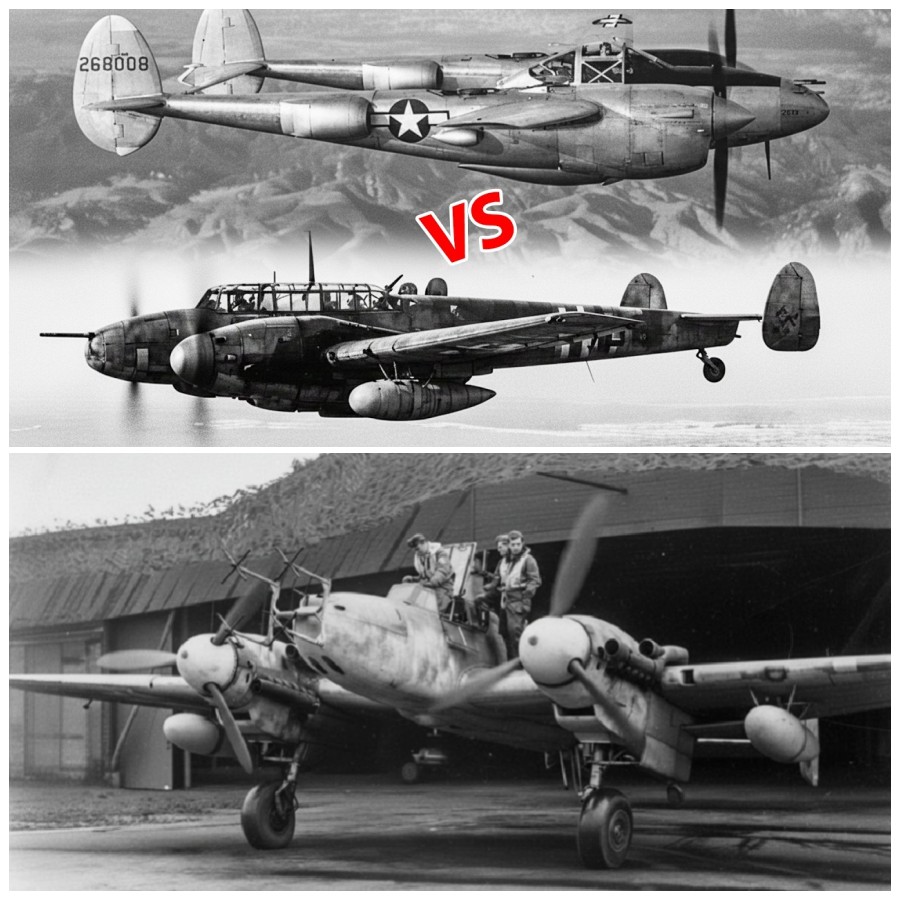
In the opening years of the Second World War, it was the embodiment of a terrifying new concept in air power. The Zer Sturer, the destroyer, the Messer Schmidt BF110. It was not a nimble dog fighter. It was a heavyweight brawler, a twin engine beast armed with a devastating battery of forward-firing cannons and machine guns.
The head of the Luftwaffe, Herman Guring, believed his Xer squadrons would sweep the skies clear of enemy fighters, blasting through any opposition with sheer, overwhelming firepower. For a time, against the unprepared air forces of Poland and France, he was right. The BF-110 was a predator, but its reign would be brutally short.

Across the Atlantic, America’s answer to the twin engine fighter was taking shape. And it was a radical departure from anything the world had ever seen. The Lockheed P38 Lightning. It was fast, it was heavily armed, and its bizarre twin boom design gave it performance characteristics that baffled its enemies.
The Germans gave it a memorable nickname, Dear Gobble Schwan Tyel. The forktailed devil. This is the story of two completely different approaches to the twin engine fighter and how America’s radical innovator hunted Germany’s heavyweight brawler into extinction. The BF-110 was a weapon born of a specific aggressive and ultimately flawed doctrine.
In the 1930s, the Luftwaffe under the influence of Herman Guring developed a concept for a comforter stirrer, a battle destroyer. This was envisioned as a long range, heavily armed aircraft that could perform multiple roles, escorting bombers deep into enemy territory, clearing a path through defending fighters, and even acting as a fast bomber itself.
The BF-110 was designed around this mission. It was a large three-man aircraft powered by two powerful liquid cooled Daimler Benz DB601 engines. Its key feature was its armament. Unlike single engine fighters that had to synchronize guns to fire through a propeller, the BF110 packed a devastating punch right in its nose.
on early models, two 20mm MGFF cannons and four 7.92 mm machine guns. This concentration of firepower could shred any aircraft of the 1930s. It also had a rear gunner for defense, a feature thought to make it invulnerable to attacks from behind. During the invasions of Poland, Norway, and France against smaller, older air forces, the BF-110 performed its role with ruthless efficiency, cementing the myth of the invincible zer.
The P38 Lightning was the result of a completely different and far more specific military requirement. In 1937, the US Army Air Corps issued a daunting challenge. They wanted a high altitude interceptor, a bomber destroyer of their own, capable of reaching 20,000 ft in just 6 minutes and flying at a top speed of over 360 mph.
The task fell to a young, brilliant engineer at Lockheed named Clarence Kelly Johnson. To meet the incredible performance demands, Johnson and his team at the Skunk Works produced a design that was unlike anything seen before. The twin boom layout was a radical but brilliant solution to several engineering problems.
It allowed for two powerful but crucially turbo supercharged Allison V1710 engines. These turbochargers, essentially air compressors driven by engine exhaust, allowed the P38 to maintain its power at the thin air of high altitudes, a realm where most other fighters struggled. The design also provided a stable central platform for an even more concentrated battery of guns than the BF-10, 120 mm Hispano cannon, and 4.
50 50 caliber machine guns, all firing dead ahead. The counterrotating propellers eliminated engine torque, making it an incredibly stable gun platform and easy to fly for a novice. It was fast. It was futuristic. And when it finally arrived in the European theater, German pilots had never seen anything like it. The primary advantage of a twin engine fighter is the ability to carry a massive armament.
And the late war BF-110G models were devastatingly armed. A single burst of 30 mm cannon shells could, as documented in German combat reports, tear the wing off a B17. Some were even fitted with massive 37 mm underwing cannons. This was a true bomberkilling payload. However, this firepower spread across the nose could be difficult to converge accurately at long range.
The P38’s armament was a masterpiece of concentration. The P38 did not need to worry about convergence. The P38 fired a dense laser-like stream of projectiles that was accurate out to 1,000 yard. This gave it a massive advantage in accuracy and effective range. While the BF-110 carried a heavier punch, the P38’s concentrated, accurate, and longer ranged firepower made it the more effective and lethal gun platform.
For firepower, the victory goes to the Lightning. This is the category where the P38 reveals its genius. It was one of the only fighters of the war to be equipped with a sophisticated turbo supercharger for each engine. Its operational ceiling was nearly 44,000 ft, and it performed brilliantly in the thin cold air above 25,000 ft where bombers flew.
The BF-110’s Dameler Benz engines were powerful, but they used a standard mechanically driven supercharger. its performance would drop off dramatically in the thin air where the P38 was just hitting its stride. This meant that when BF-110s were sent up to attack high-flying American bomber formations, they were often fighting at the absolute limit of their performance.
The P38 was purpose-built for high-altitude combat, and its advanced technology was simply unbeatable. In the high altitude arena, the P38 Lightning achieves total and absolute victory. This is the traditional Achilles heel of any twin engine fighter. Both were susceptible to being outturned. The BF110’s weakness was brutally exposed during the Battle of Britain.
When faced with agile spitfires and hurricanes, the Zerers were slaughtered. Their slow rate of roll and wide turning circle made them easy targets. The destroyer had become protected. This single catastrophic failure of the Zerto doctrine shaped the rest of the BF10’s service life. The P38, while also not a great turner, had several advantages.
It had an excellent rate of climb and a phenomenal dive speed. But its most surprising feature was its excellent maneuverability for its size thanks to its fowler flaps. In the Pacific, P38 pilots like America’s ace of aces Richard Bong regularly engaged in dog fights with the famously agile Japanese Zero and one. While it was still vulnerable to the best single engine fighters in Europe, it was a far more capable dog fighter than its German counterpart.
While neither could outturn a Spitfire, the P38 was a far more capable and agile air combat machine. For maneuverability, the Lightning takes the win. Here, the P38’s brilliant design shows its true worth. It was a high alitude escort, a dive bomber, a ground attack platform, and stripped of its guns and fitted with cameras, it became the most important photo reconnaissance aircraft in the US arsenal.
It was also famously tough. Its twin engine design was a massive advantage in survivability. Hundreds of P38 pilots are documented to have returned safely to base after losing an engine to enemy fire. It was the only American fighter in production at the start of the war that was still in production at the end. The BF110, having failed in its primary role as a daylight destroyer, found a second brilliant career as a night fighter.
Its large airframe was a perfect platform for the bulky early airborne radar systems and its heavy armament was ideal for shooting down lumbering British heavy bombers. In this role, German aces like Hines Wolfgang Schnofer became legends. However, this was a highly specialized defensive role. The BF-110 had effectively been relegated to a single mission, while the P38 was excelling at a dozen.
While the BF-110 found a deadly niche, the P38 was a true multi-roll weapon system that could perform almost any mission asked of it. For versatility and survivability, the Lightning wins. So, which was the superior twin engine fighter? The Messor Schmidt BF110 was a weapon born of a bold but flawed idea.
The Zertoa concept was a dead end, a tactical miscalculation that was brutally exposed in the Battle of Britain. While the aircraft found a second life as a highly effective specialist night fighter as a daytime heavy fighter, it was a failure. The Lockheed P38 Lightning was a generational leap forward. It was a machine that proved a twin engine aircraft could dogfight with single engine fighters and win.
It was a strategically vital weapon that filled the crucial long range escort gap, served as a deadly ground attack platform, and was the eyes of the Allied Army. While the BF-110 was a specialist that was forced into a defensive role, the P38 was the multi-roll offensive weapon that helped win the war.