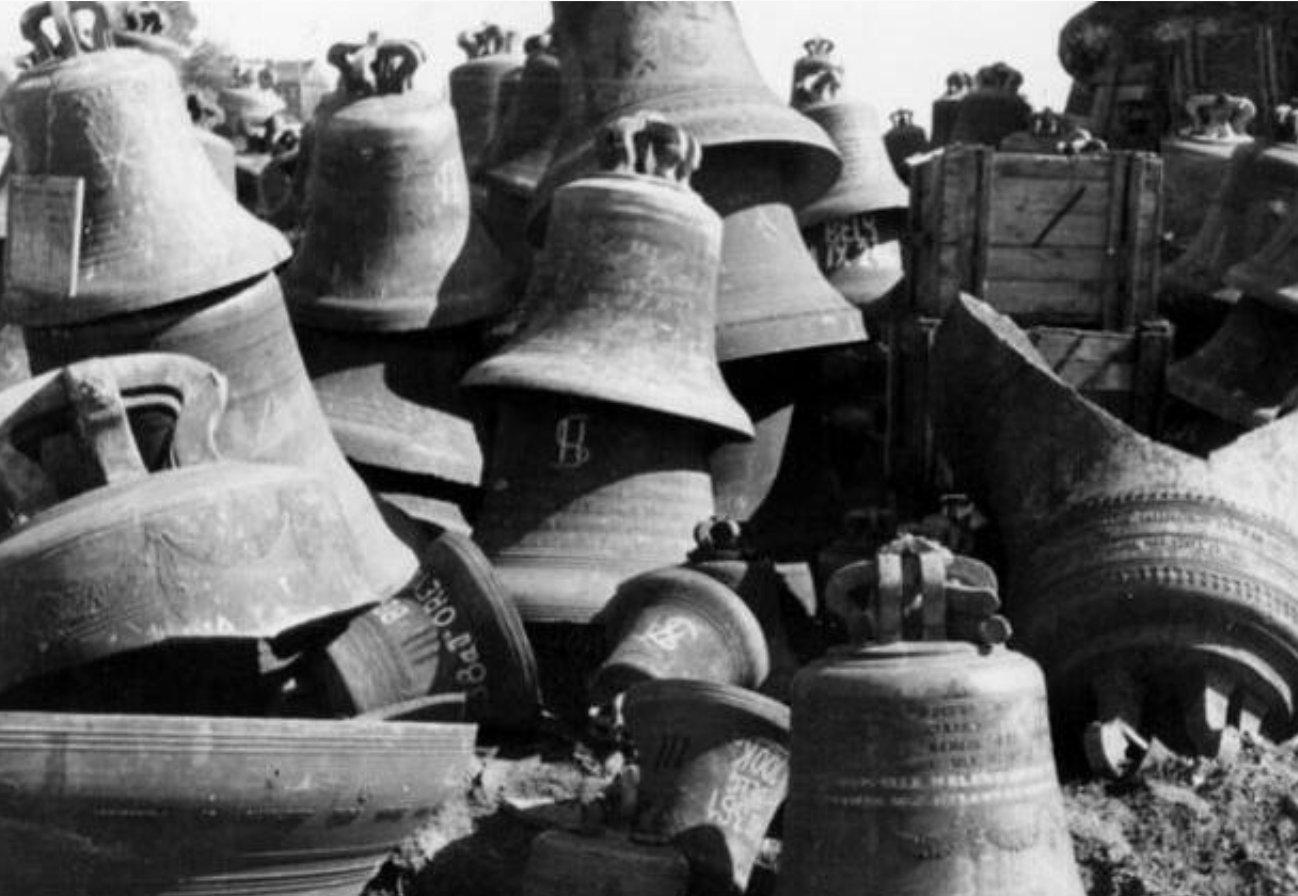
For centuries, the joyful pealing of church bells was the heartbeat of European life. The bells marked holidays, called parishioners to worship, and rang at times of celebration. But during World War II, a chilling silence fell across the continent when Hitler’s troops began confiscating the bells to melt them down for armaments. During the war, Germany stole some 175,000 church bells. Still others were removed and hidden to prevent them from being looted. Following the war, extensive efforts were made to reunite surviving bells with their original homes. That effort continues to this day, with buried bells uncovered as recently as 2021.
Starting as early as 1939 and escalating dramatically, Nazi troops began systematically confiscating church bells. News reports of stolen bells began circulating in the papers in 1941, following the U.S. entry into the war. The Nazis divided the looted bells into four groups – categories A through D. Category A bells were the newest and the first to face the furnace. Category D bells, which were as old as 200 years, carried the most historical value.
The bells were made of bronze and once smelted, were incorporated into the German armament industry. Religious and political leaders protested vehemently, citing the Hague Convention, but their pleas were met with cold disregard.

When bells were confiscated, they were shipped to German collecting points called Glockenfriedhöfe, or bell cemeteries, to await the smelting process. When the war ended, many plundered bells were found still piled up in heaps. Thus began the work of the U.S. military, including the Monuments, Fine Arts, and Archives Division, where the “Monuments Men” started the process of identifying and returning the beloved bells.
A few days before Christmas in 1943, Nazi soldiers confiscated bells from the church in the French city of Mittersheim. The bells were taken to the nearby town of Fénétrange, where German soldiers planned to ship them back to Germany. For some unknown reason, the bells were never transported and remained at the station until 1944.
When troops from the U.S. Fourth Armored Division liberated Fénétrange, they sent the bells back to Mittersheim just before Christmas in 1944. Several days later, the mayor of Mittersheim and two village pastors sent a letter of thanks to the general of the division. They wrote:
“For all of us, Catholic, Protestant, it is the most beautiful Christmas gift imaginable. This Christmas, we shall again hear the chimes which we missed for so long a time, and which, thanks to the 4th American Armored Division under your command, have this day been returned to us. Please accept as the general of the division, the thanks of a grateful community.”
Decades after the war, communities whose beloved church bells were hidden from the Nazis are still finding buried treasure. In 1994, a 450-pound bell was found buried in Emmaste, Estonia. In 2021, researchers near Krosno, Poland, uncovered a bell that had been buried for 80 years.