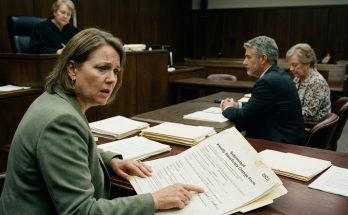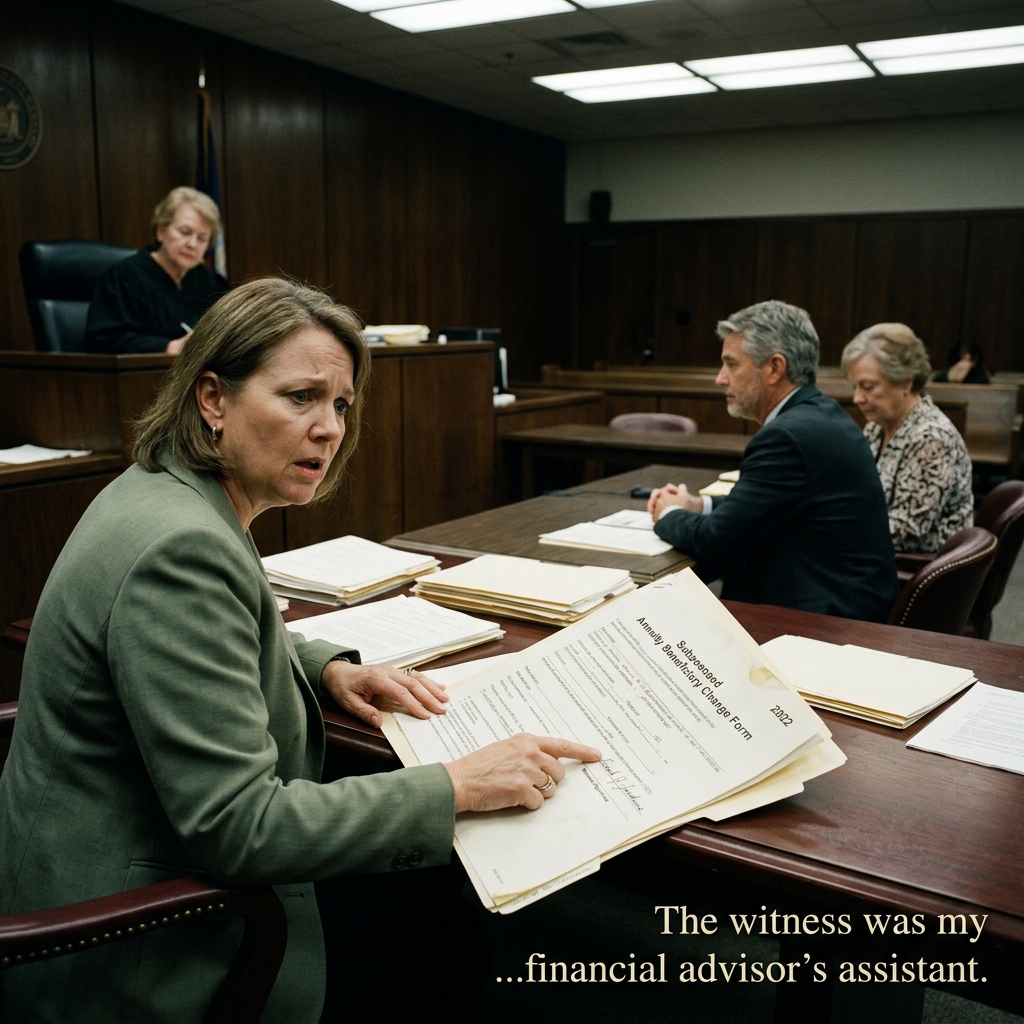
The witness was my husband. I stared at his name beneath the signature line until the letters stopped looking real. Daniel Reed. My husband of eighteen years. The man who had stood beside me at Dad’s funeral in January, holding my hand while I cried. The man who had heard Dad say every Christmas, “When I’m gone, that annuity is for the grandkids.” Dad bought it in 2008 with $300,000 from the sale of his construction company. He named me as the beneficiary, not because I needed the money, but because he wanted my children, Emma and Noah, to have college funds and a safe start in life. He repeated that promise so often it became part of our family tradition. After dessert, Dad would raise his glass, smile at the kids, and say, “Your future is already handled.” Daniel always smiled with the rest of us. Yet his signature was now on the document that gave every dollar to my stepmother, Debra Mitchell. I took a photograph of the page and sent it to him with one question: “Why is your name here?” He called immediately. “Where did you get that?” he asked. There was no confusion in his voice, only fear. “The judge ordered the originals,” I said. “You witnessed Dad changing the beneficiary two months after his Alzheimer’s diagnosis.” Daniel remained silent. I could hear traffic in the background and realized he had stepped outside his office. “It wasn’t what you think,” he finally said. “Then tell me what it was.” “Your father wanted Debra protected.” “My father thought it was 1997. He asked for my mother every day, and she died in 1988.” “He had moments of clarity.” “The advisor wrote that he was confused.” “But cooperative,” Daniel replied.
The word made my skin crawl. Cooperative. That was how the financial advisor had described a sick man who no longer knew what year it was. “Were you in the room?” I asked. “Yes.” “Was Debra there?” “Yes.” “Did Dad ask for you to witness it?” Daniel hesitated. “Debra called me.” My knees weakened, and I sat down at the kitchen table. “Why would my stepmother call my husband to help remove me as beneficiary?” “She said your father wanted to avoid family conflict.” “And you believed her?” “The advisor said everything was legal.” “Did you speak to Dad alone?” Silence again. “Daniel, did you ask him whether he understood what he was signing?” “He nodded.” “That isn’t an answer.” “Laura, let this go.” His voice hardened. “Debra cared for him every day. She deserves something.” “She received the house, his pension, his savings, and his life insurance. The annuity was for the children.” “You’re making this about money.” “No. You helped someone take advantage of my father while he was losing his mind.” Daniel exhaled sharply. “I have to go.” “Don’t come home until you’re ready to tell me the truth.” He hung up without answering. Twenty minutes later, Debra called. “You had no right to subpoena private records,” she snapped. “They stopped being private when you stole from an Alzheimer’s patient.” “Your father chose me.” “My father couldn’t remember his own wife was dead.” “He remembered enough to know you only visited when you wanted something.” Her cruelty was deliberate, but I refused to react. “Why was Daniel your witness?” I asked. The line went quiet. “Ask your husband.” “I did.” “Then perhaps you should wonder why he is protecting me.” Before I could respond, she ended the call. That evening, Daniel did not come home. He sent a message saying he was staying at a hotel until I “calmed down.” I did not answer. Instead, I searched our joint bank accounts. At first, nothing looked unusual. Then I noticed a savings account I had never seen before.
It had been opened in April 2022, six days after Dad’s beneficiary form was signed. The account was under Daniel’s name alone, but because it was linked to our mortgage, I could view the transaction history. Its opening deposit was $25,000. The transfer came from an account belonging to Debra Mitchell. I printed everything. The next morning, I took the records to my probate attorney, Maya Patel. She read the bank statement and looked up at me slowly. “This may show your husband was paid to witness the change.” The words made me nauseous. “Can we freeze the annuity?” I asked. “We can request an emergency injunction, but we need stronger evidence that your father lacked capacity or was subjected to undue influence.” Maya filed the motion that afternoon. The judge temporarily blocked Debra from collecting the $300,000 and ordered the financial advisor to turn over his full file, including emails, calendars, handwritten notes, security footage, and internal compliance reports. Three days later, two boxes arrived at Maya’s office. We spent hours sorting through account statements and duplicate forms. Near the bottom of the second box, I found an appointment worksheet dated June 14, 2022. Under “Persons Present,” the advisor had listed Dad, Debra, Daniel, and a fourth person whose name had been covered with black marker. Maya held the page toward the light and frowned. “This wasn’t professionally redacted,” she said. She scanned it, adjusted the contrast, and slowly revealed the hidden name beneath the ink. Dr. Samuel Hayes. Dad’s neurologist. I felt a rush of hope. If his doctor had been there, he could confirm Dad’s condition. But Maya’s expression remained troubled. “Why would a neurologist attend a financial meeting?” she asked.
We searched the rest of the box and found an envelope labeled “Medical Capacity Letter.” Inside was a typed statement from Dr. Hayes declaring that Dad was mentally competent to alter his estate. The letter was dated the morning of the beneficiary change. At the bottom was the doctor’s signature, but beside it, written faintly in pencil, were four words: “Prepared at Debra’s request.” Maya immediately called Dr. Hayes’s office. The receptionist placed us on hold, then returned sounding nervous. “Dr. Hayes retired unexpectedly in 2023,” she said. “Do you have a forwarding address?” Maya asked. “No, but his former nurse may know how to reach him.” Ten minutes later, the nurse called us from her private phone. When Maya explained why we were contacting her, the woman began to cry. “I told him not to sign that letter,” she whispered. “Your father failed every cognitive test that morning. He didn’t know his own name. Dr. Hayes said Debra would ruin him if he refused.” “Why?” I asked. The nurse lowered her voice. “Because Dr. Hayes wasn’t just your father’s doctor. He and Debra had been hiding something for years.” Before she could explain, a loud knock sounded on her end of the line. She gasped and whispered, “They found me.” Then the call went dead. Ten minutes later, Maya received an email from the nurse’s address containing one attachment: a photograph taken inside the advisor’s office on the day Dad signed the form. Dad sat slumped in a chair, staring blankly at the wall. Daniel stood behind him with one hand on his shoulder. Debra was holding the pen. But it was the fourth person in the corner who made my blood run cold, because it wasn’t Dr. Hayes. It was my seventeen-year-old daughter, Emma—and she had never told me she was there. Type ‘Next’ if you want next part.
 Follow Page For More Real Life Stories.