No one came to my graduation. That was the sentence I kept trying not to say out loud, because once it became words, it would stop being a private ache and become something solid in the room with me The ceremony hall was all hard light and polished floor, the kind of brightness that made every smile look official and every absence look deliberate. Outside, the pavement was still wet from a passing shower, and people were coming in with damp hems, folded umbrellas, and cheeks pink from the wind. Inside, there were gowns rustling, programmes being folded and unfolded, phones lifted high above heads, and families leaning over one another as if love itself needed a better camera angle. Someone behind me had coffee in a cardboard cup, burnt and sweet, and the smell made me think of early shifts before school, of standing behind a counter at sixteen, trying not to yawn into the steam. I told myself not to look.
I told myself I knew better. Then the announcer called my name.
“Camila Elaine Reed, Master of Data Analytics.”
My feet moved, my hands tightened around the empty diploma folder, and my face arranged itself into the smile I had practised for years.
Before I could stop myself, I looked towards the family section.
There were mothers with flowers in their laps.
There were fathers already standing, clapping before their child had even crossed the stage.
There were little brothers waving both hands, grandparents crying openly, partners mouthing proud of you across a crowded hall.
There was no one there for me.
Not my mother.
Not my father.
Not Avery.
Not even a coat thrown across a seat to suggest they were late.
The space where my family should have been was simply empty.
I kept smiling because the photographer had turned towards me, and because I had been trained not to make my disappointment inconvenient.
The flash went off.
For one sharp second, I wondered if the picture would catch the exact moment my smile stopped meaning anything.
By the time I stepped down from the stage, applause had already moved on to the next name.
That was the cruelest part of public hurt.
Everyone else’s life kept going at its proper speed.
People hugged in the aisles.
A woman near me was laughing and crying at once while her mother adjusted the collar of her gown.
A man held a bunch of supermarket flowers as if they were priceless.
A toddler on someone’s hip kept shouting, “That’s my auntie,” even though the auntie had already disappeared into the crowd.
I stood beside a family I did not know while they took pictures, and when one of them accidentally pulled me into the edge of a photograph, I stepped away and said, “Sorry,” because apparently I was still apologising for taking up space.
It was not as if this was the first time.
My parents had missed my undergraduate graduation as well.
Dad’s back was playing up.
Mum said Avery had a rehearsal she absolutely could not miss.
Before that, there had been prize evenings, scholarship dinners, parents’ weekends, and school assemblies where other children scanned the room and found their people.
I learned not to scan for long.
There was always a reason.
There was always a complication.
And somehow, every complication seemed to have Avery’s name attached to it.
Avery was younger, brighter, louder, and easier for my mother to worry about.
She had lessons, rehearsals, dresses, trips, shoes, parties, and sudden tears that rearranged the whole household.
I had jobs.
I had grades.
I had a habit of saying, “It’s all right,” so often that my family began to treat it as a permanent fact.
At sixteen, I wore a coffee shop apron before sunrise and tried to scrub the smell of espresso from my hands before first lesson.
At nineteen, I sent money home from my campus job while telling my flatmates I was not hungry because I had already eaten.
At twenty-four, I was managing rent, tuition, insurance, repairs, and my mother’s little emergencies like they were all direct debits with my name printed on them.
Mum never shouted when she asked.
That would have made it easier to resent her.
She wrote soft messages.
“Thank you, sweetheart.”
“You always come through.”
“We’re so proud of you.”
Then came the request underneath.
Avery needed music lessons.
Avery had a trip.
Avery felt left out because everyone else had a nicer dress.
The heating bill was worse than expected.
Dad could not pick up extra hours.
It would only be this once.
It was never only once.
For years, I believed that usefulness was a kind of place at the table.
I thought if I paid enough, helped enough, swallowed enough, then one day my mother would look at me and see a daughter instead of a safety net.
When I was accepted onto the master’s course, I carried the acceptance email around in my head for days before telling anyone.
It felt enormous.
It felt like proof.
I rang Mum that evening and told her I had got in.
There was a pause, then a pleased little sound.
“That’s lovely, Camila,” she said.
I waited.
Then she added, “Can you help Avery with her laptop this weekend?”
I said yes.
Of course I said yes.
That was the shape I had been poured into.
So when graduation came around, I tried to be sensible about my expectations.
I sent the details early.
I sent the time, the venue, the parking information, the reminder.
Mum replied with a thumbs up and a kiss.
Dad said he would see how his back was.
Avery did not reply at all.
Still, a part of me believed they might surprise me.
Hope is humiliating that way.
It keeps turning up at the door even after you have changed the locks in your mind.
After the ceremony, I walked back to my flat with the gown bag folded over one arm and rain starting again, light and needling.
I passed a red post box shining wet on the corner and a queue outside the little shop where people were buying milk, biscuits, and lottery tickets as if the world had not quietly split open for me.
My phone stayed silent.
No missed call.
No apology.
No photograph request.
No message saying, “How did it go?”
By the time I got home, my shoes were damp and my chest hurt from holding myself together.
I hung the gown by the door because I did not know what else to do with it.
The fabric brushed against my shoulder each time I passed, soft and accusing.
For three days, it stayed there.
For three days, I worked, washed mugs, answered emails, reheated leftovers, and tried to convince myself that being alone on a graduation day was not a verdict.
Then Tuesday evening came.
The flat was quiet in that particular way small rented places are quiet after rain, with the fridge humming, pipes settling, and tyres hissing on the road below.
I had made tea, but I had not drunk it.
The kettle had clicked off, the mug sat beside the sink, and the unopened dental estimate was still tucked inside a blue folder on the side.
At 8:16 p.m., my phone lit up.
Mum.
For half a second, my stomach lifted.
I hate admitting that.
Even after everything, even after the empty seats, some small foolish part of me thought perhaps she was going to say she was sorry.
Perhaps she had been ashamed and did not know how to start.
Perhaps she had finally seen the pictures online and understood what she had missed.
I opened the message.
I need £2,100 for your sister’s Sweet 16.
That was all.
No greeting.
No explanation.
No “How was graduation?”
No “I’m sorry.”
No “We’re proud of you.”
Just a number, a demand, and Avery’s name standing in the middle of it like a wall.
I stared at the screen until it dimmed.
The silence in the flat changed.
It was no longer peaceful.
It was waiting.
I opened my banking app because my body moved before my dignity could catch up.
£3,084.22.
I knew what every pound was supposed to do.
Rent was due in nine days.
My student loan payment was scheduled for the 15th.
The car needed brakes before it became more expensive than I could handle.
The dental estimate sat unopened because I had already seen enough figures that month.
I should have put the phone down.
I should have laughed.
I should have written, “No.”
Instead, my thumb hovered over the transfer button, and that tiny movement told me the truth more brutally than my mother ever had.
I was still trained.
I was still ready to rescue the person who had not bothered to sit in a chair for me.
It was not the request that broke me.
It was how close I came to agreeing.
Avery’s party had somehow become urgent.
My degree had somehow been optional.
My mother’s disappointment still had a hand around my throat.
I sat there with the phone glowing in my palm and felt the years stack up behind me.
The early shifts.
The missed meals.
The bank transfers.
The thank-you messages that were never quite thanks, only receipts with affection stuck on top.
The birthdays where I bought gifts and then helped pay for better gifts from them.
The little family jokes about how sensible Camila was.
The way Dad would say, “You know what your mum’s like,” as if that absolved him of ever standing between us.
The way Avery accepted everything as weather.
At 8:21 p.m., I entered £1.
Not £2,100.
Not £500 with an apology.
Not half because I felt guilty.
One pound.
In the note box, I typed one word.
Congrats.
I looked at it for longer than necessary.
Then I pressed send.
The confirmation appeared on the screen.
Sent.
Such a small word for something that felt like cutting a rope.
I sat very still.
There was no thunder.
No music.
No sudden rush of bravery.
Just the flat, the rain, the cold tea, and a quiet in me I did not recognise.
Boundaries do not always arrive as speeches.
Sometimes they arrive as one pound, sent without an apology.
After a while, I stood up.
My legs felt odd, as if I had been sitting for hours instead of minutes.
I walked to the narrow drawer by the front door where spare batteries, takeaway menus, old receipts, and one loose key had collected over time.
The spare key was wrapped in a faded paper tag.
Mum had insisted on having it.
“For emergencies,” she had said.
In my family, emergencies had a very flexible meaning.
She had used it to let herself in and borrow my blender.
She had used it to drop off Avery’s laundry because the machines in my building were better.
She had used it to stand in my kitchen, open my cupboards, and ask whether I really needed branded cereal when I was always claiming money was tight.
Once, she had come in while I was still at work and moved things around because, in her words, “Your flat looked sad.”
When I asked her not to, she looked hurt.
When I asked when she would pay me back for the last transfer, she called me selfish.
Trust does not always die in one grand betrayal.
Sometimes it is filed down by little permissions you never meant to give.
I held the key in my palm.
It looked harmless.
That made me angrier.
I dropped it into the bin.
Then I took it out again because keys can be copied, and because apparently my courage had practical limitations.
At 9:04 p.m., I rang a locksmith.
My voice shook when I gave my address.
At 9:17, the invoice came through by email.
I almost cancelled when I saw the cost.
Almost.
Then I looked at the gown by the door and thought of all those empty seats.
At 10:38, a man in a grey hoodie and muddy work boots arrived with a toolbox.
He was polite, tired, and completely uninterested in my family history.
That helped.
He removed the old cylinder, dropped screws into his palm, tested the new deadbolt twice, and gave me two fresh keys.
When the lock clicked into place, the sound was clean and blunt.
Final.
I paid him.
I closed the door.
I leaned my forehead against it.
For the first time in years, I did not feel rude for keeping people out.
That night, my phone buzzed four times.
I did not check it.
Then it rang.
I turned it face down on the bedside table and lay very still in the dark.
The habit of obedience does not leave quietly.
It paces.
It knocks.
It tells you that you are cruel, dramatic, ungrateful, difficult, selfish.
It speaks in the voices of the people who benefited from you never saying no.
I listened to it until I fell asleep.
In the morning, I woke before my alarm.
Sunlight came through the curtains in pale strips, the kind that made the little kitchen look softer than it was.
The world had not ended.
The door was still locked.
The new key was on the table beside my mug.
My phone was still face down.
I made coffee and stood barefoot on the cool floor while it brewed.
For a few minutes, nobody needed me.
For a few minutes, there was no request hanging over my head, no family crisis wearing Avery’s name, no sweet message with a bill hidden inside it.
Peace had a sound.
It sounded like the kettle settling and the road outside drying in the weak morning light.
I picked up my mug.
Then the knock came.
Firm.
Even.
Not a neighbour’s tap.
Not a delivery driver’s quick rap.
Not a friend trying to be funny.
This was the kind of knock that assumed it would be answered.
I froze with the mug halfway to my mouth.
My landlord always rang first.
My friends texted from downstairs because the entry buzzer was unreliable.
My mother would have used the key.
Except she could not.
The knock came again.
I put the mug down so carefully it barely made a sound.
For a second, I considered not answering.
Then I moved to the door and looked through the peephole.
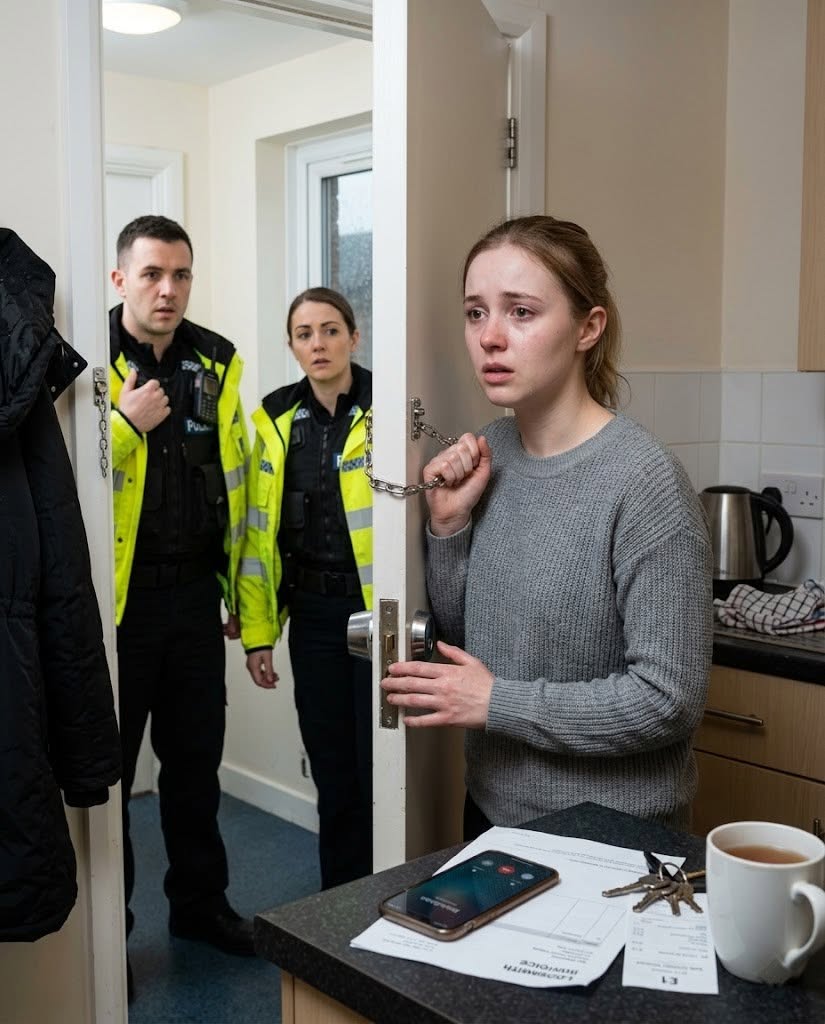
Two police officers stood in the hallway.
One older, one younger.
Both calm.
Both waiting.
The whole flat seemed to shrink around me.
“Miss Reed?” the older officer called.
My hand went to the chain before I opened the door.
The new lock turned smoothly.
I hated that my first thought was still relief.
I opened the door only as far as the chain allowed.
“Yes?”
The older officer held a small notepad.
The younger one looked past me into the flat, not aggressively, but carefully, the way people look when they have been told to check whether danger is hiding in plain sight.
“Camila Reed?”
“Yes.”
“We’ve received a call from your mother,” he said.
My fingers tightened on the door edge.
“She’s concerned for your welfare.”
For a moment, I genuinely did not understand.
Concerned for my welfare.
The phrase sounded official and kind and completely unreal.
My mother had not asked whether I got home safely from graduation.
She had not asked whether I had eaten, slept, cried, or celebrated.
She had not asked whether I could afford to live after sending her money for years.
But one changed lock and one pound later, she was concerned.
The younger officer glanced at my face.
“Are you all right, miss?”
There it was.
The question I had wanted from my family for years, arriving from a stranger in uniform after my mother had weaponised it.
I opened my mouth.
Nothing came out.
Behind me, my phone began to buzz on the kitchen counter.
Once.
Twice.
Again.
The sound filled the little flat.
All three of us looked towards it.
I could see the screen from where I stood, bright against the counter beside the cold tea, the locksmith invoice, and the new keys.
Mum.
Again.
Again.
Again.
The message preview lit up before fading.
Tell them you’re confused, Camila.
My skin went cold.
The older officer saw my face change.
The younger officer saw it too.
In that second, the whole scene rearranged itself.
The police at the door were not there because my mother loved me too much.
They were there because the old key no longer worked.
They were there because I had sent one pound instead of £2,100.
They were there because, for the first time in my life, I had not made myself useful.
I kept my hand on the chain.
The hallway smelled faintly of damp coats and someone’s fried breakfast from another flat.
The phone buzzed again.
Another message appeared, too fast for me to read fully.
The older officer’s voice softened.
“Miss Reed, would you like to explain what’s going on?”
I looked at the gown still hanging by the door.
I looked at the new lock.
I looked at the phone, glowing with instructions from a woman who had not come to watch me graduate but had found the time to call the police when I stopped paying.
And that was when I realised my mother had not sent help.
She had sent witnesses.