There is a kind of silence that tells you the truth before your brain can explain it.
Emily heard it the second she opened the door to her apartment.
The hallway behind her smelled like floor cleaner, old coffee, and someone’s takeout left too long near the trash chute.

The elevator gave a tired ding behind her, then closed its doors and carried on like nothing had happened.
Her key was still in the lock.
Her suitcase was still beside her leg.
But her home was gone.
Not damaged.
Not ransacked in the messy way people imagine when they picture a burglary.
Gone.
The living room was empty from wall to wall.
No couch.
No rug.
No television.
No little side table where she dropped her mail after work.
The floor had pale rectangles where furniture had sat for years, and when she took one step inside, the sound of her heels bounced back at her from bare walls.
Emily stood there in her travel cardigan, still carrying the stale chill of the airport on her clothes, and tried to make the room become familiar again.
It would not.
She had been gone seven days.
One work conference in Chicago.
One carry-on suitcase.
One week of hotel coffee, name tags, conference rooms, and the kind of networking smile that made her jaw ache by dinner.
When she left, the apartment had smelled like coffee beans and laundry detergent.
Her leather couch had been by the window.
Her espresso machine had been on the counter.
Her bed had been made, because she always made it before trips, mostly so she could come home to one small mercy.
Now the air smelled like dust.
She moved through the living room slowly.
There was nowhere to sit.
A bare hook stuck out of the wall where her framed print used to hang.
The windows had no curtains.
Even the little ceramic dish near the door, the one that held loose change and spare keys, was missing.
For a few seconds, Emily told herself she was in the wrong unit.
That was the kind of lie panic offers when the truth is too ridiculous to hold.
Then she saw the scratch near the kitchen doorway from the day she had dragged the bookshelf in alone.
It was her apartment.
Or what was left of it.
She went to the bedroom next.
Nothing waited for her there.
The bed was gone.
The dresser was gone.
The small lamp she had bought after her first promotion was gone.
The closet had been stripped of storage bins, winter blankets, extra hangers, even the cheap full-length mirror that had leaned against the wall since college.
On the carpet, dust had gathered around the places where furniture legs used to be.
It looked like a chalk outline of a life.
Emily walked into the kitchen because some part of her still believed the appliances had to be there.
The refrigerator was missing.
The washer was missing.
The espresso machine was missing.
The toaster, the kettle, the mixing bowls under the sink, the magnetic knife strip, the little stack of dish towels she bought every January at a clearance sale.
All gone.
She opened one cabinet.
Empty.
She opened another.
Empty.
The kitchen made a hollow sound when she moved, as if the room itself had been scooped clean.
Then she walked into the bathroom.
That was when her hands started shaking.
The shower curtain was gone.
Not just the expensive things.
Not just the things someone might sell.
The shower curtain.
Emily gripped the sink and looked at the bare rod above the tub.
A person had stood here and decided that even the plastic curtain was worth taking.
Her first thought was burglary.
She checked the lock.
No damage.
She checked the windows.
Closed.
No broken glass.
No pry marks.
No splintered frame.
Nothing forced.
Nothing random.
The place had not been robbed.
It had been emptied by someone who had permission to enter.
And that was when Ashley’s text came back to her.
“Can I stay at your apartment while you’re out of town? I swear I’ll take care of everything.”
Emily sat down on the floor because there was no chair left.
The floor was cold through her slacks.
She opened the message thread and read it again.
Ashley had sent it the Monday before Emily flew out.
At first, Emily had almost said no.
Her thumb had hovered over the screen.
She had even typed, “I don’t think that’s a good idea.”
Then Ashley had called.
She had sounded tired, soft, wounded.
“Em, I just need somewhere quiet to think,” Ashley had said. “I’m not asking for money. I’m not asking you to fix anything. Just a few days.”
Those words had worked because they were aimed directly at Emily’s weakest place.
Not asking for money.
Not asking you to fix anything.
Ashley was three years younger, but somehow everyone treated her like a beautiful accident the family had to keep rescuing.
Emily was the responsible one.
That label had followed her since childhood like an unpaid bill.
When their mother’s washing machine broke, Emily was called.
When Ashley needed a ride, Emily was called.
When a deposit was due, when a phone bill bounced, when a crisis suddenly appeared on Friday afternoon, Emily was called.
If Emily hesitated, her mother made the same hurt little sound.
“Your sister is trying.”
Trying had covered a lot of ground in their family.
Ashley had tried yoga instruction.
Ashley had tried social media management.
Ashley had tried wellness retreats.
Ashley had tried luxury resale, which mostly meant buying expensive things on credit and praying someone else would pay more before the statement closed.
When Ashley failed, she was brave.
When Emily refused to fund the failure, she was cold.
Money can make people honest.
Not because it improves them.
Because it removes the costumes.
Two years earlier, Emily had co-signed Ashley’s boutique lease.
Ashley had cried at Emily’s kitchen counter, mascara under her eyes, a folder of printed projections spread out beside two coffee mugs.
“It’s my real start,” Ashley had said. “I just need one person to believe in me.”
Emily believed in documents more than tears, but she had also believed in the version of Ashley that existed only in family stories.
The bright little sister.
The dreamer.
The one who just needed support.
So Emily signed.
Four months later, the rent stopped.
Eight months after that, Emily was making payments to keep her own credit from being dragged through collection notices and court filings.
Ashley never apologized properly.
She cried.
Their mother asked Emily to let it go.
Emily paid.
After that, she promised herself Ashley would never touch her name again.
Then she gave her a key.
Sitting on the bare floor, Emily felt shame rise hot in her throat.
Not because Ashley had betrayed her.
Because some part of Emily had known better and still opened the door.
At 6:18 p.m., she took the first photo.
At 6:22, she started recording video.
She said the date out loud.
She filmed the living room, the bedroom, the kitchen, the empty bathroom rod.
She opened cabinets.
She opened closets.
She narrated every missing appliance and every empty wall.
Her job had taught her one useful habit: document before emotion takes over.
By 6:49, she had created a folder on her laptop called APARTMENT INVENTORY.
By 7:12, she had saved Ashley’s text message as a screenshot.
By 7:38, her mother had called twice.
Emily did not answer.
At 8:03 p.m., headlights swept across the bare living room wall.
Emily looked down through the window.
A glossy black coupe was pulling up at the curb.
The roof was down.
Ashley was driving.
She parked like she wanted the whole building to notice.
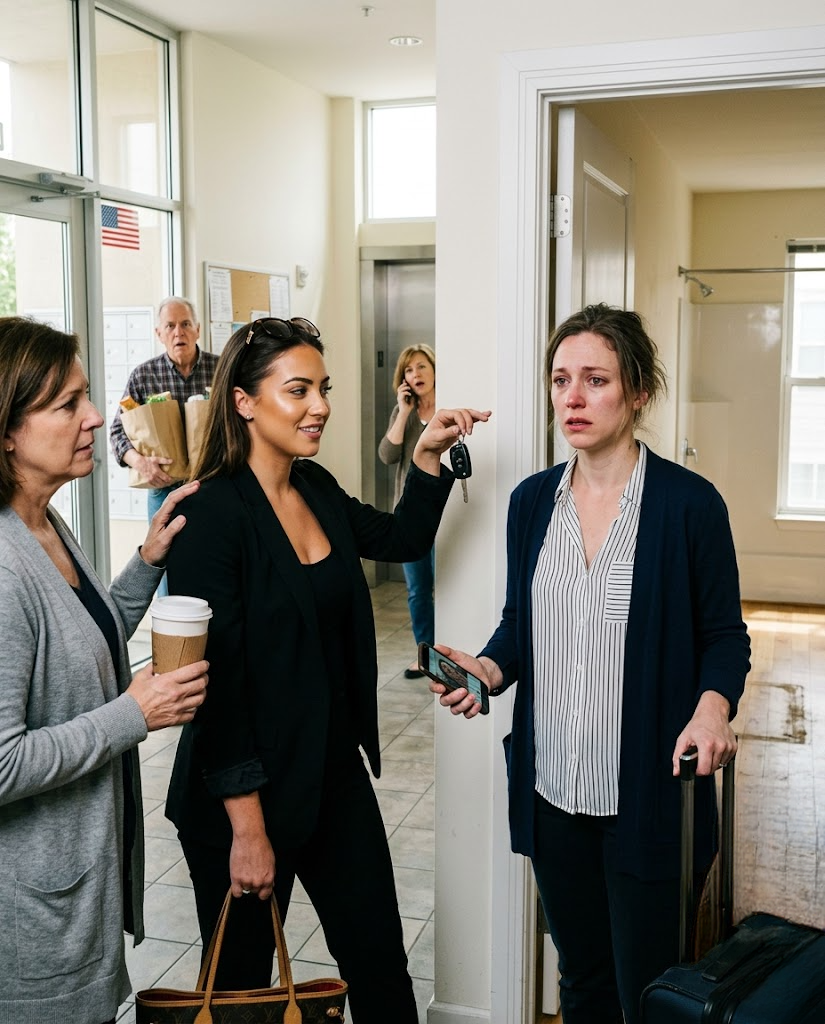
Then she climbed out wearing oversized sunglasses, shiny lipstick, and a black jacket too sharp for someone who had been crying about money a week earlier.
A designer-style bag hung from her wrist.
Emily’s mother got out of the passenger side holding a paper coffee cup.
Ashley looked up toward the building and smiled.
It was not a nervous smile.
It was the smile of someone who thought the story was already over.
Emily went downstairs before Ashley could buzz in.
The lobby smelled like mail paper, detergent, and the faint rubber scent from the elevator mat.
A small American flag decal stuck to the glass front door near the mailboxes, fluttering slightly whenever the air conditioner kicked on.
Mr. Keller from 3B came in carrying grocery bags and slowed when he saw Emily’s face.
A woman from upstairs stood by the elevator with her phone halfway to her ear.
Ashley swung the car keys around one finger.
“See?” she said. “I told you I was going to earn this car.”
Emily looked at the keys.
Then at the car.
Then at her mother.
“What did you do?”
Ashley rolled her eyes.
“Relax,” she said. “I did you a favor.”
Emily felt something in her go very still.
“Where is my furniture?”
Ashley made a small face, like the question was annoying.
“You were going to replace most of that stuff anyway.”
Emily’s mother stepped closer and put a hand on Ashley’s shoulder.
That gesture told Emily almost everything.
Her mother was not confused.
She was not shocked.
She was managing the scene.
“Your sister needed a chance,” her mother said. “And honestly, you were going to remodel anyway.”
Mr. Keller stopped pretending he was checking his mail.
The woman by the elevator lowered her phone.
Emily looked through the lobby door toward the empty apartment upstairs, as if the rooms could speak for themselves.
“My bed was part of the remodel?” she asked.
Ashley laughed once.
“Don’t start.”
That laugh did more damage than the empty rooms.
It told Emily that Ashley had expected anger, tears, maybe a long argument.
She had not expected evidence.
For one ugly second, Emily imagined snatching those keys and throwing them into the storm drain.
She imagined screaming until every neighbor knew that her sister had gutted a $320,000 apartment and turned up smiling beside the getaway prize.
She imagined her mother finally looking ashamed.
Then she let the picture pass.
Rage is satisfying for about ten seconds.
Paper lasts longer.
Emily said one word.
“Noted.”
Then she turned around and went back upstairs.
Behind her, Ashley called, “Emily, don’t be dramatic.”
Her mother added, “You’re going to regret making this ugly.”
Emily did not turn around.
The apartment was darker now because the lamps were gone.
Streetlight came in through uncovered windows and spread across the floor in pale yellow strips.
Emily sat on the kitchen floor because there was still no chair.
Her laptop rested on her suitcase.
Her phone kept lighting up.
Ashley.
Mom.
Ashley again.
Mom again.
At 11:54 p.m., her mother sent, “Please don’t ruin this for your sister.”
At 12:07 a.m., Ashley sent, “I can explain when you calm down.”
At 12:19, her mother wrote, “Family should not call police on family.”
Emily stared at that one for a long time.
Family, in her mother’s mouth, had always meant Emily’s obligation and Ashley’s escape route.
At 12:41 a.m., Emily found the pending transfer.
It was tied to the car purchase.
At 1:06 a.m., she opened the bank dispute form.
At 1:19, she froze the pending payment and downloaded the confirmation number.
At 1:27, she filed a police report for the missing property and uploaded the photos, videos, and Ashley’s original text asking to stay in the apartment.
She did not do it because she wanted to hurt Ashley.
She did it because she was finally done being useful.
The next morning, Emily called the dealership finance office.
She kept her voice calm.
She asked for copies of every document connected to the black coupe.
The receptionist put her on hold.
Seven minutes passed.
The hold music was bright and cheerful in a way that made the empty kitchen feel even stranger.
When the receptionist returned, her voice had changed.
“Ma’am,” she said carefully, “are you saying you did not authorize your income information to be used?”
Emily looked at the bare rectangle on the floor where her refrigerator had been.
“Repeat that,” she said.
The receptionist did not repeat it.
She transferred Emily to a finance manager.
His name was Mr. Dawson, and he sounded like a man who had already opened the file and wished he had not.
He confirmed that Emily’s name appeared on the credit application.
He confirmed that her income information had been entered.
He confirmed that her apartment had been listed as an asset.
He would not say much more without sending it through the proper review channel.
Emily thanked him.
Then she muted the phone and sat there with one hand over her mouth.
The car was not just bought with money from sold furniture.
Her name had been used.
Again.
After the boutique, after the lease, after the promises, after the tears.
Ashley had found a new way inside.
By the third day, Emily had moved from panic into precision.
She made a spreadsheet.
She listed each missing item, approximate value, purchase date if she had it, and whether she had a receipt.
She called her insurance company.
She updated the police report.
She emailed the apartment building office and requested access logs for the week she was gone.
She called her bank again.
She called the dealership again.
At 8:11 a.m. on Thursday, her phone woke her with 33 missed calls.
Ashley.
Mom.
Ashley.
Mom.
A voicemail from Ashley came through first.
Her voice was shrill with panic.
“You froze it? Are you insane? Do you know what you just did to me?”
Emily sat on the floor of her empty bedroom, still in sweatpants and an old T-shirt, staring at the dust outline where her bed used to be.
Another voicemail followed.
This one was from her mother.
“Emily, call me right now. This has gone too far.”
Emily almost laughed.
Not because it was funny.
Because the phrase had arrived late.
It had not gone too far when Ashley emptied the apartment.
It had not gone too far when a $320,000 home became a storage unit shell.
It had not gone too far when her name was printed on forms she had never signed.
It had gone too far when consequences became visible.
At 8:26 a.m., the email from Mr. Dawson arrived.
Subject: FRAUD REVIEW.
Emily opened it.
The attachments loaded slowly.
Credit application.
Income verification page.
Scanned signature.
The signature looked almost like hers.
Almost.
The y looped wrong.
The pressure was wrong.
The spacing between her first and last name was wrong.
Emily had signed enough contracts in her life to know her own hand.
This was imitation.
Bad imitation, but close enough for someone in a hurry.
Her phone rang again.
Ashley.
Emily answered on speaker.
“You need to call them back and say it was a misunderstanding,” Ashley said immediately.
No hello.
No apology.
Just command.
Emily stared at the forged signature.
“A misunderstanding?”
“You gave me permission to stay there,” Ashley said. “You knew I was trying to make moves. Don’t act like you didn’t know.”
Emily’s mother’s voice came from somewhere behind her.
“Emily, don’t be cruel. She was trying to build something for herself.”
Emily closed her eyes.
There it was again.
Trying.
The family word that turned theft into ambition and boundaries into betrayal.
“You used my income information,” Emily said.
Ashley went quiet for half a second.
Then she recovered.
“I didn’t think it would matter. You have great credit. You weren’t using it.”
Emily opened her eyes.
“You weren’t using it.”
That was the sentence that cut through everything.
Not the missing bed.
Not the shower curtain.
Not even the car.
Her sister had looked at the life Emily built and decided unused access was the same thing as permission.
Then a new email landed.
The apartment building office.
Subject: STORAGE ACCESS LOG.
Emily opened it while Ashley was still talking.
The document was a simple table.
Date.
Time.
Keycard.
Door.
Tuesday, 9:14 a.m.
Ashley’s keycard.
Storage hallway.
Tuesday, 9:16 a.m.
Linda Parker.
Storage hallway.
Emily read her mother’s name twice.
Then she read it again.
The air seemed to leave the room.
Her mother had not been a bystander.
Her mother had gone into the building with Ashley.
Emily scrolled down.
Tuesday, 10:02 a.m.
Ashley.
Service elevator.
Tuesday, 10:03 a.m.
Linda Parker.
Service elevator.
Wednesday, 4:31 p.m.
Ashley.
Storage hallway.
Wednesday, 4:33 p.m.
Linda Parker.
Storage hallway.
Emily looked at the phone.
“Mom,” she said.
The silence on the line changed shape.
It became heavy.
It became guilty.
Ashley whispered, “Mom, why would you let them send that?”
Emily did not need a confession after that.
She had the log.
She had the police report.
She had the finance documents.
She had the forged signature.
She had 33 missed calls proving panic arrived only after the payment froze.
Still, hearing Ashley blame their mother for getting caught did something final inside Emily.
“Here’s what happens next,” Emily said.
Her mother made a small sound.
“Emily, please.”
The word please had been useful to them for years.
Please help.
Please understand.
Please don’t make this hard.
Please be the person we can take from and still call family.
Emily looked around the empty room.
The apartment no longer looked like a loss.
It looked like evidence.
“I’m sending everything to the officer assigned to the report,” she said. “I’m sending the finance documents back to the dealership. I’m notifying my bank in writing. And if either of you contacts my employer, my building, or my bank again pretending to be me, I’m adding it to the file.”
Ashley started crying then.
Real crying, maybe.
Or practiced crying.
Emily had paid too much money learning not to tell the difference.
“You’re going to ruin my life,” Ashley said.
Emily held the phone steady.
“No,” she said. “I’m going to stop letting you spend mine.”
Her mother began to speak, then stopped.
For once, there was no easy sentence waiting for her.
No “be kind.”
No “she needs you.”
No “you’re the older one.”
The words had all run into paper.
Later that afternoon, the finance manager called back.
He was careful, formal, and kinder than he had to be.
The dealership had flagged the application.
The pending funding was suspended.
The car could not stay in Ashley’s possession under the current file.
Emily asked what she needed to do.
He told her to submit a signed fraud affidavit.
He told her to contact the credit bureaus.
He told her to freeze her credit.
She wrote it all down.
At 3:42 p.m., she printed the affidavit at the building office.
At 4:05, she signed it in front of the notary at her bank.
At 4:38, she sent copies to the dealership, her bank, and the officer listed on the report.
At 5:11, Ashley called again.
Emily did not answer.
At 5:14, Ashley sent a text.
“You got what you wanted. They’re taking the car.”
Emily looked at the message while standing in the aisle of a discount home store, holding a cheap shower curtain in one hand.
For some reason, that was when she almost cried.
Not in the empty bedroom.
Not in the lobby.
Not when she saw the forged signature.
In front of a row of plastic shower hooks under fluorescent lights, because rebuilding a life can look embarrassingly small at first.
A curtain.
A folding chair.
An air mattress.
A lock change request.
A police report number folded in your wallet.
She bought the cheapest curtain they had.
White.
Plain.
Clean.
When she got home, Mr. Keller was by the mailboxes again.
He looked at the bag in her hand and hesitated.
Then he said, “I saw them moving things out Tuesday. I didn’t know you weren’t aware.”
Emily turned toward him.
He shifted the grocery bag to his other hand.
“There was a truck,” he said. “Not a big company truck. Just a rented one. Your sister was arguing with your mother about the couch.”
Emily felt tired all the way down to her bones.
“Would you be willing to say that to the officer?” she asked.
Mr. Keller nodded.
“Yes, ma’am.”
The next week did not bring one dramatic ending.
Real consequences rarely arrive like a movie scene.
They arrive in forms.
Emails.
Follow-up calls.
Receipts.
Recorded statements.
Credit alerts.
Insurance adjusters.
A locksmith who smells like cigarettes and says, “You’d be surprised how often family does this.”
Ashley did not return the furniture.
Some of it had already been sold.
Some of it had vanished into the kind of resale chain that eats proof quickly.
The dealership recovered the coupe.
Ashley sent Emily one long message blaming her for public humiliation, financial stress, anxiety, and their mother’s blood pressure.
Emily saved it to the folder.
She did not answer.
Her mother called from a different number two days later.
Emily answered because she wanted to hear what came after silence.
For once, Linda did not start with Ashley.
She started with a breath.
Then another.
Then she said, “I thought you would just replace things.”
Emily sat on her new folding chair beside the window.
The apartment still echoed, but less now.
A borrowed lamp glowed in the corner.
The white shower curtain hung in the bathroom.
“That’s the problem,” Emily said. “You didn’t think of them as my things. You thought of them as available.”
Her mother did not deny it.
That hurt more than a lie would have.
“I didn’t sign your name,” Linda said quietly.
“No,” Emily said. “You just opened doors.”
The line went quiet.
For years, Emily had believed the worst part of being the responsible daughter was paying.
It was not.
The worst part was realizing people had mistaken your reliability for consent.
Her mother cried then.
Emily listened, but she did not rush to comfort her.
That was new.
That was difficult.
That was necessary.
The police report moved slowly.
The insurance claim moved slower.
The credit bureau corrections took three rounds of letters.
Emily learned to attach documents in the right order.
Police report first.
Fraud affidavit second.
Dealership letter third.
Access log fourth.
Photos after that.
She became very good at writing, “Please confirm receipt.”
By the end of the month, she had a mattress again.
By the second month, a small couch.
By the third, a table from a neighbor who was moving out.
None of it matched.
All of it belonged to her.
Ashley tried once to come by the building.
The new lock stopped her.
The building manager called Emily from the lobby.
“Your sister is here,” he said. “She says she needs to pick up something.”
Emily looked around her apartment.
There was nothing of Ashley’s inside.
Not anymore.
“Tell her no,” Emily said.
Through the phone, she heard muffled arguing.
Then the manager came back on.
“She says your mother told her you would calm down by now.”
Emily smiled, but it did not feel warm.
“I did calm down,” she said. “That’s why the answer is still no.”
That was the part Ashley never understood.
Anger might have opened the door for one last fight.
Calm kept it shut.
Months later, Emily still had the folder.
APARTMENT INVENTORY.
Inside were photos of bare rooms, the forged signature, the access log, the fraud affidavit, the police report, and the first receipt for the cheap white shower curtain.
She kept that receipt on purpose.
Not because it was worth anything.
Because it reminded her of the day she stopped measuring family by how much she could endure.
People talk about betrayal like it is one big dramatic act.
Sometimes it is smaller and uglier than that.
A key copied.
A signature imitated.
A mother holding coffee in a lobby while your sister smiles beside a car she could never afford.
A shower curtain missing from a bathroom because someone believed even that was theirs to take.
Emily’s apartment became a home again, slowly.
There were still echoes in some rooms.
There were still empty walls.
But the silence changed.
It no longer sounded like something stolen.
It sounded like space.
And for the first time in her life, Emily did not fill that space with other people’s emergencies.