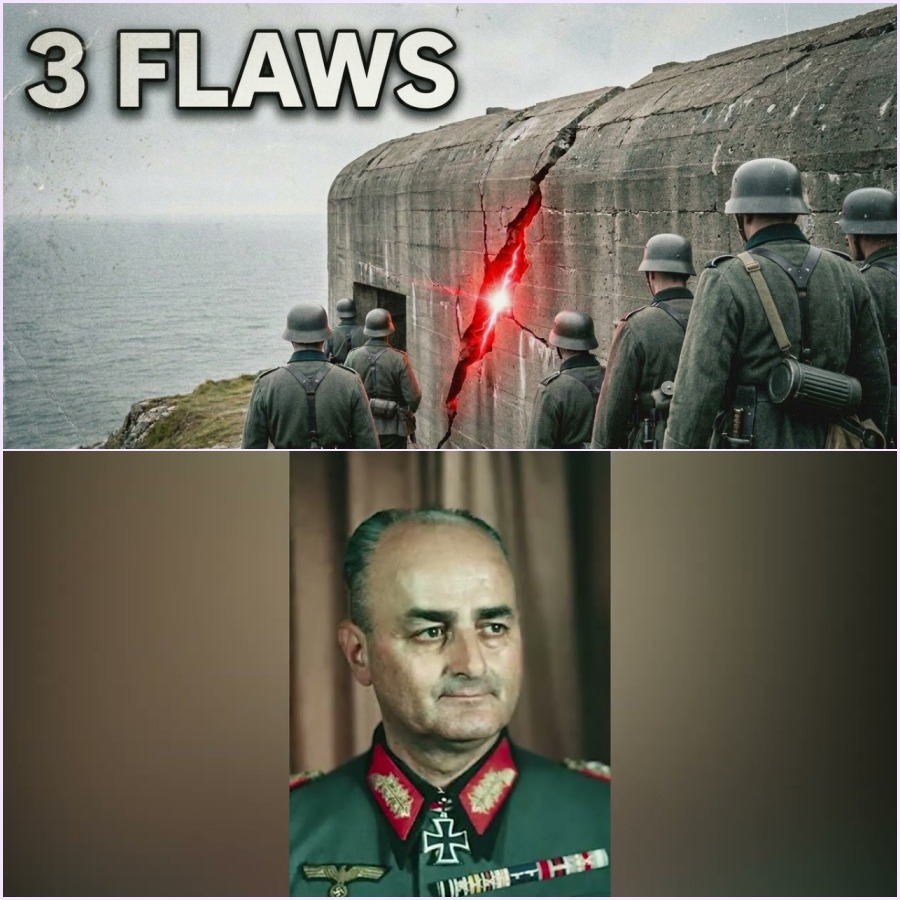
17 million cubic meters of concrete, 1.2 million tons of steel, 5% of Germany’s entire annual steel production poured into 2,400 m of coastline from the Arctic Circle to the Spanish border. It was the largest fortification project since the Great Wall of China. It consumed more resources than any defensive structure in modern history, and it was breached in a single morning.
But this video isn’t about D-Day. It’s about why 17 million cubic meters of concrete couldn’t stop 156,000 men in wooden boats. Because the Atlantic Wall didn’t fail on the beach, it failed on the blueprint. In March 1942, Furer directive number 40 ordered the creation of an impenetrable coastal barrier.
The concept was simple. Seal off every possible invasion beach with concrete, steel, and firepower. forced the allies to attack a port where the heaviest guns were concentrated or not attack at all. The project was handed to organization TOT, the same engineering corps that built the Autoban and the Ziggfrieded line.
They had experience, they had methodology, and they had something no previous fortification project had ever consumed at this scale, reinforced concrete. The Regalbau system, over 600 standardized bunker designs, was an engineering marvel on paper. Each type was pre-engineered. The type 677 for infantry positions. The type 683 for 50mm anti-tank guns.
The type 272 for heavy coastal batteries. Every bunker specified exact wall thickness, rebar spacing, ventilation systems, armored doors, emergency exits. The B standard bunker had 2 m thick walls rated to survive a direct hit from a 210 mm artillery shell. The A standard had 3.5 m walls designed to withstand naval bombardment.
This was industrial age fortification engineering at its most ambitious, standardized, scalable, efficient, and it contained three fatal engineering flaws that no amount of concrete could fix. Here’s the first number that matters. 1.2 million tons of steel. That’s 5% of Germany’s total annual steel production every year for 2 years diverted from tank factories, artillery production, and aircraft manufacturing poured into rebar, bunker doors, gun platforms, and I-beams that would sit inside concrete walls.
To put that in perspective, 1.2 million tons of steel could have produced approximately 50,000 Panzer 4 tanks. Germany built roughly 8,500 Panzer 4s during the entire war. Albert Shpear who inherited control of organization taught after Fritz Taught’s mysterious death in February 1942 later wrote from Spandow prison that the entire expenditure was quote sheer waste.
But even Shar underestimated the cascading damage. The Atlantic wall wasn’t the only consumer. Yubot pens along the French coast were absorbing 80,000 to 130,000 cubic meters of concrete every month. VWeapon launch sites demanded their share. Luftwafa airfield hardening competed for the same steel.
The result was a resource war, not against the Allies, but against Germany’s own industrial capacity. Every ton of steel embedded in a static bunker on the coast was a ton of steel that didn’t become a tank engine, an artillery barrel, or an aircraft frame. And here’s the paradox that no one in Berlin seemed to notice. The wall was supposed to be a substitute for manpower.
Hitler explicitly stated that fortifications would replace troops, freeing divisions for the Eastern Front. But the wall consumed industrial resources that those Eastern Front divisions desperately needed. The concrete was supposed to save soldiers. Instead, it starved the factories that armed them. But the resource drain was only the beginning because even where the concrete was poured, even where the bunkers were built exactly to specification, there was a second flaw hiding inside the engineering itself.
The regal bao system was designed for efficiency. One set of blueprints, any coastline, any terrain. Build it the same way in Norway as in Britany. That was the theory. In practice, the wall was catastrophically uneven. The Padal, where Hitler was convinced the invasion would come, received 495 casemates for guns of 150 mm or larger.
The seventh army sector covering Normandy and Britany received roughly 200. General Hans von Salalmouth commanding the 15th Army described the fortifications as quote a thin and fragile cord which has a few small knots at isolated places such as DEP and Dunkirk. His colleague Blumenrit was even more blunt. It is a line, a chain of individual works without depth.
If the enemy penetrated to a depth of 1 kilometer, they would be in free terrain. This is the second fatal engineering flaw. The Regalbau system built positions. It didn’t build defense in depth. Each bunker was an isolated concrete box connected to its neighbors by telephone wire, a trench, and hope. A typical Stutz punct or strong point contained an 88 mm gun casemate, a 75mm gun casemate, a 50mm anti-tank position, multiple machine gun bunkers, mortar imp placements, and a minefield.
It could hold a reinforced platoon. It was designed for all-around defense. It was stocked for 2 weeks of autonomous operation, but the strong points were islands. The gaps between them, sometimes a kilometer or more, were covered by nothing but barbed wire and a prayer. The Magino line, which Hitler himself had bypassed in 1940, at least had depth, underground railways, interconnected tunnel systems, multiple lines of resistance.
The Atlantic Wall had none of this. It was a single crust. Crack it anywhere and you were through. And there was another problem embedded in the standardized designs. The guns faced the sea. Most casemates were designed for enmphilide fire, raking the beach laterally. The embraasers faced along the coastline, not directly out to sea.
This was tactically sound against a beach assault. But it meant the guns had limited ability to engage naval vessels offshore. And it meant that once troops got past the beach, even by a few hundred meters, the bunkers couldn’t rotate to engage them. The concrete that was supposed to protect the guns became a prison.
The guns could fire in the direction the engineers had predicted and nowhere else. But even if the wall had been built uniformly, even if every kilometer had been fortified, there was a third floor that made the entire concept obsolete before the first bunker was finished. A floor that Hitler himself had exploited four years earlier against France.
In May 1940, Adolf Hitler bypassed the Magino line. He didn’t bother attacking it headon. He went around it through the Arden where the French believed tanks couldn’t operate. Four years later, the Allies did exactly the same thing to his wall. They didn’t attack where it was strongest. They attacked where it was weakest.
And every ton of concrete poured at Calala. Every heavy battery, every astandard bunker was irrelevant. But the real killer wasn’t geography. It was the sky. By June 1944, the Luftvafa had effectively ceased to exist over France. Luft fla 3 responsible for defending France, Belgium and the Netherlands had a nominal strength of 400 aircraft.
In practice, most had been pulled back to defend Germany against the strategic bombing campaign. On D-Day, the Allies flew over 14,000 sorties. The Luftvafa managed 319. And here’s why this made the entire Atlantic Wall concept not just tactically weak, but engineering nonsense. A reinforced concrete casemate is extremely resistant to blast.
A 2 m wall can absorb a 210 mm shell, but concrete has a fundamental limitation. It can only protect what it encloses. The gun opening, the embraasure, is the weak point. A direct hit into the embraasure destroys the gun and kills the crew regardless of how thick the surrounding walls are. On June 6th, 1944, the USS Texas alone fired 441 rounds from her 14-in guns and 253 rounds from her 5-in secondary batteries.
The battleship HMS Warspite added her 15-in guns. Combined, the Allied Naval Bombardment Fleet included seven battleships, 18 cruisers, and 43 destroyers. No amount of concrete can withstand sustained bombardment from 14-in and 15-in naval rifles firing from multiple angles, especially when the defenders have zero air cover to drive the ships away, and zero naval assets to threaten them.
The Marines channel force by June 1944, approximately 60 miscellaneous craft, a handful of destroyers, some torpedo boats, patrol boats, and mine sweepers. They couldn’t leave port without being attacked from the air. This is the engineering truth that no blueprint could solve. Fixed fortifications only work as part of a system.
Concrete plus air cover plus naval interdiction plus mobile reserves. Remove any leg and the fortress becomes a tomb. Hitler knew this. He’d proven it in 1940. And then he spent 3.7 billion Reich’s marks, roughly $ 160 billion in today’s dollars, building the exact same trap for himself. Even if the concrete had been perfect, even if every kilometer had been fortified to a standard, the Atlantic wall had a flaw that no engineer could fix.
Three commanders, three strategies, zero agreement. Field Marshall Fon Runstead, nominally commander-in-chief West, called the Atlantic Wall nothing but a gigantic bluff, a propaganda wall. After the war, he said, the enemy probably knew more about it than we did ourselves. He wanted mobile defense, let the allies land, then crush them with panzer reserves in the interior.
Field Marshal Raml, assigned in late 1943 to accelerate construction, believed the opposite. He’d fought the British and Americans in North Africa. He’d seen what Allied air power could do to armored columns in the open. His conclusion, if the Allies got ashore, no counterattack would ever reach the beach.
The invasion had to be stopped at the water line. He wanted Panzer divisions positioned directly behind the coast. General Guyire Fonenberg, commander of Panzer Group West, sided with Runstead. Keep the armor back. Concentrate it. Strike when the invasion point is confirmed. Hitler’s solution was the worst possible outcome. He split the difference.
Two Panzer divisions near Paris, three in southern France. Raml got operational control of just three and only one, the 21st Panzer Division, could realistically reach the Normandy beaches. The remaining four required Hitler’s personal authorization to move. On the morning of June 6th, 1944, Hitler was asleep. His staff refused to wake him.
For critical hours, while Allied troops were fighting their way off the beaches, the Panza reserves sat motionless, waiting for an authorization that wouldn’t come until the afternoon. The wall had no mobile reserve behind it, not because Germany lacked tanks, because the command structure couldn’t agree on where to put them.

And the one man who could make the decision was in bed. 17 million cub m of concrete, 1.2 million tons of steel, 286,000 workers, many of them forced laborers, prisoners of war, concentration camp inmates. Thousands died building it. The Atlantic Wall wasn’t defeated on June 6th, 1944. It was defeated on the drawing board. Flaw one, it consumed 5% of Germany’s annual steel production, starving the factories that built the weapons the army actually needed.
Flaw two, the Regalbau system built a line, not a defense. Standardized blueprints ignored local terrain, created no depth, and left kilometer wide gaps between strong points. The guns faced one direction. The enemy came from every direction. Flaw three. Fixed fortifications without air superiority, naval defense, or mobile reserves are not a fortress.
They’re a collection of very expensive coffins. Von Runstead was right. It was a propaganda wall, a monument to the belief that concrete could substitute for strategy. Hitler proved in 1940 that static fortifications don’t work against a mobile enemy with air superiority. And then he spent 2 years and $ 160 billion building the biggest static fortification in modern history.
The Magino line failed because the Germans went around it. The Atlantic Wall failed because the Germans built their own Maginino line and forgot why the first one didn’t work. If you want to see how another German wonder weapon failed because of a single engineering flaw, watch our video on why German tank sites failed in 1944. The optics were perfect.