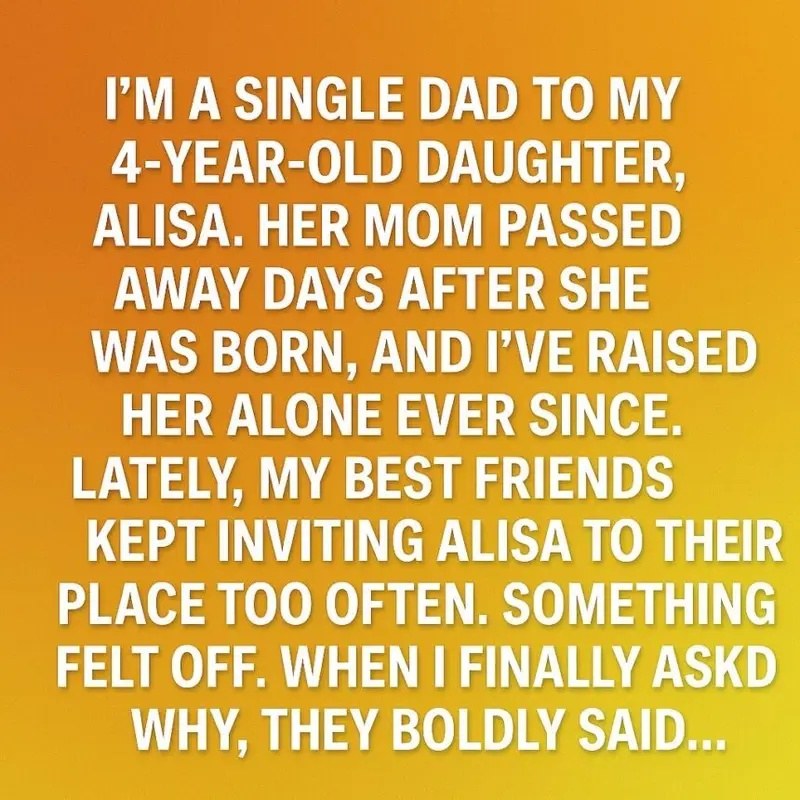
There are certain truths we build our lives on. Pillars of certainty. For me, one of those unshakable truths was the unwavering, almost miraculous, support of my two best friends. They stepped in when my world imploded, loving my daughter with a ferocity that often put my own overwhelmed heart to shame. I owe them everything. I used to think that.
My daughter was barely a year old when her father walked out. Not a dramatic exit, just a slow, quiet fade. The kind that leaves you staring at an empty space, wondering when the light went out. I was a wreck. A shell of a person, grappling with a tiny human whose every need felt like a mountain I couldn’t climb. Sleep was a myth. Hope was a flicker I often couldn’t locate. And then, there they were.
My friends. Let’s call them my anchor and my sail. One, the calm, steady presence who always knew what to say, what to do. The other, the effervescent burst of energy who could make anyone laugh, even me, even then. They didn’t just offer help; they demanded to be involved. “You’re not doing this alone,” one declared, holding my daughter while I cried into her shoulder. The other, already unpacking groceries in my fridge.
They were there for the late-night feeds when I couldn’t keep my eyes open. They took her for entire weekends, giving me the precious, vital space to just be – to sleep, to shower, to remember who I was before “mother.” They taught her to ride her first bike. They listened to her tell stories about imaginary dragons. They celebrated every scraped knee, every lost tooth, every triumphant report card like it was their own personal victory. My daughter adored them. She’d throw her arms around their necks, burying her face in their clothes, whispering secrets that were just for them. It was beautiful. Truly. I had never seen such pure, unconditional love outside of a parent and child.
They were her constants. Her steady rocks. If I had a work emergency, they were there. If I was sick, they were there. They never asked for anything in return, beyond my well-being and her happiness. I often joked that they were her “other parents.” It felt true. They shared inside jokes with her, had special traditions, knew her favorite everything. I even caught myself, sometimes, envying their effortless connection, their boundless patience. But mostly, I was just overwhelmingly grateful. How could I ever repay them? How could anyone be so selfless?
Years passed. My daughter grew into a bright, curious, utterly delightful child. She inherited my eyes and her father’s mischievous smile. But in her spirit, in her kindness, in her unwavering loyalty, I saw the imprint of my friends. Their values, their laughter, their quiet wisdom. She was a testament to the village they had built around us. I truly believed I was the luckiest person alive to have such friends, such a family, forged not by blood, but by pure, undeniable love.
Then came the fall. A simple fall from the monkey bars, a scream, a rush to the emergency room. Nothing dramatic, just a broken arm. But it led to tests. Routine pre-op blood work. And then, the call from the doctor. A follow-up, “just to be safe.” A specialist. More tests. My heart began to clench. It wasn’t just a broken arm.
My daughter had a rare blood disorder. Not immediately life-threatening, but serious. It meant a lifelong regimen of medication, careful monitoring, and potentially, in the future, a bone marrow transplant. The doctor was kind, explaining everything with grave gentleness. “We’ll need to screen for a donor. Full siblings are the best match, but we’ll also test parents, and then cast a wider net.”
My friends were immediately there, of course. Holding my hand, crying with me, promising to do whatever it took. “We’ll get tested too,” one said, voice thick with emotion. “Whatever she needs.” The other nodded, squeezing my arm. My saviors, again.
The first results came back. My blood type was compatible, but not a full match. The percentages were low. My ex-partner, her biological father, was contacted. He was, predictably, difficult to reach. When he finally showed up for his blood draw, he was a ghost of a man, evasive and strangely agitated. The doctor called me a few days later. “His match is even lower than yours. Almost negligible.” That was odd, I thought. But genetics can be funny.
Then came the conversation about extended family. Aunts, uncles, grandparents. “Have you considered reaching out to your friends who are so close to her?” the doctor suggested gently. “Sometimes, even non-biological close family can have unexpected compatibilities.” I nodded, numbly. My friends had already offered. They were already scheduled for their own screenings.
The day the results for my friends came in, I was a nervous wreck. I sat in the doctor’s office, clutching a tissue, tears welling even before he spoke. He looked at me with an expression I couldn’t quite decipher. A mixture of pity, confusion, and something else. Sadness, perhaps?
“We have the results for your friend, the one we’ll call… the anchor,” he began, looking at his notes. “Her blood type is a perfect match. A very high compatibility score.”
I gasped, relief flooding through me. “Oh, thank God! She’s always been so healthy. I knew it!”
The doctor held up a hand. “Yes, it’s excellent news. Potentially life-saving for your daughter. But there’s something else. Her genetic markers… they show an extremely high probability of a direct parent-child relationship.”
My breath hitched. “What? No. No, that’s impossible. She’s my friend. She’s… she’s not…”
He met my eyes, his voice softening further. “I understand this is shocking. We double-checked. Triple-checked. The markers are undeniable. Based on these results, and given your daughter’s specific condition, your friend… she is very likely your daughter’s biological mother.”
The room spun. BIOLOGICAL MOTHER? The words echoed, distorting, reverberating in the silence of the sterile office. My anchor. My calm, steady, selfless friend. No. It had to be a mistake.
“But… but that’s impossible,” I stammered, my voice barely a whisper. “I… I gave birth to her.”
“Yes,” he confirmed. “And our records show you are the biological mother as well. It’s… it’s a very unusual situation. It suggests…” He paused, choosing his words carefully. “…that your daughter has two biological mothers. Or, more accurately, that the genetic material from both you and your friend contributed to her conception.”
My mind raced, trying to make sense of the nonsensical. Two mothers? How? Then, a terrible, sickening realization began to unfurl. A memory. A distant, half-forgotten conversation with my ex-partner, many years ago, about “fertility issues.” His strange evasiveness then. His even stranger evasiveness now. His negligible match.
“What about my other friend?” I asked, my voice trembling now. “The sail. What were her results?”
The doctor looked at the second file. His expression grew even more grave. “Her results… are also highly compatible. Not as close as the other friend, but far beyond what we would expect for just a ‘friend.’ And her genetic markers… they point to a strong paternal link.”
I remember the exact moment the universe cracked open. The silent scream that erupted inside me. My ex-partner. My two best friends. It wasn’t just one affair. It wasn’t just one betrayal. It was an elaborate, years-long lie.
My daughter wasn’t just loved like their own.
She was their own.
My daughter was conceived through a twisted, secret affair between my ex-partner and my “anchor” friend.
And my “sail” friend… she had been his genetic donor. His true partner, the father.
My anchor and my sail. My two best friends. They didn’t “step in to love my daughter like their own.” They stepped in to love their own daughter, the child of a years-long affair between my ex-partner and them. The child I had carried, nurtured, raised, believed was solely mine and my ex-partner’s.
The fall from the monkey bars. The rare blood disorder. The medical necessity that ripped away the carefully constructed façade. It wasn’t just a broken arm. It broke my entire life.
Every laugh, every hug, every selfless act of love from them was a lie. A beautiful, agonizing, calculated lie designed to keep them close to the child they had made together, while I was blissfully, tragically unaware. I had thanked them, cherished them, called them my saviors. All while they were living a secret life, a secret family, right under my nose.
Now, my daughter needs a bone marrow transplant. And her best chance is from the woman I considered my sister, the woman who helped create her with the man I thought I loved. The woman who watched me grieve his departure, knowing all along he was probably going to her. And the other friend, the one who was the true father, pretending to be an uncle.
I am shattered. Utterly, irrevocably broken. I look at my beautiful, innocent daughter, and I see the echoes of the deepest betrayal imaginable. How do I tell her? How do I live with this? How do I thank the people who saved her life, knowing they also stole mine?
My best friends didn’t just love my daughter like their own.
They WERE her own.
And I, her mother, was just the incubator, the unwitting dupe, for a love story that was never mine to begin with.
And now, I have to let them save her, knowing this truth will forever poison every act of kindness they ever showed me.