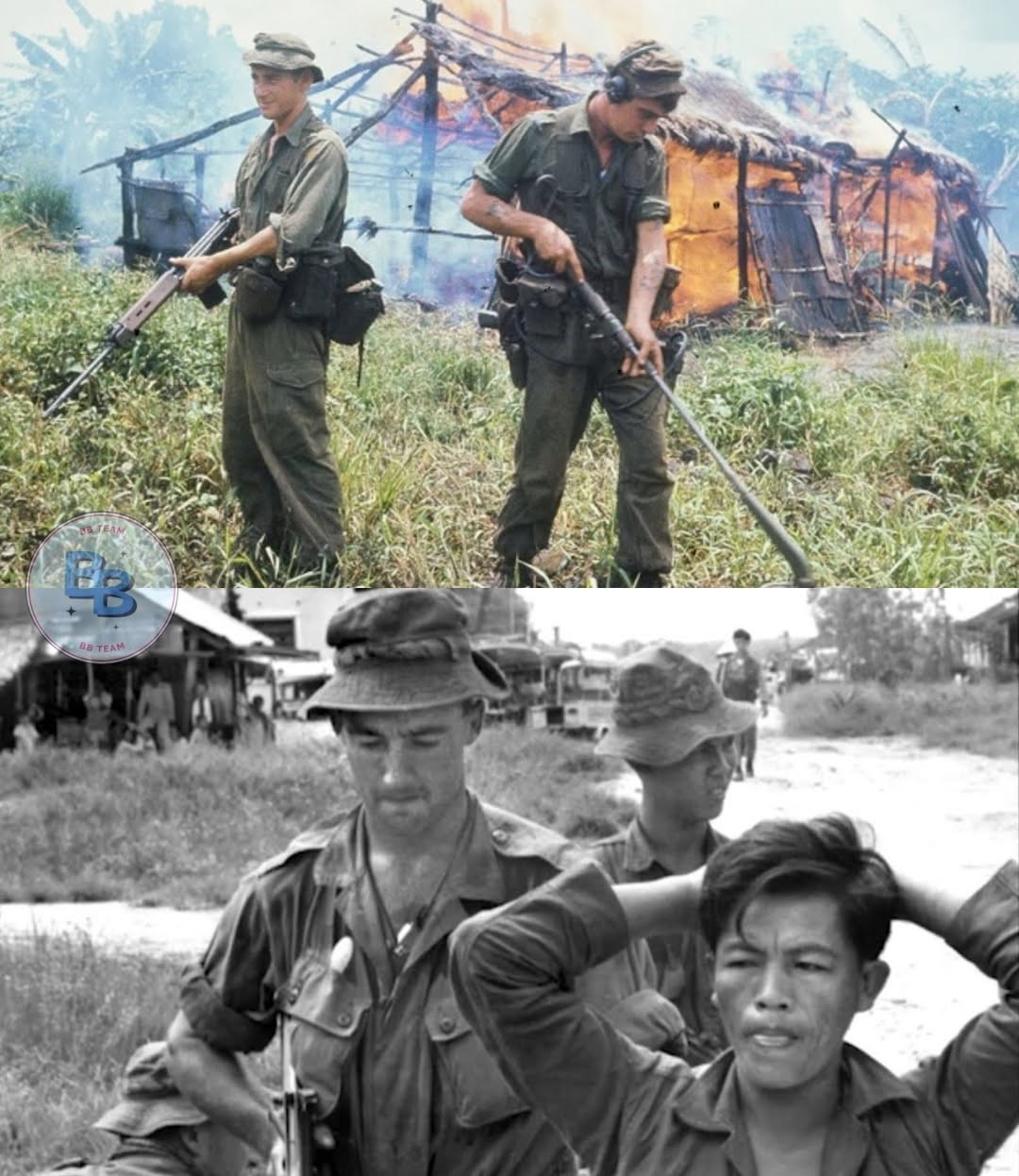
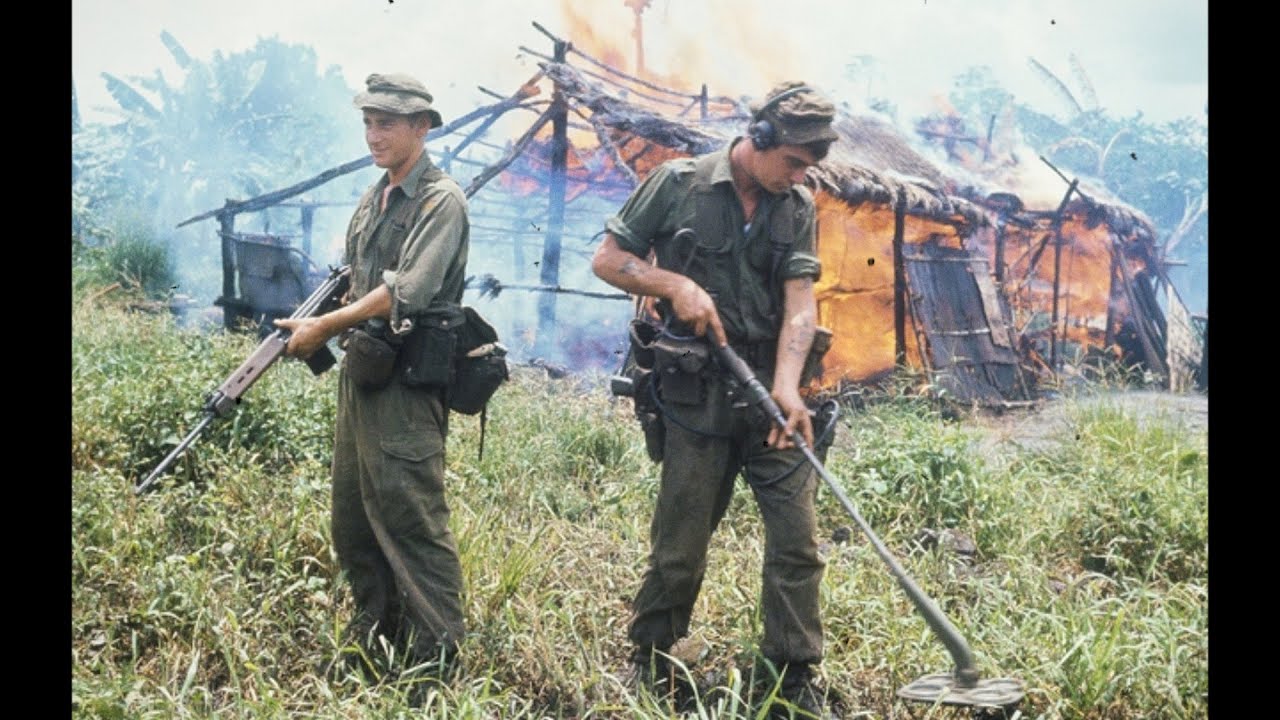
The order came through the radio like a hammer. Confirm the target. American aircraft were already inbound. The village below had minutes left. 3 km south of Newi dot deep in Puaktua province. An Australian SAS patrol lay motionless in the canopy. Six men, faces painted, uniforms soak through with sweat and humidity.
They had been watching the village for 48 hours, silent, patient, waiting. The radio operator’s hand moved to his handset. Static crackled. An American voice, calm but urgent, requested confirmation. Fast movers were 8 minutes out. F4 Phantoms carrying enough ordinance to erase the village from the map. Intelligence suggested it was a Vietkong supply node.
a waypoint on the Ho Chi Min trails infinite web. A target worth hitting hard. But the SES commander, a sergeant with three tours behind him, saw something the intelligence reports hadn’t mentioned. Through his binoculars, he watched an old woman tending a cooking fire, children running between huts, a man repairing a fishing net.
The movement was wrong for a VC staging area. Too slow, too domestic, too alive. His finger hovered over the radio transmit button. One word would confirm the strike. One word would send those phantoms screaming down from 30,000 ft. One word would turn smoke into fire, fire into dust, dust into unmarked graves. He keyed the mic. Negative. Do not strike.
Civilians present. Silence on the other end. Then sharp and confused. Say again. Negative on target confirmation. Civilians in the village. Multiple non-combatants observed. The American battalion operations officer came on the line. Are you certain? Intelligence indicates high value target. The sergeant looked through his binoculars again.
A child kicked a ball made of bundled rags. A grandmother carried water from the well. He’d seen VC villages before. This wasn’t one. Affirmative. Do not strike. And that’s when he made the decision that would change the war and nearly break the alliance. To understand why an Australian sergeant could refuse an American air strike order, you have to understand how differently the two armies fought the same war.
By 1968, the Americans had been in Vietnam for 3 years at full strength. They brought overwhelming firepower, technological superiority, and a doctrine built on one principle. Find the enemy, fix them in place, and destroy them with coordinated fire support. Artillery, gunships, tactical air strikes.
If you could see it, you could kill it. That was the American way. The Australians arrived in 1966 with a different philosophy. smaller force, tighter area of operations, and a doctrine inherited from decades of jungle warfare in Malaya, Borneo, and New Guinea. They called it winning hearts and minds before that phrase became a cliche.
But more accurately, it was about control through knowledge, not firepower through saturation. Australian infantry battalions rotated through Fuakt Thai Province, a coastal, a region southeast of Saigon that the Americans considered a backwater. The main action was up north in the central highlands along the DMZ. Fuaktui was rubber plantations, rice patties, and scattered villages.
Low priority for American planners, perfect for Australian tactics. The SAS squadrons that deployed to Vietnam operated differently than almost any other special forces unit in theater. They ran long range reconnaissance patrols that lasted days, sometimes weeks. Five or six men moving through dense jungle with no resupply, no fire support, no extraction plan unless things went catastrophically wrong.
Their job wasn’t to kill. It was to watch, listen, and report. American doctrine gave platoon leaders authority, but kept tactical decisions tightly controlled at battalion level. Australian doctrine pushed authority down to section commanders and patrol leaders. A corporal leading a patrol had the power to call off an operation if the situation changed.
A sergeant running a four-man reconnaissance team could refuse orders if his assessment on the ground contradicted headquarters intelligence. This wasn’t insubordination. It was trust. The Australian army had learned in Malaya that the man on the ground saw things that maps and aerial photos couldn’t show. Terrain looked different at eye level.
Villages change character between dawn and dusk. The difference between a VC base camp and a hamlet where the VC occasionally slept was invisible from altitude but obvious if you watch long enough. So when the American battalion called for target confirmation that morning, they were following standard procedure. Intelligence had marked the village.
Aerial reconnaissance showed structures consistent with supply storage. Radio intercepts suggested enemy movement in the area. The pieces fit. The target was valid, but they were asking an Australian SAS patrol to confirm. and that patrol answered to a different standard. The alliance between Australian and American forces in Vietnam was built on mutual respect but divergent methods.
American officers admired Australian fieldcraft. Australian commanders appreciated American firepower and logistical support. They trained together, fought together, bled together. But on this day, trust was about to snap. The patrol had inserted 72 hours earlier. Dropped by helicopter into a landing zone 5 km from the target village.
They moved through primary jungle so thick that sunlight barely reached the ground. Every step measured, every sound monitored. The point man stopped every 50 m listening. The rest of the patrol froze in place. Weapons covering arcs. Eyes scanning the undergrowth for trip wires, pungy stakes, or the telltale signs of recent foot traffic.
They communicated in hand signals. A clenched fist meant stop. Two fingers pointed at the eyes meant observe. A flat hand swept horizontally meant move. Vietnam’s climate was a weapon all by itself. The humidity sat at 90%, turning uniforms into second skins of sweat. Leeches dropped from branches and burrowed into any exposed skin.
Mosquitoes swarmed at dusk. Water from cantens tasted like plastic and iodine tablets, warm and chemical. The men rationed it carefully. Resupply wasn’t an option. If they ran out, they drank from streams and hoped for the best. Navigation meant dead reckoning and compass work. Maps were often inaccurate, drawn from French colonial surveys that didn’t account for decades of jungle growth.
The patrol leader kept track of pace counts, matching steps to distance, correlating terrain features with map contours. One wrong turn could put them kilome off course. One misstep could walk them into an enemy patrol. They moved at night when possible, using darkness for concealment. During the day, they laid up in thick cover, rotating watch shifts, sleeping in 2-hour increments.
Sleep came hard when every sound could be a threat. A branch snapping meant an animal or a man. Distant voices could be farmers or fighters. The jungle revealed nothing easily. On the second night, they reached the ridge overlooking the target village. The patrol leader chose a position in thick undergrowth with clear sidelines down into the valley.
They settled in, camouflage their position, and began the watch. The village appeared peaceful. 50 or 60 structures, mostly thatchroofed huts, arranged in loose clusters. Smoke rose from cooking fires. A well stood at the center of the settlement where women gathered in the early morning and late afternoon. Children played in the clearings between homes. Dogs wandered freely.
Chickens scratched in the dirt. Through binoculars, the sergeant studied the pattern of life. He’d done this a hundred times before. VC villages had rhythms. Men of military age avoided open areas during daylight. Movements followed patterns, disciplined and rehearsed. Supply routes showed signs of heavy use.
Trails worn smooth by foot traffic carrying loads. This village didn’t match. The men he saw were old or young, too old for combat or too young to carry a rifle. Women moved without caution. Children played without supervision. If the VC were using this village, they were hiding it well. But there were inconsistencies. Late on the second day, he spotted three figures moving through the tree line on the village’s eastern edge.
Young men moving quickly, not following the trails. They entered a hut, stayed for 20 minutes, then left the way they came. No one in the village acknowledged them. The sergeant made notes on his map. Possible VC contact, possible supply drop, possible recruiting visit. Not enough to confirm enemy presence, not enough to justify an air strike.
On the third morning, the American battalion called. They had signal intelligence suggesting increased enemy radio traffic in the area. Aerial reconnaissance had spotted new construction in the village. Higher headquarters wanted the target hit before whatever was being built could be used.
The American operations officer was professional but firm. We need confirmation within the hour. Aircraft are being tasked now. The sergeant looked through his binoculars again. Morning in the village. Smoke from cooking fires. Children playing near the well. An old man leading a water buffalo toward the rice patties. A woman hanging laundry on a line strung between two huts.
He handed the binoculars to his second in command. What do you see? The corporal studied the village for a long moment. villagers. Maybe VC passing through, not a base. Agreed. The radio operator looked at both men. Americans want an answer. The sergeant took the handset. He’d been in situations like this before, where intelligence didn’t match ground truth, where headquarters saw patterns and data that didn’t exist in reality, where someone far away made decisions about life and death based on maps and reports instead of eyes and instinct. He keyed
the mic and made the call that would define the next hour of his life. One wrong word on the radio and hundreds die. Negative, do not strike. Civilians present, static on the line. Then the American operations officer voice tight with surprise. Say again. Aussy 32. Negative on target confirmation. Village contains civilians.
Multiple non-combatants observed. Women, children, elderly. Does not match profile for VC staging area. A pause. The sergeant could imagine the scene in the American Tactical Operations Center. Officers gathered around a map table, radio handsets pressed to ears, helicopters idling outside, jets being armed on the flight line.
He just thrown a wrench into a carefully coordinated strike mission. Aussie 32 intelligence indicates this is a high value target. Supply cache confirmed by signals intelligence. Understood. Ground observation does not confirm. Recommend no strike. Another pause. Longer this time. Then a different voice came on the line. Hardered edged, higher rank.
This is Blackjack 6. Are you refusing to confirm the target? The sergeant kept his voice level. Affirmative. Blackjack 6. Cannot confirm enemy presence. Civilian population observed. Strike not recommended. We have solid intelligence on this target. Roger 6. Intelligence may be outdated or inaccurate. Request strike be canled pending further reconnaissance.
The tension over the radio was palpable. The Australian patrol could hear it in the silences, in the clipped responses, in the careful choice of words. This wasn’t just a tactical disagreement. This was an Australian sergeant contradicting American intelligence, refusing to authorize an air strike that had already been set in motion.
The American battalion commander came back in the line. Aussie 32, are you 100% certain? The sergeant looked down at the village. A child had climbed a tree near the well. Women were gathering water. An old man sat in the shade of a hut, smoking a pipe. Affirmative Blackjack 6 100%. Roger, standby. The radio went silent.
The patrol waited. The sergeant knew what was happening on the other end. American officers were weighing his assessment against their intelligence. They were calculating risk. If they canled the strike and he was wrong, the VC would use the village and American soldiers would die. If they launched the strike and he was right, civilians would die and the political fallout would be catastrophic. It came down to trust.
Did they trust an Australian sergeant they had never met? Watching a village through binoculars from a jungle ridge over intelligence reports compiled by analysts with access to signals intercepts. Aerial photos and agent networks. 5 minutes passed. 10. The patrol remained motionless. Then the radio crackled. Aussie 32 blackjack 6.
Strike is canled. Repeat. Strike is canled. Fast movers have been diverted. You were cleared to conduct ground reconnaissance at your discretion. The sergeant felt the weight lift slightly. Roger. Blackjack 6 will report findings. Make damn sure you’re right about this. Understood. Six. Out.
The radio operator looked at the sergeant. Now what? Now we go down there and prove it. This is the moral turning point of the whole story. The jets were diverted mid-flight. Pilots redirected to secondary targets or sent back to base with ordinance still loaded. The American battalion operations center stood down. Higher headquarters was notified that the strike had been cancelled based on ground reconnaissance assessment.
And an Australian SAS patrol prepared to walk into a village that might still be full of Vietkong. Now the Australians had to prove their call wasn’t a mistake. The patrol moved off the ridge at midday when the heat and humidity were at their worst, when anyone watching would be seeking shade and rest.
They descended through jungles so thick they used machetes sparingly, cutting only when necessary, moving through gaps in the vegetation like water, finding paths of least resistance. The point man led with his rifle at low ready, eyes scanning for trip wires, pressure plates, or the disturbed earth that might indicate buried mines.
The VC were expert at building defenses that looked like natural jungle until you triggered them. A vine across a trail could be exactly that, or it could be connected to a grenade with the pin already pulled. A fallen log could be cover or concealment for a spider hole with a fighter waiting inside. They moved without speaking.
Hand signals coordinated movement. Every man knew his role. The point man navigated. The second man covered left. The third man covered right. The patrol leader maintained situational awareness. The radio operator stayed close to the leader, ready to call for extraction if contact was made.
The rear guard watched their back trail for followers. 50 m from the village edge. They stopped. The patrol leader moved forward alone, crawling through undergrowth to observe the village from close range. He watched for 10 minutes. No sentries, no lookouts, no defensive positions, just villagers going about their daily routines.
He crawled back and briefed the patrol using hand signals. They would enter from the east, moving between huts, clearing each structure carefully. No weapons would be displayed unless necessary. The goal was reconnaissance, not confrontation. They stood and walked into the village. The first person to see them was a child, a girl perhaps 7 years old, carrying a basket of vegetables.
She froze, eyes wide, basket slipping from her hands. The sergeant raised one hand slowly, palm out, in a gesture of peace. He didn’t smile, didn’t speak, just held her gaze and kept his rifle pointed at the ground. The girl’s mother appeared, saw the soldiers, and pulled her daughter close.
Other villagers emerged from huts, suspicious, but not panicked. An old man, the village elder perhaps, stepped forward. He looked at the Australian soldiers, at their painted faces and camouflaged uniforms, at the weapons they carried but didn’t aim. The sergeant spoken broken Vietnamese phrases learned from phrase cards and practice.
We are friends. We are not here to hurt anyone. We are looking for Vietkong. The elder said nothing. His face revealed nothing. The patrol began clearing huts. They move methodically, entering each structure with practice caution, checking for weapons, ammunition, supplies, tunnel entrances. They found cooking pots, sleeping mats, farming tools, fishing nets.
They found rice stores and vegetables. They found the detritus of rural life lived close to poverty. They found no weapons. They found no ammunition. They found no radio equipment. They found no medical supplies beyond basic herbs and traditional remedies. One of the patrol members, a corporal who’d grown up on a farm in Queensland, recognized the patterns.
This was a farming village, rice cultivation, some fishing from the nearby river. subsistence living. The kind of place where families had lived for generations, tending the same plots of land their grandparents had tended, following the same seasonal rhythms that governed rural life throughout Southeast Asia.
But then they found something that made the sergeant’s jaw tighten. In a hut on the village’s western edge, hidden under a sleeping mat, they found a leaflet. Vietkong propaganda printed in Vietnamese calling for resistance against American imperialism. It was recent, the paper still crisp. They found another leaflet in a different hut, then another.
Then scraps of others that had been torn up, as if someone had tried to dispose of them quickly. The patrol regrouped near the village center. The sergeant studied the pattern. VC were here recently, but they’re not here now. Recruitment visit, the corporal suggested maybe. Or they’re using the village as a way point.
Come through, rest, resupply from villagers who don’t have a choice, then move on. So, the intelligence was partly right. Partly. But this isn’t a staging area. It’s not a supply cache. It’s a village the VC passed through. That’s not the same thing. The sergeant looked around at the villagers who watched from a distance. Old men, women, children.
If this village had been bombed, they would have died for the crime of being unable to resist Vietkong demands. They would have died because intelligence analysts interpreted signals, intercepts, and aerial photos without understanding the ground truth. They would have died because war made no distinction between complicity and coercion.
One of the patrol members approached. Found something else, boss. They followed him to the village’s eastern edge where the treeine began. There, barely visible under fallen leaves and branches, they found marks in the dirt. Bootprints, multiple sets, recent made within the last day or two. But the pattern was wrong.
The prince led into the village from the east, then led back out the same way. They didn’t spread through the village. They didn’t move toward the huts. They came in, stopped near the treeine, then left. The corporal knelt beside the tracks. They didn’t enter the village. They wanted someone to think they did. The sergeant understood immediately. The VC had staged evidence.
They’d left just enough signs, just enough traces to make the village look like a supply point. They knew American reconnaissance flights would photograph the area. They knew intelligence analysts would flag it as a potential target. They knew or hoped that an air strike would follow and if it did, the village would be destroyed.
The civilian casualties would be blamed on the Americans. The propaganda value would be immense. Another atrocity. Another reason for the Vietnamese people to support the revolution. Another wedge between the Americans and the population they claimed to be defending. The VC had tried to bait an air strike and it had nearly worked.
The sergeant keyed his radio. Blackjack 6 Aussie 32. Go ahead. 32. Target village cleared. Negative on enemy presence. Negative on supply cache. Found evidence of recent VC transit but no permanent enemy occupation. Village is civilian. Recommend no strike. Repeat. Recommend no strike. A pause. Then Roger 32. Understood. Good work.
Return to base at your discretion. The sergeant looked at the elder who stood watching with an expression that might have been gratitude or might have been simple relief. The old man bowed slightly. The sergeant nodded in return. One of the younger patrol members, a private on his first tour, quietly waved at a child. The child, a boy with a gap to smile, waved back tentatively.
The human moment slowed the pace and deepened impact. The patrol withdrew from the village the way they had entered, moving silently through the treeine, disappearing into the jungle. Behind them, the village returned to life. Women resumed their work. Children resumed their play. The elder sat down in the shade and lit his pipe.
They would never know how close they’d come to annihilation. They would never know that eight F4 Phantoms had been 8 minutes away from turning their home into a crater. They would never know that one Australian sergeant watching through binoculars from a ridge had made the call that saved their lives. And then the evidence appeared. proof that the Australians had stopped a catastrophe.
The patrol moved through the jungle for six hours before reaching their extraction point. A radio call brought in a Huey helicopter which landed in a small clearing long enough for the six men to board, then lifted off and flew low over the canopy back toward the Australian base at Nui Dot. Back at the tactical operations center, the sergeant debriefed his patrols findings to the Australian officer commanding.
They reviewed the map, discussed the patrol’s observations, examined the notes the sergeant had taken. The officer listened without interrupting, asking questions only when necessary. You’re certain the village was civilian? Certain, sir. VC had passed through, but they weren’t occupying it. The villagers were scared of us, but they weren’t hostile.
And those tracks at the treeine, that was staged. VC wanted us to hit it. A propaganda play. Yes, sir. The Australian officer picked up a field telephone and placed a call to the American Battalion headquarters. The conversation was professional, measured, military courtesy masking tension beneath. Your SAS patrol was correct.
The Australian officer reported, “Village is civilian. No enemy fortification. Evidence suggests VC attempted to bait an air strike. Your intelligence was partially accurate. Enemy movement in area confirmed, but the village itself is not a legitimate target. On the other end of the line, the American battalion commander acknowledged the report.
He thanked the Australians for their thoroughess. He said he was glad the strike had been cancelled, but the American intelligence staff wasn’t satisfied with a verbal report. They wanted confirmation. They wanted documentation. They wanted proof that their intelligence had been wrong. Within hours, another reconnaissance flight was dispatched.
Highaltitude photography of the village. Detailed analysis of structures, trails, and surrounding terrain. Signal intelligence focused on radio traffic in the area. Agent reports from local informants. Everything was reviewed, cross-referenced, verified, and the evidence supported the Australian patrols assessment.
The village showed no signs of fortification. The structures were consistent with civilian habitation. The trails showed patterns of agricultural use, not military movement. The radio traffic that had triggered the initial intelligence report turned out to be from a different location entirely, misattributed by triangulation error.
The intelligence analysts had made assumptions based on incomplete data. They’d seen patterns that fit their preconceptions. They’d marked the target without ground truth to confirm it, and they’d nearly caused a massacre. Two days later, a senior American intelligence officer visited the Australian base at New Dot.
He met with the SAS squadron commander and asked to speak with the patrol leader, who’d refused to confirm the strike. The sergeant was called in from the field, still wearing his jungle greens, face sunburned and tired. He stood at attention while the American officer looked at him with an expression that was hard to read.
You saved a lot of lives, the American said. Yours, ours, and theirs. If we’d hit that village, the political fallout would have been catastrophic, and the VC would have won a propaganda victory that would have cost us support across the entire province. The sergeant said nothing. Waited. I want you to know that your report has been forwarded up the chain.
Higher headquarters is reviewing our intelligence procedures. We’re going to be more careful about target confirmation from now on, and we’re going to trust Australian ground reconnaissance more than we trust our own signal intelligence. The American officer extended his hand. The sergeant shook it.
Thank you for having the balls to say no. After the American officer left, the squadron commander pulled the sergeant aside. You did the right thing, but you know that’s not always going to be enough, don’t you? Sometimes you do everything right and people still die. Sometimes you make the hard call and it’s still the wrong one. That’s the war. Yes, sir.
But not today. Today you were right. Today you saved lives. That matters. For the Australians, it was one village. For the locals, it was their world. Word spread through the Australian task force at NewI dot. The way news always spreads in military units quickly, informally with details embellished and simplified as the story passed from one soldier to another.
An SAS patrol had stopped an American air strike. An Australian sergeant had refused a direct order. A village full of civilians had been saved. The story reached the American advisers working with Australian units who passed it to their own commands. It reached helicopter pilots who’d flown the patrol in and out. It reached artillery officers coordinating fire support.
It reached the battalion and brigade staff officers who planned operations across Puaktai province. And the story changed how those officers thought about intelligence and ground truth. American commanders began requesting Australian SAS reconnaissance more frequently before conducting operations in contested areas. They wanted eyes on target.
They wanted ground confirmation. They wanted to avoid another near miss like the village incident. Australian liaison officers noticed the shift. American planning meetings that once relied heavily on signals, intelligence, and aerial photography now included requests for patrol reports and ground reconnaissance.
The Australians had earned credibility the hard way by being right when it mattered. But the impact went deeper than tactical coordination. It went to the question that haunted every soldier in Vietnam. What the hell are we doing here? The war was supposed to be about winning hearts and minds, about protecting the South Vietnamese population from communist aggression, about building a democracy that could stand on its own.
But the reality on the ground was more complicated. Villages didn’t choose sides cleanly. The Vietkong lived among the people, sometimes by choice and sometimes by coercion. And the distinction between enemy, combatant, and innocent civilian was often impossible to make from altitude or from behind a map table. American doctrine tried to solve this problem with firepower.
If you couldn’t tell who was VC and who wasn’t, you created free fire zones and assumed everyone in them was hostile. You used artillery to soften up targets before infantry moved in. You dropped bombs on suspected enemy positions and sorted out the details later. It was efficient. It was lethal. And it was destroying the very thing the war was supposed to protect.
The Australians offered a different approach, slower, more deliberate, built on patience and restraint rather than overwhelming force. It required trusting junior leaders to make life and death decisions without immediate oversight. It required soldiers who could read terrain, read people, read situations with nuance and judgment.
One American adviser, a captain who’d spent three months working with Australian infantry, later recalled his impressions. The Aussies moved like they belonged in the jungle. They didn’t fight it, they used it. They’d set up an ambush and wait for days if they had to. They’d track VC for kilometers without taking a shot.
They wanted to know everything before they acted. Another American officer, this one an intelligence analyst, noted the difference in approach. We tried to find patterns in data. The Australians found patterns in behavior. We looked at maps. They looked at people. Both methods work, but theirs was better for Vietnam. You can’t fight a guerilla war with statistics.
The saved village became part of that learning process. It became a case study in what could go wrong when intelligence outpaced ground truth. It became proof that sometimes the right call was to do nothing, to wait, to verify before striking. For the villagers themselves, the impact was immediate and personal. They didn’t know about intelligence reports or tactical coordination.
They didn’t know that jets had been minutes away, but they knew that Australian soldiers had walked through their homes, looked them in the eyes, and left without firing a shot. That knowledge spread through the local population. The Australians at Newot weren’t like other foreign soldiers. They didn’t shoot first and ask questions later.
They could be trusted to distinguish between enemy fighters and civilians. They treated elders with respect. They waved at children. In the weeks and months that followed, villagers in the Australian area of operations began providing information. A tip about a VC supply cash hidden in the jungle. A warning about an ambush being prepared along a road.
An identification of a stranger who had arrived in the village asking questions. The intelligence flowed because the trust existed. And the trust existed because Australian soldiers had proven they valued Vietnamese lives, even when doing so contradicted intelligence reports and complicated military operations.
One village, one patrol, one sergeant’s decision to say no. The ripple spread farther than anyone could have predicted. This wasn’t just a refusal. It became a model. To understand why that Australian sergeant made the call he made, you have to understand the culture he came from. Not just military culture, but the deeper Australian tradition that shaped how men fought wars.
The Bush soldier tradition went back generations to the Boore War and Gallipoli and the Western Desert campaigns of World War II. It was a tradition built on self-reliance, independence of mind, and a healthy disrespect for authority that didn’t earn its keep. Australian soldiers obeyed orders, but they expected those orders to make sense.
They followed leaders who led from the front, who shared the hardships, who didn’t ask men to do anything they wouldn’t do themselves. That tradition created an army where junior non-commissioned officers, sergeants, and corporals carried more authority and responsibility than they did in most other militaries.
A section commander in the Australian Army wasn’t just a tactical leader. He was a decision maker, a problem solver, someone trusted to assess situations and take action without waiting for permission from above. The SAS took that tradition to its extreme. Selection courses filtered out anyone who couldn’t think independently, who needed constant oversight, who followed orders without question.
The men who made it through were capable of operating alone or in small teams for extended periods, making tactical and sometimes strategic decisions on the fly, adapting to changing situations with minimal guidance. training emphasized patience and observation. Australian SAS troopers learned to move through jungle for hours without making a sound.
They learned to read terrain the way a tracker reads animal signs, noticing patterns invisible to untrained eyes. They learned to control adrenaline, to suppress the fight orflight response, to remain calm when every instinct screamed for action. Fire discipline was paramount. Any soldier can pull a trigger. It takes discipline not to.
It takes training to hold fire when a target appears, to wait for a better shot, to let an enemy patrol pass without engagement if engaging would compromise the mission. The Australians trained for restraint as much as they trained for as violence. That discipline extended to their relationship with civilians.
The Australian Army’s experience in Malaya fighting communist insurgents in the 1950s taught them that population support was the center of gravity in counterinsurgency warfare. Win the civilians and you win the war. Lose the civilians and you lose no matter how many enemy fighters you kill. In Malaya, Australian soldiers learn to distinguish between committed insurgents and civilians caught between sides.
They learned that brutality drove populations toward the insurgents while restraint and respect could shift support toward the government. They learned that one village won over was worth more than 10 villages destroyed. Those lessons shaped Australian operations in Vietnam. In Fuakt Thai Province, Australian units conducted aggressive reconnaissance and ambush operations against VC fighters, but they were careful around villages.
They didn’t automatically treat civilians as hostile. They didn’t fire indiscriminately. They used force precisely, discriminately, only when necessary. This approach earned the Australians a unique reputation. The Vietkong respected Australian combat effectiveness. VC afteraction reports captured during operations frequently mentioned Australian units, noting their skill at ambushes, their patience and reconnaissance, their ability to track VC movements through dense jungle.
But the civilians in Fuaktai province developed a different kind of respect. The Australians were dangerous to the VC, but not necessarily dangerous to villagers. They could be approached. They could be talked to. They could be trusted not to massacre a village on suspicion alone. One Australian infantry officer reflecting on his tour years later described the balance his men tried to strike.
We were there to fight the VC, not terrorize the population. If we saw a man with a weapon, we shot him. If we saw a man with a hoe, we left him alone. It sounds simple, but in practice it was complicated as hell. The VC hid among civilians. They looked like civilians. They were civilians most of the time, except when they were fighters.
So, you had to watch, wait, gather evidence, make judgments based on behavior and context. You couldn’t just shoot anyone who looked suspicious. That approach required a different kind of courage than charging into battle. It required the courage to hold fire, the courage to accept risk rather than eliminate it with overwhelming force, the courage to trust your judgment even when it contradicted intelligence reports or higher commands assumptions.
The sergeant who refused the air strike order embodied that tradition. He wasn’t a rebel. He wasn’t disobeying for the sake of disobedience. He was making a tactical judgment based on ground truth using the authority his training and command structure gave him. Acting in accordance with values his army had spent years instilling.
He saw civilians in the village. His training told him civilians were not legitimate targets. His culture told him to trust his own eyes over someone else’s reports. His authority gave him the power to refuse. So he refused and hundreds of people lived because he did. This is why the VC feared them and why villagers trusted them.
The sergeant never talked much about the village incident. Years later when Australian veterans gathered and stories were told over beer and barbecue, someone would occasionally bring it up. Remember when you stopped that air strike? And he’d nod, shrug, and change the subject. He didn’t see it as heroism. He saw it as doing his job. The job was to provide accurate reconnaissance.
Accurate meant telling the truth about what he observed, even when that truth contradicted intelligence reports and complicated operations. Even when it meant refusing an order from an Allied force. even when it meant risking his career and his reputation on the judgment call of what he could see through binoculars from a jungle ridge.
The village never forgot, though they never knew exactly who to thank. They knew Australian soldiers had come. They knew the soldiers had searched their homes. They knew the soldiers had left without violence. And they knew that shortly afterward they heard jets fly over at high altitude and then turn away.
In the years that followed, as the war ground on and casualties mounted and the politics back home turned sour, that village remained standing. The VC continued to pass through occasionally, leaving leaflets and demanding rice. The villagers continued farming their land, raising their children, trying to survive in a war zone. When the Australians pulled out of Vietnam in 1971, some of the civilians in Puaktu province who had cooperated with them faced retribution.
The VC had long memories, but others simply faded back into the rhythm of rural life, weathering the change in power the same way their ancestors had weathered previous changes. The sergeant rotated home, did another tour in Vietnam with a different unit, then left the army, and returned to civilian life. He worked in construction, raised a family, attended Anzac Day ceremonies when his mates convinced him to show up.
He carried the war with him the way all veterans do, in memories that surfaced at unexpected moments, in reactions to sounds or smells that triggered something deep and automatic. But he also carried the knowledge that once when it mattered, he’d made the right call. One decision, one moment, one refusal that saved lives.
The American officers who had been involved in the incident came away with lessons of their own. Some of them rose through the ranks, carrying what they had learned into later commands. When they planned operations, they remembered the village that almost died. They remembered that intelligence could be wrong. They remembered that sometimes the man on the ground sees things that analysts miss.
The alliance between Australian and American forces deepened after the village. Incident American commanders learned to trust Australian reconnaissance. Absolutely. When Australian SAS patrols reported enemy positions, American fire support responded. When Australian patrols said a target was not valid, American strikes were cancelled.
That trust saved lives on both sides. Australian reconnaissance prevented civilian casualties that would have turned the population against Allied forces. American firepower protected Australian infantry when they made contact with VC forces. The partnership worked because both sides learned to respect what the other brought to the fight.
In the broader context of the Vietnam War, one village saved doesn’t change the outcome. The war was lost for reasons far beyond tactical decisions made on jungle ridges. Political will eroded. Public support collapsed. The South Vietnamese government proved unable to sustain itself. And in 1975, North Vietnamese tanks rolled into Saigon and the war ended.
But for the people in that one village, the outcome was everything. They lived, their children grew up, their grandchildren were born. The generational chain continued because one Australian sergeant looked through binoculars and saw human beings instead of grid coordinates. There’s a broader truth in that moment, something that transcends Vietnam and speaks to what soldiers are asked to do in every war.
They’re asked to make impossible decisions with incomplete information under extreme pressure. They’re asked to kill when necessary and show mercy when possible. They’re asked to balance mission accomplishment with moral responsibility, tactical effectiveness with strategic wisdom, following orders with following conscience.
Most of the time, those demands align. The enemy is clear. The target is valid. The orders make sense. Soldiers do their jobs and go home, carrying whatever they must carry. But sometimes the demands conflict. Sometimes the order doesn’t match the reality. Sometimes the right thing to do is say no, to push back, to refuse, even when refusing carries consequences.
The Australian SAS operated in Vietnam with a culture that permitted that kind of moral courage. They trained for it. They valued it. They promoted men who demonstrated it. The system supported junior leaders who made hard calls based on ground truth. Even when those calls contradicted higher commands plans, that didn’t make them better soldiers than the Americans they fought alongside.
It made them different soldiers, shaped by different traditions, following different doctrines, accountable to different standards. But in that moment, on that day, with jets inbound in a village minutes from destruction, the difference mattered absolutely. The sergeant who made the call is old now. If he’s still alive, he’d be in his 80s, part of a generation of Vietnam veterans who have watched the war recede into history, reinterpreted and reframed by people who weren’t there.
He’d probably tell you he just did his job. He’d probably say any decent soldier would have made the same call. He’d probably minimize his role, deflect the attention, change the subject to something less heavy. But the truth remains solid and unshakable as the mountains overlooking that village. One decision, one refusal, one moment of moral courage that chose restraint over action, verification over assumption, humanity over efficiency.
In a war defined by chaos, one Australian patrol proved that courage isn’t just pulling a trigger.